D1-2-3: Drow Trilogy: Difference between revisions
1d4chan>Zimriel |
1d4chan>Zimriel |
||
| Line 7: | Line 7: | ||
==Plot== | ==Plot== | ||
The plot of the original modules ''Descent Into the Depths of the Earth'' and ''Shrine of the Kuo-Toa'' places a party of player characters (PCs) on the trail of the drow priestess Eclavdra through the Underdark | The plot of the original modules ''Descent Into the Depths of the Earth'' and ''Shrine of the Kuo-Toa'' places a party of player characters (PCs) on the trail of the drow priestess Eclavdra through what we're now calling "the Underdark": a vast subterranean network of interconnected caverns and tunnels, battling various creatures on their journey. | ||
If teeing off from ''Hall of the Fire Giant King'', M5-138 on the Greyhawk map: the PCs were supposed to have discovered that the drow had instigated the alliance between the races of giants and their attacks on neighboring humans. The drow that survived the party's incursion have fled into tunnels leading deep into the earth. The adventurers will have arrived at the bottom of the dungeon below the cave-castle of King Snurre. That, of course, is optional. Quite a lot of the following is optional, too... | If teeing off from ''Hall of the Fire Giant King'', M5-138 on the Greyhawk map: the PCs were supposed to have discovered that the drow had instigated the alliance between the races of giants and their attacks on neighboring humans. The drow that survived the party's incursion have fled into tunnels leading deep into the earth. The adventurers will have arrived at the bottom of the dungeon below the cave-castle of King Snurre. That, of course, is optional. Quite a lot of the following is optional, too... | ||
Revision as of 15:24, 23 November 2020
 | This article or section is about something oldschool - and awesome. Make sure your rose-tinted glasses are on nice and tight, and prepare for a lovely walk down nostalgia lane. |
The Drow Trilogy, also known as the D Series due to its official coding (D1-D3), or sometimes Depths Trilogy or Descent Trilogy - are an Adventure Path for Advanced Dungeons & Dragons 1st edition in which the party Descends into the Depths (of Greyhawk) to confront the machinations of the Drow. They are canonically a sequel to the Against the Giants trilogy, and have their own sequel/conclusion in the module Queen of the Demonweb Pits. The entire Adventure Path has been published in the form of the super-module Queen of the Spiders.
The word "Underdark" isn't used here but it will be. It will be.
This [part of the] adventure path consists of three modules: Descent into the Depths of the Earth, Shrine of the Kuo-toa, and Vault of the Drow. Confusing things, Descent and Shrine were also republished in a combined format, also named Descent into the Depths of the Earth.
Plot
The plot of the original modules Descent Into the Depths of the Earth and Shrine of the Kuo-Toa places a party of player characters (PCs) on the trail of the drow priestess Eclavdra through what we're now calling "the Underdark": a vast subterranean network of interconnected caverns and tunnels, battling various creatures on their journey.
If teeing off from Hall of the Fire Giant King, M5-138 on the Greyhawk map: the PCs were supposed to have discovered that the drow had instigated the alliance between the races of giants and their attacks on neighboring humans. The drow that survived the party's incursion have fled into tunnels leading deep into the earth. The adventurers will have arrived at the bottom of the dungeon below the cave-castle of King Snurre. That, of course, is optional. Quite a lot of the following is optional, too...
... but the D series doesn't let you cheat on those options. Drow (and Gygax) aren't retarded. They don't let any asshole rules-lawyer just teleport their party ahead on their route. "Pressure" and "powerful magnetic forces" disable all teleporting short of a wish down in the underworld. You're going to walk it.
The basis of the trilogy - especially "D1-2" - is the GenCon Tournament, XI played at 1978 to be exact. This explains the linear and three-step waltz format, fractally arranged in three steps of module. Although D3 attempts a sandbox of it.
The network is a hex-based flowchart, one mile per hex, with three types of cavern. Single hex is a 130' x 130' map - basically just an "area of interest". Doublehex is the endgame for D1 and D2, a map to fill a 1970s-era cover and (here) nowhere near 5820' x 10560'. Six hex is the Vault. There's a "Sunless Sea" off to the northeast, from Coleridge; sporting the only fourhexer, an island. But if you're there you have traveled too far to be playing this series, or blew an encounter in D2 so hard your character's probably not rejoining the party.
DMs up for saving trudge time and don't care about muh canon can rule that a hex is only half a mile. The Vault would then be 24-hex but feh. There's a plot here and the Vault is off on the northwest corner.
The players get a Player's Map of the network, with only the relevant part of the route, but with pretty icons to hint at what they're to face. The Queen of the Spiders remake editors took the icons away, those bastards. It's still on the mimesis-stretching hex plan though.
Players with an ounce of sense will grasp that if one hexes are small, and two hexes are big; that last six-hex area should be... important. They'll be seeking intelligence on the Vault. The drow all bear medallions; the PCs will want some, to avoid a confrontation with what drow laughably term "the law". DMs who bypass the caverns mentioned in the printed text will need to think up means to get medallions into the party's hands (or necks).
D1 Descent Into the Depths of the Earth
The PCs seek the home of the drow by traveling through an underground world of caves and passages. In the tunnels, the adventurers first fight a tough drow patrol, and the next major fight is with a raiding party of mind flayers and wererats, who have halted their patrol long enough to torture their drow prisoner.
The centrepiece is a grand cavern containing drow soldiers, purple worms, Asberdies the max-level party-wiping lich, a clutch of undead, a giant slug, sphinxes, trolls, bugbears, troglodytes, wyverns, and fungi. While it is possible to forge an alliance with the drow by demonstrating you've killed the mind flayers (saving the prisoner is virtually impossible), the module doesn't really account for this.
First appearance of the Jermlaine.
Much of this can be bypassed; the Players Map even shows how not to play hex M12. Such bypasses are great for DMs who don't want to dick around with mostly-irrelevant encounters before getting to the Vault. Other DMs may be saddled with players who know most of the printed content already because it's all just that famous, and would rather roll their own encounters. So, on to the big whale in the room, D2:
How Not To Play D2
The deadites are "on their way northwest to serve the Drow" - by way of a bypass that end-runs the whole damn D2 module, northeast, currently obstructed. If the party clears their way for them, they'll get a horde of stinky rotting travel-companions on their way right to D3. If the party fights the ghoulies off, they now own a map to the doublehex ST-17 presumably their home - how very Lovecraft Dreamland. Not that the ghoul-kingdom (or -baronetcy) has anything more to do with the plot than, er, D2 does. And Gygax probably should have mooted this at the first encounter of D1, by way of O10. BUT ANYWAY
The Player's Map like it did for M12 shows part of this bypass too - but only the start of it, so PCs won't naturally dare it. If the DM wants to cut to the chase, as it were, s/he can have someone hint at this route instead. Although probably not Eclavdra herself since she's not a spider-worshipper anymore. The ghouls are an option.
DMs who dislike kuo-toa, are creative, and have time on their hands, can consider another end-run. That's through W22 and then F229; doublehex I2J2-34/35 sits out on the sideline as optional-to-that-option. Since the ghouls don't take this path we may assume it is not ghoul-friendly, nor drow-friendly; the DM gets to decide why, and where to put the obstruction. The Queen of the Spiders appendix 3 has ideas.
D2 Shrine of the Kuo-Toa
If the party pursues the drow directly it encounters at W27 a kuo-toan rogue monitor (thus introduced to D&D for the first time). He helps the PCs cross a large river "Svartjet" for a fee, assuming they have an interpreter or magical means of understanding his language, otherwise he beats their asses and summons a gigantic gar. A party of Svirfneblin (or deep gnomes - also new here) approaches the player characters on the other side, and the party has a chance to convince them to help them fight against the drow and kuo-toa in exchange for gems. As the party travels, signs of the drow are all around; the drow are allowed to pass through these subterranean areas, even though they are hated and feared by the other local intelligent races.
The party then moves through kuo-toa territory, or not, to the eponymous shrine ruled by the Priest-Prince Va-Guulgh. Although statted as neutral-chaotic evil, the fishmen behave more like neutrals although, yes, with a sliding scale of chaos. The party learns that the drow and kuo-toa trade with each other openly, but the kuo-toa hate and fear the drow, resulting in frequent skirmishes between the two peoples. If the PCs appease the kuo-toa and respect their customs, they are not openly hostile to the party. They will attack if... they go crazy (there's your chaos) or if the party gives them a reason, which may or may not include accidentally violating their weird customs with no owner's manual.
This whole module is, as noted, technically optional. Within this module, from W27, the party can get on the barge and head off to B224 - which although a river-junction is not an encounter area - and to the Sunless Sea beyond. Based on the map, this text probably means to dock you at E224. Once there, um. I guess you go through that sixhexer J2K2-26-28, thence find your way to that aforementioned bypass. It doesn't look like Gygax thought much of this through himself.
Contains major write-ups for both svirfneblin and kuo-toa, some of if not the first sources of extended information for these races.
D3 Vault of the Drow
If the party didn't play D2 they fight through the spider-lair in U248. Either way after that, the party get a choice. The main route goes to Q249 / VII standing in for the Black Gate of Mordor, so good luck with THAT. Otherwise there's some vampire / succubus ecchi at R247 / VIII, where the two lovers try to charm the party to stay for lunch, and get bonuses to fight if combat starts because, in the vein of the Graz'zt/Iggwilv relationship, they do love each other despite being depraved and horrible people. Depending on how kind is the DM, the party might have to go out of their way to fight those spiders first anyway.
At last the adventurers come upon the Vault, the vast subterranean capitol of the drow; and its slum Erelhei-Cinlu. The adventure is written in a very open-ended fashion, giving the Dungeon Master (DM) free rein to script any number of mini-campaigns or adventures taking place inside the drow capital. An extensive overview of the drow power structure is given for just this purpose. The book also notes the party will hopefully have accumulated enough medallion-passes from prior modules to get through this one with minimal fuss and muss just from walking around; the chaotic dark elves will not organize to stop them for anything short of a major slave uprising.
Eventually, the players may discover an astral gate leading to the plane of the Abyss, leading into the Q1 module, by exploring the Fane of Lolth.
Legacy
The impact of these modules cannot be overstated; they literally defined the existence of the Underdark and many of its most notable denizens. These were the first ever printed stats for the drow, who had prior to that simply been mentioned as an evil, underground-dwelling counterpart to the elf race, as well as the first ever revelation of lore for their goddess Lolth. The modules also provided stats for other Underdark creatures, most notably the svirfneblin.
The hex map, as an unholy union between a flowchart and a real caver map such as Carlsbad will sell to tourists, has been deemed a Sin Against Mimesis so is no longer employed for Underdark maps, like those in Douglas Niles' Dungeoneers Survival Guide and then Carl Lynwood Sargent's Night Below. The choice between one, two, and six hexes is, arguably, limiting; its 2-D layout fails if we're designing a full ecosystem with caverns overlaying caverns. But here (as in Night Below) - who cares? You're going from point 1 to point 3, and you're on the clock.
Paul Kidd wrote a Descent novel in June 2000, part of a series of crawls through classic dungeons for the nostalgia-market. Because there isn't much plot behind any of this beyond GUH SMASH SPIDAH, on the way to SPIDAH the book concentrates on banter between the lead character and his feisty faerie sidekick. Those who bought it generally liked it, based on Amazon and Thrift Books user reviews.
Gallery
-
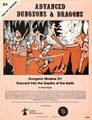 D1 cover
 -
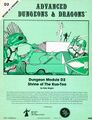 D2 cover
 -
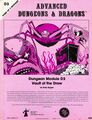 D3 cover
 -
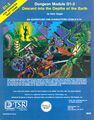 D1-2 cover
 -
 D3 cover


