* In AD&D 2nd edition, the Forgotten Realms campaign setting has a religion dedicated to her.
* In AD&D 2nd edition, the Forgotten Realms campaign setting has a religion dedicated to her.
* In D&D 3rd and 4th editions, she is no longer considered a unique type of dragon, but always referred to as a goddess who happens to have a draconic primary avatar.
* In D&D 3rd and 4th editions, she is no longer considered a unique type of dragon, but always referred to as a goddess who happens to have a draconic primary avatar.
{{D&D4e-Deities}}
[[Category:Dungeons and Dragons]][[Category:Awesome]][[Category:Greyhawk]]
[[Category:Dungeons and Dragons]][[Category:Awesome]][[Category:Greyhawk]]
Revision as of 19:24, 3 November 2011
This article is a stub. You can help 2d4chan by expanding it
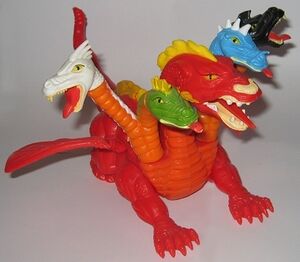
Tiamat, also known as the Polychromatic Dragon and the Mother of Dragonkind, is the goddess of Chromatic Dragons in the Dungeons and DragonsGreyhawk setting, and was a centerpiece of the lore until 4E fucked everything up. Her name is taken from "Tiamat", a goddess in ancient Mesopotamian mythology who is substantially different (and does not have multiple heads). Arguably one of the most powerful things in existence due to her incredible power, her true form is that of a five-headed dark dragon of colossal size, with each head being of a different color (White, Black, Green, Blue, and Red). She has the abilities of all of the chromatic dragons, with each head able to use its associated breath weapon, on top of her immense physical size and a massive, sting-tipped tail, like that of a Wyvern.
A bitter enemy of Bahamut, Tiamat represents the qualities of dragonkind that non-dragons despise: avarice, pride, arrogance, and the raw power to get away with it. She is a vain, greedy, and arrogant goddess, expressing what would be extreme hubris if she wasn't already a god. Though she is a paragon of dragon strengths, she shows few of their weaknesses; she is not impatient, nor overconfident (when dealing with other gods). Her primary concern is the propagation and well-being of chromatic dragons as a whole, ensuring her children become owners of the world. She believe this goal necessarily requires overthrowing the rule of Bahamut and establishing supremacy over metallic dragonkind. Like Anonymous, Tiamat never forgets and does not forgive. Although she is not adverse to occasionally burning a village to the ground for the lulz, Tiamat is not exactly an up-front goddess; she is a long-term plotter and schemer, carefully manipulating others in Tzeentchian plots that are so subtle and so long-reaching that an enemy would likely find themselves unprepared even if they had foreknowledge of what she had planned years in advance, making her a deity of Just as planned.
The Queen of Chromatic Dragons demands reverence, homage, supplication, and tribute from her subjects. As a dragon, her hoard is believed to be worth trillions.
Depictions
In Advanced Dungeons & Dragons, Tiamat first appears as a unique boss-monster in the Greyhawk setting. Later, she has the first layer of the Nine Hells assigned to her as her 'home plane,' giving her Outsider status and the ability to avoid permanent death.
with kung-fu action gripIn the Dungeons and Dragons cartoon, she was powerful enough to kick the shit out of both the Dungeon Master and the Venger, the show's main antagonist, giving you a general grasp of how goddamned powerful she is. When she feels the need to deal with mortals, she typically assumes the form of an exquisitely beautiful dark-haired human sorceress.
In the Dragonlance setting, the goddess of evil stuff "Takhisis" uses a Tiamat form as her avatar. She is opposed by a god of good stuff "Paladine" who uses Bahamut as his avatar. Between them as moderator is "Gilean," with a librarian avatar. The evil and good gods agree to a 'hands-off' policy, and withdraw their dragons from the world at large, until Tiamat/Takhisis finds a loophole a couple years before the story starts.
In AD&D 2nd edition, the Forgotten Realms campaign setting has a religion dedicated to her.
In D&D 3rd and 4th editions, she is no longer considered a unique type of dragon, but always referred to as a goddess who happens to have a draconic primary avatar.
 This article is a stub. You can help 2d4chan by expanding it