Nobledark Imperium Drafts
 This page is in need of cleanup. Srsly. It's a fucking mess. This page is in need of cleanup. Srsly. It's a fucking mess. |
 This article is autistic and stinks of fanboy drooling. You can help by making it less bloated. This article is autistic and stinks of fanboy drooling. You can help by making it less bloated. |
This page is part of the Nobledark Imperium, a fan re-working of the Warhammer 40,000 Universe. See the Nobledark Imperium Introduction and Main Page for more information on the alternate universe
It is the 41st millennium. For more than a hundred centuries the Eternal Emperor and Empress have been joined in their holy union. He is the last relic of a lost age when hope and wisdom ruled the galaxy, still clinging to his purpose of forging a better future, and she is the last remnant of an ancient pantheon, a mother watching over dying children brought low by their own hubris. Together, they are the Masters and Guardians of Mankind and Eldar, the keepers of the Last Alliance, the embodiments of the Imperium to which a hundred sapient species swear their fealty.
At the core of the Imperium is Humanity, its teeming multitudes ever resilient, stubbornly carving out a future amongst the hostile stars. The greatest of Man’s allies are the Eldar, ancient and wise, their shared bond forged in battle and sealed in blood millennia ago. Since then, others have been judged worthy to join in the light of the Imperium, to stand with Men and Eldar as fellows: the industrious Demiurge, enigmatic Tau, countless strains of Abhumans, and many more.
Yet for all the Imperium’s numbers, it is barely enough to stave off the forces that would tear it down. United under savage Beasts, the Orkish hordes throw themselves at the great edifice of the Imperium. The Necrons are awakening to a changed galaxy, and seeth at the primitives who would dare harbor their greatest foes the Eldar. From the galactic east, the Tyranids have made landfall and sweep over countless worlds in their hungering tide. In the shadows lurk the Dark Eldar, reveling in the carnage of a galaxy at war. And from the Immaterium, the Chaos Gods brood and plot their eternal vengeance, served by the twisted Chaos Eldar.
To be a man in such times is to be one amongst untold trillions. It is to live in the last bastion of civilization as the darkness draws near. These are the tales of those times. Forget the stories of peace and harmony, for they are fables of a gentler time, when the world still made sense. Remember the stories of struggle and defiance, full of brotherhood and sacrifice, for those are the ones that really matter. Peace is a distant dream growing ever fainter, and there is only war as Men and Eldar hold the line for the promise that has been whispered through the generations, from father to son, from mother to child: that there is good left in the world, and that is worth fighting for.
To-do List[edit | edit source]
- Finish Primarchs
- Establish timeline and events, and how similar they are to canon 40k
- Origins of Warlord/Steward/Emperor, and his own timeline
- Unification of Terra
- Great Crusade
- Rescue of Isha
- War of the Beast (replacing Horus Heresy)
- Armageddon?
- Tyranids? Have they fully arrived yet
- Other SMs? Only the original legions, or others? Chapters?
- When is present day?
- Repercussions of Imperium/Eldar alliance?
- add new canon from gathering storm and 8th e
The Imperium: Then[edit | edit source]
"Of course we are at war. Why on Old Earth's green soil would you believe we are not at war. We are in what is essentially a siege position, with an unfortifiable border stretching an entire 360 degrees for several light years in every conceivable direction. Our enemy has no concept of "rest" or "armistice" and can pop up at any time, on any side, in any position within the massive amounts of space between the mud marbles that we call the worlds of the Imperium. The Imperium is always going to be at war. Why would you ever believe otherwise?"
- Primarch Rogal Dorn, showing his usual level of tact
A Brief History of the Early Days[edit | edit source]
Maps of Old Earth, circa M30
-
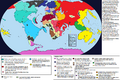 Pre-Unification
 -
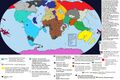 Post-Unification


Ursh[edit | edit source]
Of all the national entities that existed when the Warlord emerged on Old Earth, none is perhaps as infamous as the Empire of Ursh. The Tyrant of Gredbriton consorted with the Ruinous Powers and used horrific chemical weaponry, but few others in Gredbriton actually worshipped Chaos and thus his ability to do widespread damage was limited. The Pan-Pacific Empire was an absolute nightmare to its own people, but seemed largely unconcerned with the world outside its borders. The Yndonesian Bloc was a brutalistic theocracy, but also tended to be rather isolationist. The Merican junta was an expansionistic, nationalistic military state, but at the very least it did not treat its citizens as disposable, if only to protect the investment, and the people there had at least some standard of living. Ursh, by contrast, shared all of these negative features with its contemporary empires and suffered none of the limitations. The Empire of Ursh was a major influence in the histories of numerous other Unification-era countries, including Terrawatt-Uralia, Duscht Jemanic, Bania, the former components of the Everlasting Tharkian Empire (including Macedonia and Achaemenidia), the Nord Afrik conclaves, the Afrique League, Merika, Ind, Sibar, Sino-Japan, and the Khanate. In many ways, the Unification of Earth can be directly tied to the rise and fall of the Empire of Ursh.
The Empire of Ursh was originally founded in northeastern Azia, on the banks of the Amyur River. Despite containing fertile riverlands, this area was never an important center of industry and agriculture during the Dark Age of Technology, and so was spared from some of the worst of the horrors of the Old Night. The ancestors of the people who would come to form the Empire of Ursh came from such ancient, long-forgotten countries as Russia or China, but they nation they ended up founding would become a completely different entity altogether. The first ruler of Ursh was a rather eccentric man named Kalagann the Great, who in spite (or more likely because) of his eccentricity, was able to unite the various pocket kingdoms, city states, and villages around the Amyur River into an actual nation-state. Early historians often described Kalagann as nothing more than a prelude to the infamous cruelty of the Despots, but later historians have found that there was nothing to suggest that Kalagann was as evil as his successors. Indeed, Kalagann seemed to be genuinely concerned for the welfare of his people, and there is no evidence that Ursh had yet been corrupted by the Ruinous Powers. Ursh was one of the first nation-states to rebuild from the metaphorical and literal fallout of the rebellion of the Men of Iron and the beginning of the Age of Strife, and for a while it seemed like Ursh was going to be the pinnacle of civilization on Earth, an illustration that society could rebuild from the Age of Strife. However, a few years after Kalagann’s death, it all started to go wrong.
As they expanded from their initial cradle of neo-civilization, the Urshii found themselves surrounded on three sides by tribal hunter-gatherers (Sibar), steppe nomads (the steppe nomads of the future Khanate), and subsistence farmers that seemed to have no aspirations of greater empire (Sino-Japan). Over time, the Urshii began to see themselves as the sole remaining carriers of the torch of civilization that stretched all the way back to ancient Sumeria, and as “enlightened” people it was their job to shepherd the rest of the uncivilized masses back into the light. Urshii art and architecture was heavily influenced by this concept, being consciously modeled after imperial China or ancient Mesopotamia, two of the great cradles of civilization, despite Ursh itself have very little direct connection with either. These included a lot of ziggurats, which were seen as stairways to the heavens and often the site of important, and often unsavory, political or religious functions. The rulers of Ursh, the infamous Despots, believed that they had been given the divine mandate to bring civilization back to the people of Earth, granted to them by the four great heavenly powers, which were represented by the four directional winds. These four gods were, of course, the Ruinous Powers, who just loved to subvert and co-opt local cultural and religious beliefs for their own purposes. The Despots were educated from birth that they were god-kings, and that they and they alone knew what was best for Ursh and humanity. This, along with the systematic dehumanization of the serfs and non-Urshii, was one of the reasons for the infamous brutality of the Despots of Ursh. In their view, questioning the Despots or making a request was tantamount to saying the "god-kings" didn't know what they were doing.
Despite seeing the usefulness of advanced weapons of war, the Empire of Ursh was downright backwards technologically when compared to the other major empires of that time such as Merika, Hy Braseal, and the Pan-Pacific Empire. Indeed, one of the major reasons the Empire of Ursh invaded the Afrique League and the Nord Afrik conclaves in M28, one of the largest military engagements on Earth prior to the Unification Wars themselves, was primarily for technology to use against their larger neighbors. Instead, the Urshii preferred to look inwards, focusing more on religion and the occult rather than technological advancement. To the Urshii, technology was only useful if it could further aid them in their goal of conquest.
The Empire of Ursh had the largest fleet of any pre-Unification power with over twelve ships, but these ships were so derelict as to be borderline space hulks and could not even leave low Earth orbit. Indeed, because these ships were so decrepit and spread over such a wide area of territory they were used more for denying the orbital high ground than to actually fight. Records indicate that when a ship was too damaged to fly or an enemy ship was actually shot down the Urshii would swarm over the wreckage like scavengers on a Void Whale carcass, salvaging the ship's weapons to attach to ground vehicles to turn them into overbuilt weapons platforms. This was about the limits of Urshii technological aptitude.
Ursh was perhaps best known for its army, which despite its limited technology was the terror of Old Earth for many years. At the center of the army were the Nobleborn, elite warriors who were born of the upper class and given the best weapons and training the Urshii could afford. However, there were never enough Nobleborn to make a full-scale army large enough to take on Ursh's neighbors, even with Ursh's massive population. Additionally, although the Nobleborn made good shock troops, they had little tactical flexibility and could not perform specialist roles. Therefore, the Urshii often supplemented the Nobleborn core of their army with various auxiliaries, drawn from the numerous enslaved people and vassal states around the empire. Ursh primarily controlled its auxiliaries through mutual fear. The Red Engines feared the steppe nomads, who feared the Tupelov Lancers, who in turn feared the Roma, and so on and so forth. All feared the wrath of the Despot of Ursh.
Urshii society could be divided into three major groups. On the one hand, there were the various vassals and conquered peoples, who were seen as less than human and treated poorly. On the other, there were the serfs, who despite being Ursh-born were not “chosen”, and therefore also considered to be subhuman and treated poorly. And finally, there was an upper class, composed of a combination of the military, scientific, religious, mystic, and cultural elite. One of the only good things one could say about the Empire of Ursh is that they valued personal ability when they saw it, though admission into the nobility was only available to those who were both skilled and truly indoctrinated in the Urshii philosophy and religion. Urshii high courts were often a web of treachery and deceit, with nobles plotting against each other for power. The Despots encouraged this behavior, particularly among the Urshii lords of far-off conquered territories, as it kept them fighting among themselves for the Despot’s favor rather than deciding to secede and form their own petty empires.
After the fall of Ursh, this class system was thoroughly dismantled, though few of the nobility actually survived. Most of the nobility had been so indoctrinated in the superiority of Ursh and their gods that they would rather charge unarmed at a group of soldiers outnumbering them a hundred to one than accept defeat at the hands of “lesser peoples”. It was this attitude that led to the Urshii insurgency in Sibar, which was a thorn in the side of the Imperium for nearly twenty years after the fall of Ursh itself. The various freed vassals and serfs, on the other hand, were in some ways brought together by the shared experiences of the horrors of the tyrants, leading to the use of the term “Children of Ursh” to refer to those who had suffered at the hands of the Despots.
The Khanate[edit | edit source]
The Great Crusade[edit | edit source]
The Fable of Djerba[edit | edit source]
Today the world of Djerba in the Segmentum Solar is not particularly notable. But it’s Crusade-era history is well-known. Like many worlds during the Age of Strife, the original population included a significant number of people who were touched by the Warp, which increasing manifested itself as the Age of Strife went on. Unfortunately, like many worlds during the Age of Strife, including Barbarus, the psykers on Djerba went mad with power and set themselves up as god-kings over the common people. On Djerba, these psykers called themselves Cognoscynths.
The psychic abilities of the people of Djerba primarily manifested as a form of mind control. Cognoscynths could invade and control the mind of an ordinary person on a whim, rewriting memories, suppressing morality and self-preservation, and forcing any who could not surpass their willpower and psychic might to be their slaves. Before long, although the surface of Djerba was nominally made up of numerous warring nation-states, the leadership of these nations were little more than puppets to the Cognoscynths. The Cognoscynths erected their City of Sight above Djerba, from which they controlled the people below like marionettes on strings. They forced the people below them to go to war for their amusement, laughing as man slaughtered man at their whim.
According to legend, the Imperium sent three emissaries to the Cognoscynths. The first was the Scholar, a giant clad in red, who came bearing words of warning. He had come to Djerba hearing rumors of a society where outcasts such as he could co-exist in peace with normal men without fear of persecution. What he saw disheartened him. Here was a society which embodies the worst nightmare of the most closed-minded and hateful of mankind, who feared the witch and hated the psyker.
The Cognoscynths psychically commanded him to bow. The Scholar said no. In that moment, the Cognoscynths realized that they were to the man before them as hills were before a mountain. With rage burning in his one eye, the Scholar said he would give the Cognoscynths one warning. Dismantle their oppressive society and free the ordinary men and women they had enslaved, or face the consequences. For if they did not he would to return with his liege, and his liege was not as forgiving as he.
The second was the Shepherd, clad in gold, who brought words of doom. The Cognoscynths had ignored the warning of the Scholar, and had not changed their ways since he had left. The Shepherd was the Scholar’s liege, and came before the Cognoscynths much as the Scholar had. He said that he had seen the world the Cognoscynths had wrought. The Cognoscynths had been judged, and found wanting. Once more, the Cognoscynths were enraged at being judged by an outsider, and attempted to psychically compel him to bow. They failed. Whereas the Scholar had been a mountain, the Shepherd was like a monolith of adamantium, only gold instead of grey.
Their prodigious psychic powers failing them, the Cognoscynths turned to words. They scoffed at the idea of the Shepherd bringing judgement up