3D Printing

"But this constructor is both efficient and flexible. I feed magnetronic plastics — the stuff they make houses and ships of nowadays — into this moving arm. It makes drawings in the air following drawings it scans with photo-cells. But plastic comes out of the end of the drawing arm and hardens as it comes... following drawings only."
- – Murray Leinster, Things Pass By
3D Printing is, putting it simply, the home modeler's new best friend. Discontinued games, long since given up hope of reprints, are now almost completely supported by use of hobbyists and printers alike.
Overview[edit | edit source]
How many cars will you download?
3D Printing is the catch-all term for use of a specialized printer that is fed some form of plastic or other, similar malleable material to turn into a three dimensional object via use of a computer that has a renderable 3D file. The technology was first described in a sci-fi story in the forties, and has since become not only science fact, but a commercial success. Prior to the 2000's, it was mostly only ever used in an industrial capacity, up until 1988 when the company Stratasys came up with the concept of Fused Deposition Modeling (FDM) printing, which brought the complex process to the consumer grade market for a hefty, Forge World-esque price right up until 2009, when the process became public domain, and as a result, more and more companies and builders could get in on the process, making the process still yet far more accessible than ever before. By now, a former $2000 printer may only cost as much as a new video game console.
The accessibility of printer technology, continued availability and sharing of 3d Modeling files, and the complete boredom of lock-downs thanks to the 2020 pandemic has created a boom in 3d printer use for table-top gaming. This is assuming, of course, that you buy your own, and don't just cheap out the work to a company that specializes in 3D printing, like Shapeways.
Types of Printing[edit | edit source]
- Stereolithographic Apparatus (SLA)
Traditional SLA technology uses a DLP rear-projection screen or LCD under a vat of UV-cure resin. The projector sends UV light to select points at the bottom of the resin vat, hardening the liquid resin into a solid. DLP 3D printers can image an entire layer of the build all at once, resulting in faster build speeds than FDM. While frequently used for rapid prototyping, the fine detail allows for quality minis to be printed. However, this type of printing is significantly more complicated, and thus costlier, than FDM printing. The resin itself is also highly toxic if inhaled or exposed to the skin (which can cause debilitating allergic reactions that often become triggered by most forms of plastic as well), and can blind you for life if it gets in your eyes. You will need extensive ventilation, protective gear, and waste disposal systems to use it safely.
- Fused Deposition Modeling (FDM)
FDM is a common desktop 3D printing technology for plastic parts. An FDM printer functions by extruding a plastic filament layer-by-layer onto the build platform, like drawing and coloring in an image but in 3D. It’s stinky (just use PLA) but a cost-effective (up to 30 times cheaper than GW) and relatively quick method for producing physical models. This is best for creating terrain or larger models as the lines left behind by the string of semi-solid filament piling on top of itself obliterate any fine details.

While not as good for miniatures compared to SLA, FDM is cheaper and somewhat safer since there's no liquid resin to deal with.
Impact[edit | edit source]
While covered in more detail over at the Casting page, suffice it to say that for traditional tabletop gaming, the level of disruption is shaping out to be MASSIVE indeed.
Let's start with the relatively innocuous example. You can now design your own custom character for games like D&D and simply print it out, no more need for proxies or drawn cardboard cutouts, and there are even online companies like HeroForge that allow you to make free digital models that you can then buy the model file for.
However, this pales in comparison to the implications this tech has for tabletop gaming involving grand strategy like 40k. What was once plastic crack now becomes plastic tobacco that you grow in your own backyard. Provided that you find the right STLs or just take the time to make your own models, you can have virtually whatever army you could possibly want, from whatever era and with whatever units that were discontinued or shunted. Hell, you can even make proxies that merely resemble the official factions if your heart bleeds so much for faceless corporations that had no compunction against fleecing you via artificial scarcity.
Needles to say, GeeDubs was actually aware of what 3D printing would do to their business and promptly started shitting boulders. A general ban on using printed minis for official tournaments was issued, deeming it heretekal, but since most of the games are done in stores not owned by them or garages, the ban made little impact since the competitive chuds wouldn't have bothered with 3D printing anyways since they could've spent that time netlisting like the Powergamers they are. As the same time they've used 3d printing themselves, some of the display Imperial Knights are Warhammer world have 3d print marks on them. This is to speed up getting the first models to the 'Eavy Metal team while there still getting production set up. Additionally, GW had begun the process of getting into alternative media such as video games and animation, and while the former has had success (Total War Warhammer being the flagship franchise), the animation side has taken much longer before finding something akin to proper footing.
Interestingly enough, 3D printing may have come in the nick of time to offer a viable alternative to the all-digital iterations using Vassal and the like. Since 3D printing is much cheaper after the initial cost of getting the printer and you can print stuff for your friends who are interested in the hobby plus your local community, it is now much easier and viable to have a true flash-and-plastic matches at your local store (or garage/basement/attic) and thus there is not so much need for going on the internet to search for buddies to play with. This, of course, does not apply to everybody, but it should help to propagate the hobby far more than was previously possible, or imaginable.
There is one super-cheap 3D printer around there: RepRap. Much of it's parts can be 3D-printed themselves (yes, it's 3D-printer what can be 3D-printed); other parts are either scrap, cheap commonplace parts, or things you can maky DIY. Cheap and effective (the cheapest model has estimated cost of ≈250$, possibly smaller as it's partially made from commonplace parts and scrap).
3D Printing: The Doom of Games Workshop?[edit | edit source]
A lot of people proclaim that 3D printing will spell the end of Games Workshop, citing their increasing price increases/FOMO/etc as cosmic karma and punishment. Other claims that 3D printing won't be a threat to GW at all and will simply adapt over time. At least for now, GW seems to be responding by putting more emphasis on their media tie-ins, like the video games and animated series.
Gallery[edit | edit source]
-
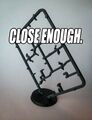 A failure of a printed model, eh it still Counts As a unit.
 -
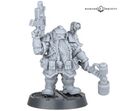 A handsome Squat resin model, and through the wonders of SLA you too can print such a masterpiece.
 -

-

-
 While resin printers can take some time to configure, the end result is ALWAYS worth it
 -
 Someone forgot to remove their supports...
 -
 This describes 3D printing vs plastic in a nutshell.
 -
 Another example of buying plastic vs printing.


