Feel free to add in the highlights. But I don't think each and every two-bit dynasty needs its own page. I *like* Chinese history and I don't think the Spring and Autumn period deserves its own section outside the works of Confucius.
Removed dipshitted and retarded "post-Communist" vomit
(183 intermediate revisions by 72 users not shown)
Line 1:
Line 1:
{{editwar}}
{{NeedsImages}}
'''China''' is probably the oldest semi-continual polity in the world anyone actually gives a shit about. Over the course of twelve major dynasties, a shitload of smaller ones, a bunch of big civil war punch-ups, one Communist dictatorship, and its current, ongoing, post-Communist oligarchy, this long strip of west Asian coast and assorted inlands has had a tremendous, outsized effect on the world economy and the culture of surrounding nations.
[[File: China map.gif |280px|right|thumb| Noodle land in all its majestic glory]]
Naturally, this has made it fertile fodder for tabletop gaming. From the [[Forgotten Realms]] to [[Pathfinder Roleplaying Game|Golarion]], few are the fantasy gaming settings ''without'' a "medieval China"-equivalent somewhere in the world. However, quite often, these Sure-Fine brand not!Chinas are about as well-researched and accurate as, well, [[Medieval Stasis|their European counterparts]], taking the broad cultural outline of a big empire ruled by a centralized bureaucracy and an all-powerful Emperor ([[God-Emperor of Mankind|who may or may not be a god / demigod]]) and a few specific trappings of architecture and dress to make what amounts to a China-based theme park for the adventurers to roam around in, seeing the sites, taking pictures, and fighting their way through that bestiary full of East-Asian monsters you never get to use.
{{topquote|[[Derp|China is a big country, inhabited by many Chinese.]]|Charles de Gaulle}}
There's nothing ''wrong'' with this, really, but there's nothing particularly interesting about it either beyond the novelty of playing a bunch of slack-jawed tourists in your adventuring campaign.
'''China''' is probably the oldest semi-continual polity in the world that anyone actually gives a shit about. Over the course of twelve major dynasties, a shitload of smaller ones, a bunch of big civil war punch-ups, and its current Communist dictatorship, this huge blob of East Asian grasslands/steppes/jungle/desert/mountains/everything and its b[[Hive World|az]]illion inhabitants has had a tremendous, outsized effect on the world economy and the culture of surrounding nations.
However, the ''other'' major influence China has had on tabletop gaming is through the medium of ''wuxia''.
Naturally, this has made it fertile fodder for tabletop gaming. From the [[Forgotten Realms]] to [[Pathfinder Roleplaying Game|Golarion]], few are the fantasy gaming settings ''without'' a "medieval China"-equivalent somewhere in the world. However, quite often, these Sure-Fine brand not! Chinas are about as well-researched and accurate as, well, [[Medieval Stasis|their European counterparts]], taking the broad cultural outline of a big empire ruled by a centralized bureaucracy and an all-powerful Emperor ([[God-Emperor of Mankind|who may or may not be a god / demigod]]) and a few specific trappings of architecture and dress to make what amounts to a China-based theme park for the adventurers to roam around in, seeing the sites, taking pictures, and fighting their way through that bestiary full of East-Asian monsters you never get to use. There's nothing ''wrong'' with this, really, but there's nothing particularly interesting about it either beyond the novelty of playing a bunch of slack-jawed tourists in your adventuring campaign.
==Wuxia==
However, the ''other'' major influence China has had on tabletop gaming is through the medium of ''wuxia'', material from a Chinese perspective that spills into the Western market. (Its cousin, ''xianxia'', is popular among sweaty Internet nerds who like ''isekai'' [[anime]], but has not penetrated nearly as deeply into the Western consciousness.)
''"'Wu' means martial arts, which signifies action, 'Xia' conveys chivalry. Wuxia. Say it gently... 'whooshah'... and it's like a breath of serenity embracing you. Say it with force, 'WuSHA!', and you can feel its power."''
== [[Wuxia]] ==
{{topquote|'Wu' means martial arts, which signifies action, 'Xia' conveys chivalry. Wuxia. Say it gently... 'whooshah'... and it's like a breath of serenity embracing you. Say it with force, 'WuSHA!', and you can feel its power.|Samuel L. Jackson, "The Art of Action: Martial Arts in the Movies"}}
<small>— Samuel L. Jackson, "The Art of Action: Martial Arts in the Movies"</small>
Thank you, Reverend Jackson.
Thank you, Reverend Jackson.
Wuxia is what China has instead of Tolkien. Just as the Western fantasy setting has got your dwarves and your elves and your dark lords leading armies to conquer the world, China has Jianghu, the Land of Rivers and Lakes, where corrupt civil authority forces noble wandering heroes to live like outlaws as they fight to restore order, learn secret techniques from old masters, are forced to battle their former best friends, etc. Just like Western fantasy, there's a lot of high-brow, literary stuff, but there's also a lot of entertaining trash pumped out to fill a public need for it. For instance, those cheap Shaw Bros. kung fu movies are wuxia, but so is ''Once Upon A Time In China''.
Wuxia is what China has instead of Tolkien. Just as the Western fantasy setting has got your dwarves and your elves and your dark lords leading armies to conquer the world, China has Jianghu, literally "the Land of Rivers and Lakes", implying a sense of freedom from both normal familial obligations and the tyrannic representatives of the [[Emperor]]. In the settings, corrupt civil authority forces noble wandering heroes to live like outlaws as they fight to restore order, learn secret techniques from old masters, are forced to battle their former best friends, etc. Just like Western fantasy, there's a lot of high-brow, literary stuff, but there's also a lot of entertaining trash pumped out to fill a public appetite for it. For instance, those cheap Shaw Bros. kung fu movies are wuxia, but so are films like ''Crouching Tiger, Hidden Dragon'' and ''Hero''.
And, naturally, this genre has its own tabletop games.
And, naturally, this genre has its own tabletop games.
The biggest success is probably ''[[Exalted]]'', [[White Wolf]]'s epic fantasy role-playing game. While there are, obviously, a shitload of other influences, from a corrupt cosmic bureaucracy and physical Realm in need of heroes to fix things to the super-martial arts and flowery naming conventions, Creation would simply not be recognizable without the trappings of wuxia. This is true even in a subtler sense: wuxia often focuses on tragedy and deeply-flawed heroes whose best intentions turn on them. Thanks to the Great Curse, all the exalts are, unless they do their utmost to defy their fates, doomed by the stars.
The biggest success is probably ''[[Exalted]]'', [[White Wolf]]'s epic fantasy role-playing game. While there are, obviously, a shitload of other influences, from a corrupt cosmic bureaucracy and physical Realm in need of heroes to fix things to the super-martial arts and flowery naming conventions, Creation would simply not be recognizable without the trappings of wuxia. This is true even in a subtler sense: wuxia often focuses on tragedy and deeply-flawed heroes whose best intentions turn on them. Thanks to the Great Curse, all the exalts are, unless they do their utmost to defy their fates, doomed to destroy all they love.
Other games, like ''[[Legends of the Wulin]]'' and ''[[Feng Shui]]'' draw on the genre more overtly. Even if the latter is more about aping the whole spectrum of Hong Kong cinema than wuxia specifically, even the later "heroic bloodshed" films are basically wuxia pictures set in the modern day with guns instead of swords, cities instead of forests, and cops and triads instead of heroes and bandits. The "69 A.D." Juncture ''is'' pure wuxia though, with an Imperial Court strangled by the machinations of the evil eunuch-sorcerers known as the Eaters of the Lotus and a countryside lousy with their supernatural and mortal henchmen terrorizing the nation.
Other games, like ''[[Legends of the Wulin]]'' and ''[[Feng Shui]]'' draw on the genre more overtly. Even if the latter is more about aping the whole spectrum of Hong Kong cinema than wuxia specifically, even the later "heroic bloodshed" films are basically wuxia pictures set in the modern day with guns instead of swords, cities instead of forests, and cops and triads instead of heroes and bandits. The "69 A.D." Juncture ''is'' pure wuxia though, with an Imperial Court strangled by the machinations of the evil eunuch-sorcerers known as the Eaters of the Lotus and a countryside lousy with their supernatural and mortal henchmen terrorizing the nation. And the text notes that the heroic Dragons are frequently destroyed and remade, heroes born beneath stars of tragedy who often go out fighting the good fight.
Wizards actually tried their own hand at a ''wuxia'' setting, the awesomely-named ''[[Dragon Fist]]''. Running on an early, jury-rigged d20 engine with a lot of leftover AD&D parts, it was barely-functional, but fun as hell, and set in the land of Tlanguo, though it got no support at all after the initial release. (Boooo!)
Wizards actually tried their own hand at a ''wuxia'' setting, the awesomely-named ''[[Dragon Fist]]''. Running on an early, jury-rigged d20 engine with a lot of leftover AD&D parts, it was barely-functional, but fun as hell, and set in the land of Tlanguo, though it got no support at all after the initial release. (Boooo!)
Line 29:
Line 28:
[[Legend of the Five Rings]] is usually seen as a more "Japanese" setting than a Chinese one, and it's true that there's plenty of ''jidei geki'' DNA in Rokugani society, from its strict, stratified class system and militarism to its overtly-Japanese names and weapons, to subtle things like "void" replacing "metal" as one of the Five Elements. But, there's still plenty of Chinese flavor there. Various periods in Rokugani history were far more friendly to the wuxia mien, with bands of heroic ronin fighting the power against a corrupt shogunate in the hands of the Shadowlands. In particular, the Phoenix Clan endorses a philosophy that has far more similarities to daoism than anything recognizably Japanese, and Rokugan itself, as a land-bound empire that relies on a coastal breadbasket to feed a less-productive inland and a Great Wall along a border with a dangerous and barbaric foreign power to keep the heartland safe, is much more like China than any period in Japanese history.
[[Legend of the Five Rings]] is usually seen as a more "Japanese" setting than a Chinese one, and it's true that there's plenty of ''jidei geki'' DNA in Rokugani society, from its strict, stratified class system and militarism to its overtly-Japanese names and weapons, to subtle things like "void" replacing "metal" as one of the Five Elements. But, there's still plenty of Chinese flavor there. Various periods in Rokugani history were far more friendly to the wuxia mien, with bands of heroic ronin fighting the power against a corrupt shogunate in the hands of the Shadowlands. In particular, the Phoenix Clan endorses a philosophy that has far more similarities to daoism than anything recognizably Japanese, and Rokugan itself, as a land-bound empire that relies on a coastal breadbasket to feed a less-productive inland and a Great Wall along a border with a dangerous and barbaric foreign power to keep the heartland safe, is much more like China than any period in Japanese history.
==History==
{{topquote|The Empire, long divided, must unite. Long united, it must divide. Thus it has ever been.|Opening lines of Romance of the Three Kingdoms}}
{{topquote|China is whole again...then it broke again.|Bill Wurtz, summarizing Chinese history}}
[https://en.wikipedia.org/wiki/History_of_China A brief timeline]
===Ancient China===
* ''[https://en.wikipedia.org/wiki/Xia_dynasty Pre-History Stuff]'': A confederation of early-agricultural peoples who will later be known as the "Han" settle in the valley of the Yellow River. Confusingly, a dynasty of the same name is also coming up (it's because they named themselves after that particular dynasty). The Han built one of the first civilizations on Earth, with block writing, metalworking, and advanced farming techniques.
* Xia: There is fuckall known about the Xia dynasty for certain, as this period had no permanent writing and exists largely as a folk story told by later generations. The Xia period is held with a sort of Arthurian reverence, with tales of bravery and dragons. Due to how China views history, these are considered historical fact, despite their fantastic elements and lack of corroborating evidence. What few records exists revolve around towns made of dirt and logs, but there is certainly a campaign or two to be had from a time of Gods, Heroes and Dragons. Also, millet and noodles; if the Erlitou theory should hold up.
*''[https://en.wikipedia.org/wiki/Shang_dynasty Shang]'': Led by the Yin family, the Shang had bronze, which, to use technical military parlance, made them the meanest bitches on the block for a long time. They worshipped a celestial god Huangdi. The Yin lords and ladies were ''obsessed'' with divination, going through huge heaps of bones and turtle shells for fortune-telling purposes whenever anyone did anything. So, yay: literacy, at last! Their nobles also had a habit of honoring ancestors by burying hundreds of slaves in their tombs. All par for the course for Early Bronze Age society - as witness the [[Maya]], [[Gilgamesh]], and the "Iphigenia" legend from Greece. Eventually, the Shang became [[Imperium of Man|engaged in too many wars]], before being overthrown by...
===The Zhou===
The Zhou were a family from out west in the boonies that moved onto Shang land and became vassals to the Shang until they... weren't.
Unlike the Shang, whose culture has to be gathered from myth and scattered nonliterary documents, Linear B style; the Zhou culture actually produced a literature, although that got transmitted through layers of copying and redaction. Still, Chinese culture is [https://razib.substack.com/p/3000-years-of-chinese-history remarkably continuous from the Zhou].
To justify their rebellion, and then their rule, the Zhou introduced the concept of a "Mandate of Heaven" (''tian ming'' in modern Mandarin orthography) issued not by the mercurial gods but by the cosmic forces of rightness, to which even gods must bow. It was brilliant, in its own way: theoretically, each dynasty ruled by the Mandate. When they didn't do so well or justly, Heaven would withdraw the Mandate and give it to someone else who'd overthrown them. And the Zhou stopped their subjects from sacrificing each other, which was a major step forward.
More-cynically, this Mandate meant that a ''successful'' rebellion was "proof" that Heaven had turned its back on the old order, and an ''unsuccessful'' one was "proof" that it wasn't time yet; this system of ''ex post facto'' justification has proven to be much more durable than the western concept of the ''divine right of kings'' and persists to this day (if not in name). It also didn't hurt that the Zhou showed mercy upon the Yin family who'd run the Shang, allowing them to keep a fief in the Song duchy. Confucius himself was of the Yin / Song ex-Shang.
Anyway, the Zhou had a good run, but the state's vassals started pulling apart during [https://en.wikipedia.org/wiki/Spring_and_Autumn_period Spring and Autumn period], and eventually the whole thing fractured into a mess of warring states fighting for supremacy. This was known as [https://en.wikipedia.org/wiki/Warring_States_period Warring States period]. At the same time, constant conflict and the need to innovate culminated in to the "Hundred Schools". The origin of both Confucianism (under the sovereign-again Song/Yin) and Daoism in some of their earliest forms was observed.
===Early Imperial China===
* ''[https://en.wikipedia.org/wiki/Qin_dynasty Qin]'': Probably the shortest dynasty that people actually remember and care about, but it had the great emperor Qin Shi Huangdi. Yes, this motherfucker had the nads literally to name himself "God". Uniting the nation by military force, the so-called "First Emperor" invented probably the first modern nation-state, standardizing culture, weights, measures, roads, and countless other things to ensure that the Chinese stopped thinking of themselves as being from Lu, Jin, or Wei and started thinking of themselves as Chinese. He's got a bad reputation as a crazed mass-murderer too, but that was mostly because he made enemies with the Confucians and the Confucians wrote the history books for two millenia and some change to come. He also "abolished history" by burning all the books not containing useful technical information (and occasionally their authors as well), keeping only a copy of each one in his private library for the leader's personal use, which was promptly lost after his death - which happened sooner than it should have, because he thought that [[fail|chugging mercury would make him immortal]]. What he built barely survived him, but there's a reason the modern nation still bears his name. (...It's pronounced "chin." Goddamn pinyin.)
* ''[https://en.wikipedia.org/wiki/Han_dynasty Han]'': This one's so important it's still what the Chinese call themselves as an ethnic group. Roughly contemporaneous with the Roman Empire, with each being aware of the other without ever quite meeting (partly because the Parthian Empire was really anal about playing middle-man on the Silk Road). They seemed to think of themselves as opposite versions of themselves on opposite ends of the world. The Han was founded by a former Qin Sheriff who lost some of his prisoners during a convoy; realizing that the punishment would be death, he decided that he already had nothing to lose and instigated a successful rebellion against the Qin (this is why there is such a thing as too severe a punishment when it ceases to be a deterrent). Introduced the concept of a centralized bureaucracy offering positions to applicants who were judged by local officials based on the Confucian classics, the latter of which would survive until the Sui initiated reforms and the ''former'' of which didn't go away until the Emperor did. A hugely-prosperous, technologically-skilled, highly-advanced society, with a new coinage standard that, unfortunately, as part of a running theme, began to fall into weakness and decadence. First, the eunuchs, always resentful of their snipping, tried seizing power for themselves, only for military officers to storm the capital and slaughter them all, leading first to a tenuous military dictatorship, and then to, well...
* ''[https://en.wikipedia.org/wiki/Three_Kingdoms Three Kingdoms], and the Romancing Thereof'': The late Han dynasty and generation shortly thereafter was a great and heroic age. It was a time of larger-than-life personalities, brave generals, brilliant strategists, and masterful politicians. It is worthy of study both for historical/entertainment value and for inspiration in any good tabletop campaign that wants to have a military-political element. And it is the subject of one of the Four Classical Novels, the historical epic usually translated into "The Romance of the Three Kingdoms" in English, this being the reason of its fame. Unfortunately, it is also ''bastard complicated'', so let's just say that one of the Three Kingdoms finally usurped the Han after using them as a puppet state for a while, and then conquered the others a generation later, all the while, after successive underage emperors, being a puppet to the founders of the next dynasty. Most gamers in the west know this period due to the Dynasty Warriors series and the [https://1d4chan.org/wiki/Total_War#Total_War:_Three_Kingdoms Total War: Three Kingdoms] game.
===[[Age of Strife]]===
* ''[https://en.wikipedia.org/wiki/Jin_dynasty_%28265%E2%80%93420%29 Jin]'': Backstabbing, political maneuverings, coups d'état, internal conflict, corruption, political turmoil followed by clashes and war; successful and unsuccesful throne usurpings, military revolts, paranoia among royal family, more revolts and end to Jin rule.
* ''[https://en.wikipedia.org/wiki/Northern_and_Southern_dynasties Northern and Southern]'': An age of civil war and political chaos complemented by a time of flourishing arts and culture, advancement in technology, and the spread of Mahayana Buddhism and Daoism. It should be noted that the Northern Dynasties were essentially [[Warriors of Chaos|barbarians]] and most of the Han fled south. Key technological advances occurred during this period, but more important was the spread of agricultural tech to the south, cementing their status as major taxgivers. The invention of the stirrup during the earlier Jin dynasty (265–420) helped to ignite the development of heavy cavalry. Advances in medicine, astronomy, mathematics, and cartography are observed by historians.
===Medieval Imperial China===
* ''[https://en.wikipedia.org/wiki/Sui_dynasty Sui]'': The good: they reunited a divided China, and 1) successfully undertook such vast internal-improvement projects as the Grand Canal connecting the city of Beijing in the north to the city of Hangzhou in the south, a thousand miles away; 2) initiated the test reforms, which will slowly change China into the model state in Voltaire's eyes in the course of five hundred years. The bad: they were extravagant assholes and control freaks whose projects were built on a foundation of peasant bones mortared with blood. Fell apart after the second emperor's repeated attempts to conquer Korea against dogged resistance and interference from the top broke the back of the army.
* ''[https://en.wikipedia.org/wiki/Tang_dynasty Tang]'': The Emperor Li Yuan, who seized the capital from the Sui, is his dynasty in microcosm. When he took power, the people thought he would be the greatest emperor in their nation's history; energetic, brilliant, skilled at all manner of government, military, and artistic tasks. He stabilized the shaking nation. Then he turned into a paranoid, murderous asshole as he got older until he finally got deposed. Sounds about right. This is the age in which the Chinese invented gunpowder, and, at its height, it was also the richest, most-advanced, most-cosmopolitan society on Earth, rolfstomping basically every thing that crossed the great houses of the dynasty. Problem is such conquest was completed by governor-generals that can tax their lands, which allowed them to rebel quite easily. The Tang dynasty also had the only officially recognized empress regnant (i.e. a woman who rules as a monarch in her own right, not as the wife of the emperor) in the history of Imperial China, Wu Zetian. Once things started falling apart, a radical sect of Confucianism began attempting to purge China of "outside influences" and restore China to the good old days through teaching and circulating their works, and also encouraging persecution and robbery of said outside influences, including Christianity and Buddhism. Buddhism survived, Christianity (Nestorians) did not.
===Second Age of Strife===
* ''[https://en.wikipedia.org/wiki/Five_Dynasties_and_Ten_Kingdoms_period Five Dynasties and Ten Kingdoms]'': The period of political disunity between the Tang and the Song, known as the Five Dynasties and Ten Kingdoms period. During this period, five states quickly succeeded one another in the Chinese Central Plain, while more than a dozen concurrent states were established elsewhere, mainly in south China. During this half-century, China was in all respects a multi-state system.
* ''[https://en.wikipedia.org/wiki/History_of_the_Song_dynasty Song]'': Invading barbarians devastated a Tang dynasty that was already eating itself alive from within. After a brief but invigorating series of civil wars and abortive wanna-be dynasts, an opportunistic general seized control of a splinter state that begun uniting China, and would go on to overlap with the Yuan for a while until the Mongols finally finished 'em off. The Song dynasty was, no bones about it, a cultural and economic powerhouse. They invented such modern marvels as paper money, steam and water-powered industry, and mass production. They also created beautiful and marvelous art, like pots depicting ponds on which fish appeared when water was poured in, or rice that smelled like flowers while it was cooking. However, they were ''also'' weak politically and militarily, and their ongoing "sour grapes" stance toward most of their neighbors, combined with Neo-Confucian abhorrence at the thought of allowing ''merchants'' to do the fighting, prevented them from properly leveraging the economic advantages of their hyper-advanced economy to dominate them with "soft power," and their underdeveloped understanding of economics meant many of these advances were eventually abandoned by a society not ready for their consequences. Ultimately gave in to...
* ''[https://en.wikipedia.org/wiki/Yuan_dynasty Yuan]'': Goddamn Mongolians. Technically "started" by Genghis Khan himself, it only really became a Chinese-style dynasty when his grandson, Kublai Khan, set up his capital in Khanbaliq (later Dadu, modern Beijing). Like the Greeks and the Romans, the "conquering" Mongolians slowly resembled their Chinese subjects. Culturally, this was the beginning of the modern Chinese novel and drama, though always with the wary eye of Imperial censors lurking over the writers' shoulders. (This was nothing new, incidentally, though the volume sure was.) This was also the dynasty that brought China to the West's attention, partly due to the Mongol invasions threatening Eastern Europe, and partly due to Marco Polo's accounts of the reign of Kublai Khan. The Mongols generally imported nobles rather than using locals, so a variety of Middle Easterners were brought in to manage and police the Chinese nation, while Chinese bureaucrats were sent to the Middle East to manage and police it. This is the origin of the Hui people, Muslim descendants of intermarrying foreign officials and soldiers who maintain their faith today and served as some of the most disciplined and feared of all Chinese soldiers in future wars. Eventually, the Yuan proved how "Chinese" they'd become by going out in the traditional Chinese way: collapsing into a mass of squabbling warlords and decadence because of fiscal disaster. Notably, the fleeing Khan took the ancient Imperial Seal dating all the way back to ol' Qin Shi Huangdi himself with him when he went back to Mongolia, and no one's ever found where he stashed it, according to legends anyway.
===Late Imperial China===
* ''[https://en.wikipedia.org/wiki/Ming_dynasty Ming]'': Founded by an illiterate peasant-turned-warlord, Zhu Yuanzhang, who stands aside such figures as Oliver Cromwell of England, Jeanne d'Arc of France, Toussaint L'Ouverture of Haiti, and the Prophet Muhammad of Arabia as one of the great completely self-taught military minds of human history, the Ming dominated the remains of the decaying Yuan empire with a mixture of [[Orks|brutal cunning]] and [[Creed|tactical genius]]. He went the way of Li Yuan by the end, but the dynasty he founded was the stablest and most-powerful China ruled by the Chinese in generations. It combined the economic power of the Song with the military might of the Yuan and the cultural sophistication of both into one of the grandest empires in human history. Politically, of course, they were rather repressive and authoritarian, hence ''[[Flash_Gordon|Flash! AHOWWW]]''. But it was ''also'' a very literate society for its time, with openly-female writers and readers getting lots of cred. This dynasty also saw the absolutely ''epic'' world-journey of the eunuch-admiral Zheng He, that was the closest the real-world ever got to a sea-based ''Dungeons & Dragons'' campaign. Unfortunately, due to the influence of the Neo-Confucians, their own self-sufficiency and comparative sophistication compared to the rest of the world, and good ol' fashioned racist jingoism, Ming China was very isolationist and arrogant; yet somehow managed to trade a lot because most of the silver Spain dug up in the Americas ended up there, meaning the rich were even more rich. This era of long-term peace led to a decay of military strength, especially as they insisted on inventing their own kinds of [[firearm]] rather than importing cheaper European models, and pervasive corruption and eunuch-influence at the top rotted everything it touched. Humiliatingly, after three centuries, the dynasty came to an end not when the next one stepped up to the plate, but when a ''fucking peasant revolt'' got there first (China's treasury was completely empty after years of excessive spending and corruption, and since the peasant rebellion meant that taxes could no longer be collected, the government was unable to pay or support any armed force to stop the revolt), and the Emperor committed suicide, leaving a gap for the Manchus to back right into.
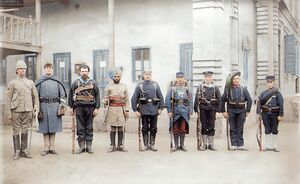
* ''[https://en.wikipedia.org/wiki/Qing_dynasty Qing]'': [[File:Eight-Nation-Alliance.jpg |300px|right|thumb|And in 15 years they'll all be at war.]]As mentioned above, the semi-nomadic Manchu invaded China from beyond the Great Wall and took over as the Qing dynasty. When you learn about the Opium Wars, the Boxer Rebellion, and Spheres of Influence in middle school, this is the dynasty it all happened in. Under the Manchu emperors, China expanded to the largest size in history, occupying Mongolia, Tibet, and much of Central Asia that had not been controlled by China since the Tang dynasty. As the last dynasty, the Qing basically reached a point of such decadence and corruption that military budgets were spent on building palaces, and attempts to modernize and "Westernize" China as Meiji Japan did were met with unremitting hostility by entrenched political factions within the Imperial palace. Into this, a series of flooding disasters destroyed harvests and left the common Chinese and the military angry at pretty much everyone. Violent rebellions began appearing, aiming to '''Make China Great Again''' by getting rid of all the foreigners. One of the revolts was the [https://en.wikipedia.org/wiki/Taiping_Rebellion Taiping Heavenly Kingdom Rebellion] caused by a man who thought he was the brother of Jesus and that the Manchu were demons, resulting in somewhere between twenty to thirty million deaths. This provoked a brief invasion by, well, everyone. Literally. Virtually '''ALL''' the European powers plus America and Japan sent troops to save their citizens (and more importantly, their colonial holdings). Some weren't so quick about leaving. With China basically becoming a big cake being sliced up by stronger colonial powers, a young Chinese-American Anglican named Sun Yixian/Sun Yat-Sen decided it was time to get rid of the imperial dynasties and establish a modern, Westernized, democratic republic. In 1912, the 7-year old Emperor abdicated (though he retained part of the Forbidden City and was paid an annual stipend), and the line of dynasties came to an end.
===THIRD Age of Strife===
*'''[https://en.wikipedia.org/wiki/Republic_of_China_(1912%E2%80%9349) Republic of China (1912-1915)]'': Sun Yat-Sen only became president with the help of Yuan Shikai, a Qing general who forced the Republicans to name him president if he made the Qing Emperor step down, with the support of most of the modernized Qing armies stationed in northern China and around the capital of Beijing. As promised, Yuan Shikai was made the new President of the Republic. A year later, having won national elections and taken control of parliament, Yuan further increased his power, such as making him able to name a successor ''by law''. Sun Yat-Sen's chosen successor was assassinated by "persons unknown", and the same fate would befall those suspected by investigators of having some role in the assassination. All things pointed to Yuan Shikai being responsible, but no charges could be filed as all potential suspects and witnesses were dead. With an abortive revolt crushed in Southern China, and the mechanisms of government in his hands, nothing much could be done when Yuan declared himself the Hongxian Emperor.
* ''[https://en.wikipedia.org/wiki/Warlord_Era Warlord Era]'': Yuan Shikai's short-lived dynasty was defeated by a coalition of anti-monarchist armies from the south, and Yuan died shortly thereafter. However, rather than re-establishing the Republic, Yuan's defeat and death simply saw many of his followers take their own portions of the army and establish warlord states throughout northern China. One of these factions became known as the Beiyang Government and claimed itself the legitimate government of the Republic of China. Sun Yat-Sen's Nationalists retreated to the south and became warlords themselves, calling for war against the autocratic Beiyang. Dozens of lesser warlords proliferated throughout China's provinces, and the Beiyang government joined the Allies in World War I in the hopes of recovering territories taken by Germany and Austria-Hungary during the Qing Dynasty, mainly Shandong.
*''Nanking Government of the Republic of China'': Starting in 1927, over the course of one year, the Nationalist army broke the back of three major warlords of the north, nominally unifying China under one government. The remaining warlords resisted Nanjing/Nanking's concentration of power, causing even more bloodshed. Making things more complicated, the Japanese controlled Shandong, having taken it from the Germans after WW1, and nobody in China liked that.
===Modern China===
''[https://en.wikipedia.org/wiki/China People's Republic (aka Communist China)]'': This is the era of history that, for better or worse, most Westerners are familiar with. To make a long, winding, and rather complicated story short, nearly everything in China nowadays can be traced to the efforts of one man; Mao Zedong, the leader of the then-outlawed Communist Party of China. Beginning in 1927, he warred against the nationalist government under Jiang Jieshi/Chiang Kai-Shek. Although they put their war on hold to kick the Japanese out of their country during the Second World War, by 1949, the nationalist government was pushed back to Taiwan (where they still rule today and claim to be the true government of China), and mainland China was unified under the communist red flag. For the next 50 or so years, the Chinese would play an interesting role in the Cold War between the USA and USSR; first as allies to the Russians until the Sino-Soviet split in '69, then as sort of-friends to the US after Nixon negotiated an agreement with them. As for Mao, historians are notably [[Skub|divided on his record as a politician]]. While it is agreed the man was a brilliant general, literally writing the book ''On Guerrilla Warfare'', the mixed reaction comes from his rather disastrous socio-economic policies. (and by that, we mean left around 72 million Chinese dead, from a mixture of starvation, political purges, and a ten-year period of anarchy that made the Reign of Terror look like a birthday party because it was legal for people to tell armies to hand over their weapons). His detractors will claim utopian stupidity, malicious tyranny, or a mix of both, while his supporters usually will make the claim that he just made honest mistakes. Nevertheless, his successors felt that the country was going to implode if they pursued any of Mao's hard left policies any further, so now we're in a weird state of limbo where a country that's still being ruled by the authoritarian Communist Party is more capitalist than it had ever been in any previous part of its history.
But don't suggest China will become a democracy anytime soon. The last time they tried that in AD 1989, things [[Baneblade|went badly]] for everyone involved, especially at Tiananmen Square (which also provided an iconic meme of the little guy standing up the big guy with [[wikipedia:Tank Man|Tank Man]]). Since then, the Chinese [[1984|Ministry of Truth]] is trying to make sure that no one knows that anything happened back then. Additionally, the current president, Xi Jinping, is easily the strongest of China's leaders since Mao and has taken the country to a notably more authoritarian direction, to the point that presidential term limits were removed and he was allowed to write his political thoughts into the constitution, which are now being studied just like Mao's Little Red Book was back in the day. Even worse, he's even taken a leaf from [[Nazi|certain]] [[Imperial Truth|other]] dictators with the treatment of China's Uyghur Muslims under his regime (complete with forcing them, at gunpoint, onto trains bound for prison camps). When COVID-19 was first discovered in the city of Wuhan, several scientists studying the virus realized it had the potential to become a pandemic and warned the government, [[Noblebright|some even suggesting they also warn other countries of the potential risk]]. The government responded by imprisoning several of them (some of who have never been seen since) and covering up COVID-19... until it became a global pandemic and intrepid truth-seekers revealed the point of origin and the cover-up.
On a lighter note, in recent history, Xi has gone full old man yells at cloud and decided that kids these days spend too much time playing video games, defining ''too much'' as three hours '''a week'''. AKA, Operation Touch Grass by some.
A more recent development is China's declining population, just like [[Japan]]. While the latter is caused by their ass backwards business culture, nepotism and inability to run their economy. China's self inflicted wound is due to their One-Child Policy they canceled in 2015 (which was originally put in place to help curb overpopulation back in the 1970s). This wouldn't have been a problem if their culture didn't have preference towards boys, while the government showed blatant favoritism towards rural provinces to circumvent it. One problem China shares with Japan here is strong xenophobia and an aversion towards all but the strictest immigration policies reducing the number of foreign people able and wanting to move there and boost the population that way. This means there are thousands of men who can't get married, many of them uneducated with lower income. Meanwhile urban women increasingly prefer husbands with the same education and values as their own or create a vicious cycle of rising demands by choosing career success over starting a family. China is now in a situation where their economic bubble is heading towards a downturn as well due to building more houses than their citizens could afford, turning unused apartments into giant money sinks. Anyone who isn't a moron will tell you that traditionalist values and Communist (or any left wing) ideology don't mix like the CCP wishes it would.
[[image:Game_Store_in_Taiwan.jpeg|thumb|150px|right|♫Some times you wanna go, where everybody knows your game...♫]]
*As a quick side note, that island Chiang Kai-Shek took over, Taiwan, or the Republic of China as it's officially called by the local government, is actually doing fine. It's a liberal democracy which is very much capable of [[Team Yankee|defending its position]]. If you like Chinese food, crowded cities, freedom of speech, freedom of religion and winding rural mountain roads it's a perfectly nice place to visit; they even play ''Warhammer'' (apparently mostly ''40k''). Taiwan is also notable for being the place where majority of the entire world's semiconductors are produced, which gives them major global influence as all countries both big and small are dependent on them. The majority of Taiwanese view Chiang Kai-Shek sort of like the Americans who wrote the majority of this article think about George Washington, or even the Puritans at Massachusetts Bay, as a [[Creed|hardcore leader]] who did some dubious, hypocritical things but was historically significant nonetheless and ultimately was the father of their country even if he killed a lot of people to get there and believed shit they find repulsive.
However, opinion on Taiwan in China is [[Skub|heavily controversial and, if non-critical, can get you blacklisted from certain places (mere mention of Taiwan can be enough to do so)]], so be careful who you talk to about it. It's become a running gag that American celebrities are often forced by their corporate masters to publicly apologize, sometimes in badly-pronounced Chinese, whenever they mention Taiwan existing, or outright support the Chinese government's more infamous actions (shit like the conquest and puppeteering of Hong Kong, the massacre at Tiananmen Square that they still deny happened and if it did they deserved it or the Uyghur Genocide) to avoid losing access to the mass-est mass market in the world.
==People's Republic of China==
After the collapse of the Qing Dynasty, China plunged into several decades of consecutive civil wars until a man named Mao Zedong unified China. After unifying China, Mao Zedong introduced a system that was distinct from any previous dynasties. This system, which is still in use in China today, combines elements of ancient Chinese centralized bureaucratic systems with the Leninist model of the Soviet Union.
In simple terms, the government in China is composed entirely of bureaucrats. Although there is a "figurehead parliament" known as the National People's Congress (NPC), which is theoretically the highest authority in China and has the power to elect the President (current President Xi Jinping is ostensibly elected by the NPC), the bureaucrats are the actual decision-makers and implementers of policies. They even oversee their own actions through internal mechanisms of supervision.
==History==
During Mao Zedong's reign, he and the Communist Party of China created this series of institutions for the entire country. In Mao's ideal vision, this system was supposed to operate effectively, be subject to supervision by the people, be free from corruption, and have bureaucrats who were honest and dedicated solely to the betterment of society. The Communist Party of China sought to merge with the Chinese government and even the Chinese people themselves (as of 2023, the Communist Party of China has around 10% of the total population as its members, which means approximately one out of every ten Chinese individuals is a party member). Most of the high-ranking officials in China, as well as the majority of known bureaucrats, are party members. Mao Zedong's ideology has been infused into the minds of every Chinese person.
In Mao Zedong's ideal vision, China was meant to be a country where the bureaucracy was supervised by workers and farmers. He was eager to introduce his ideals to everyone, writing books and compiling his own quotations, hoping that everyone would learn from them. However, in reality, the system had significant flaws. Workers and farmers were unable to effectively supervise the bureaucracy, and moreover, the majority of them lacked proper education. On the other hand, the bureaucrats were often highly educated intellectuals. During Mao's reign, he held the position of a philosopher king and could somewhat steer the country toward his ideals. But after his death in 1976, power struggles erupted within the centers of power in China. Mao's chosen successor, Hua Guofeng, was overthrown by Deng Xiaoping, who became the de facto leader representing the bureaucratic group. (It is worth noting that most Chinese people are unaware that Hua Guofeng was actually the second leader of China, and many mistakenly believe that Deng Xiaoping served as the second leader. In reality, Deng Xiaoping never held the position of President of China.)
Before his death, Mao Zedong expressed in his last wishes that his ashes should be scattered into the Yangtze River. However, the Communist Party of China established a special committee to discuss the handling of Mao Zedong's remains. They quickly reached a consensus to place Mao Zedong's body in a crystal coffin for exhibition, similar to Lenin in the Soviet Union. This decision continues to generate significant controversy. Some argue that it does not show proper respect for Mao Zedong himself, while others believe that Mao Zedong's contributions to China warrant such an action. Regardless, Mao Zedong's preserved body remains on display in the Mao Zedong Memorial Hall in Beijing, China. Anyone can enter and pay respects to this great leader.
After Deng Xiaoping came to power, he overturned a series of socialist-oriented policies in China, including the collective ownership of land and the 90% state-controlled economy. He initiated reforms that shifted China towards a capitalist direction, known as "reform and opening up," which China continues to follow to this day. During Deng's tenure, China experienced rapid economic growth, and the living standards of the Chinese people significantly improved. The issue of famine was also alleviated with the introduction of high-yield rice varieties developed by a brilliant agricultural scientist named Yuan Longping. However, Deng Xiaoping's era is widely recognized as the most corrupt period in China's history. As the chosen representative of the bureaucratic group, Deng Xiaoping inevitably protected the interests of the bureaucracy. Many high-ranking officials during Deng's era amassed vast fortunes through corruption and bribery. It was during this time that many revolutionary elites who fought to overthrow China's feudal aristocracy and warlord system became the new "red nobility" or "red capitalists."
During the early stages of Deng Xiaoping's era, China pursued a pro-American approach. However, in 1989, the United States launched a color revolution targeting China, which led to the infamous events on June 4th, known as the Tiananmen Square Incident. On that day, over a hundred people died, and there are still divergent accounts of what exactly happened due to a lack of reliable documentary evidence. Each faction within China's political circles has its own interpretation, much like the varying perspectives surrounding the events of January 6th, 2021, in the United States. Consequently, the relationship between the two countries deteriorated to a less favorable level. In the 1990s, the United States provoked China multiple times, particularly regarding the Taiwan issue. China even prepared for the possibility of war in response to these provocations, resulting in a frosty period in bilateral relations.
In 1992, Deng Xiaoping relinquished nearly all of his power and chose Jiang Zemin to succeed him as the leader of China. It is said that Jiang Zemin was selected because during the 1989 turmoil, he handled the Shanghai protesters in a non-violent manner. He mobilized Shanghai's workers to persuade the predominantly student-led protesters to go home. This approach garnered recognition from Deng Xiaoping.
After Jiang Zemin came to power, he gradually reformed the military, which to some extent alleviated the problem of bureaucratic corruption in China. At the same time, he consolidated China's capitalist path under the banner of "socialist market economy" and incorporated Deng Xiaoping's theory into the Party Constitution (which is equivalent to the Bible of the Communist Party of China, as the organizational structure of the party is akin to that of a church). From then on, China, which had previously pursued an idealistic path during Mao Zedong's era but achieved unsatisfactory results, underwent a complete transformation into a realist China.
Indeed, due to the prolonged internal conflicts that spanned almost half a century (from 1911 to 1949), and with the broader perspective of ongoing tensions between the Republic of China (ROC) and the People's Republic of China (PRC), China's economy remained underdeveloped. During this time, China relied on industries such as garment manufacturing and low-end product assembly to slowly accumulate primitive capital, while awaiting future breakthroughs. China was still struggling through a challenging and difficult period.
After Jiang Zemin's era, Hu Jintao came to power as the leader of China. How was Hu Jintao selected? In the 1990s, there were several incidents of unrest in Tibet, including one in the capital city of Lhasa. During this particular incident, as a government official, Hu Jintao donned a helmet and held a rifle while standing on a military vehicle to help suppress the rioters. This event earned Hu Jintao the nickname "Lhasa Tiger," and it was in part due to this display of leadership that he was chosen by Jiang Zemin.
In 2002, Hu Jintao came to power. His rule, compared to the era of Jiang Zemin and later Xi Jinping, appeared relatively calm and uneventful. Many people viewed him as continuing along the path laid out by Jiang Zemin. During this period, China's economy entered a golden age, and it became relatively easy for many Chinese people to find decent jobs. Various restrictions were relaxed, allowing for greater freedom of expression on the internet, including criticism of the government, the Communist Party, and even direct attacks on Hu Jintao himself. As a result, many people have fond memories of this era because it was a time of apparent tranquility and prosperity, even though it may seem that nothing significant happened.
Now, please rise as we introduce the esteemed leader who is revered by the people of China, the Chairman of the People's Republic of China, the General Secretary of the Communist Party of China Central Committee, the President of China, and the Chairman of the Central Military Commission. Comrade Xi Jinping!
In 2013, President Xi Jinping assumed power and has been leading China ever since, without stepping down.
Politically, President Xi Jinping has consolidated his position by vigorously combating corruption and purging his political opponents. His unprecedented crackdown on corruption has solidified his power. Furthermore, his efforts to combat corruption have instilled hope among the Chinese people, who have witnessed decades of corruption since the era of Deng Xiaoping. As a result, President Xi has garnered significant support from the people. It can be said that he is the most influential leader in China since Deng Xiaoping, and perhaps even since Mao Zedong.
Economically, when President Xi Jinping took office, China was at the end of the "Golden Decade," and its economic development had entered a phase of deceleration. The double-digit GDP growth rates experienced during the "Golden Decade" had slowed down to single-digit growth. However, President Xi has made significant efforts to promote technological development and encourage the growth of advanced industries such as semiconductor chips, civil aviation, pharmaceuticals, and electronics. Overall, China's economy can still be considered relatively strong.
In the realm of the internet, President Xi Jinping has strengthened internet regulation. While it is still possible to express anti-government and anti-Communist Party sentiments on the Chinese internet, compared to the Hu Jintao era when internet regulation was relatively lax, there are now stricter controls in place. Moreover, criticizing President Xi Jinping himself has become an absolute taboo. President Xi promotes the concept of internet sovereignty, which asserts that each country should have control over its own internet space. As a result, many people believe that the quality of internet information in China is gradually declining.
In terms of culture, President Xi Jinping promotes reverence for the revolutionary heroes of China's past, particularly those from the revolutionary war era of the last century. He also advocates the spirit of striving, emphasizing that every individual should work diligently in their respective positions to achieve a better life. Additionally, he requires all Communist Party members to use a mobile app called "Study Xi, Strong Country(学习强国)" to learn about the Party's new ideologies, and all Party branches are expected to regularly study the directives of the top leadership. However, despite these efforts, a culture of decadence has still prevailed since 2019.
In society, Xi Jinping has strengthened the presence of the Communist Party of China (CPC) across various social spheres, emphasizing that the Party should not solely consist of government bureaucrats. People from every industry have been encouraged to join the CPC, expanding its membership to an astonishing number, surpassing the population of possibly 80% of the countries on Earth.At the same time, he promotes China's outstanding traditional culture and integrates the predominantly Confucian thought into the mainstream ideology of modern China.
In terms of military affairs, Xi Jinping downsized the PLA from 2.3 million to 2 million troops in order to allocate higher per capita military expenditure and implemented various reforms within the armed forces. He emphasizes the absolute leadership of the Chinese Communist Party over the military (although this is a consistent stance on his part). During his tenure until 2023, China has constructed two aircraft carriers and has at least three more aircraft carriers under construction in shipyards.
===Political Affiliation===
The internal power struggles within the Chinese Communist Party (CCP) are not made public, and many people have their own interpretations of these internal dynamics. Therefore, we will only discuss the factions within the general public.
There are many political factions within China, among which the main ones are the loyalist faction and the opposition faction.
* '''Loyalist faction'''
:The loyalist faction refers to all those who are loyal to the government of the People's Republic of China and the Chinese Communist Party. Regardless of their reasons, they acknowledge and support the rule of the government and the Chinese Communist Party, and they have no intention to overthrow their rule (at least not currently). The reasons for their loyalty may vary, such as their admiration for the Chinese system, the benefits they have gained from it, or simply their dislike for other countries.
* '''Opposition faction'''
:The opposition faction, in contrast to the loyalist faction, seeks to overthrow the government of the People's Republic of China and the Chinese Communist Party, or at least one of them. Similarly, there can be various reasons behind their opposition, such as their dislike for the Chinese system, not benefiting from it, general discontent with the country, or even allegations of receiving money from organizations like the CIA or individuals associated with Taiwan.
Apart from the two factions mentioned above, there are indeed other factions within the general public.
* '''Han Nationalists(皇汉)'''
:Han Nationalists often emphasize the dominant status of the Han ethnic group in China. They typically call for the abolition of preferential policies for ethnic minorities (in China, ethnic minorities receive certain benefits, such as additional points added to their total scores in the national college entrance examination, known as the "gaokao"). Some may also demand the elimination of ethnic autonomous region policies. However, it's important to note that the most extreme and radical individuals among them advocating ethnic cleansing and promoting extreme racial ideologies represent a small faction.
* '''Maoist(毛左)'''
:"Maoist" refers to those who support Chairman Mao Zedong and have nostalgia for the era of his rule. They have varying degrees of support for the government, hoping for reforms that align more closely with the Maoist era. Some believe that China deviated from the path laid by Chairman Mao after his death and advocate for the overthrow of the Chinese government to establish a new People's Republic of China. It is worth noting that as China's economy has worsened, this viewpoint has gained increasing recognition among a growing number of people.
* '''Openist'''
:"Openist." It refers to a faction that advocates for relaxed control measures regarding the COVID-19 pandemic, opposing strict quarantine policies. Some individuals within this faction may believe that COVID-19 is just a minor cold and does not require strict control measures.
* '''Isolationist'''
:"Isolationist." It refers to a faction or group of people who advocate for strict containment measures in dealing with the COVID-19 pandemic. They support policies that involve rigorous isolation, quarantine, and other measures aimed at controlling and eventually eliminating the spread of COVID-19.
==Military Stuff before the 20th century==
As a general rule China has not been big on the idea on the idea of warriors as a class unto themselves. There were charioteers back during the Warring States Period and Manchu bannermen a long, long time after that, but otherwise there was nothing equivalent to the sort of warrior society that you saw in feudal Europe or pre-modern Japan. To give you an idea of the standing of warriors in Ancient China, let it be said that the world was made up of Four Categories of People (analogous to the Three Orders of feudal Europe): Scholars, Farmers, Artisans, and Merchants; which basically served to protect the scholars from the emergence of a middle class by inverting the relationship between mercantile wealth and social standing. The Scholars, known as ''shi'', replaced the warrior-charioteers around the time Rome invented the pyrrhic victory, and resembled the Roman prefects in terms of their duties and authority. In later eras, soldiers and warriors were considered beneath these four categories and ranked alongside [[Bard|entertainers]], [[Sharess|prostitutes]], [[Maid RPG|domestic servants]], and [[Commorragh Slaves|slaves]]. Basically, they were fightier eunuchs.
Owing to the low status of the profession, if you wanted to raise an army in China you didn't have a hereditary caste of men trained in the arts of war from childhood, like knights or samurai. Trust us, many rulers tried and failed to establish such a caste. Instead, you'd get a whole bunch of peasants together, equip them, and send them out to do your fighting for you under the command of a noble trained and educated to be a general. Armies would thus vary in quality, from solidly professional soldiers to badly-trained and ill-equipped conscripts, depending on region and era.
In general Chinese armies were more missile oriented than their medieval or classical European contemporaries with a mix of close quarters soldiers and missile troops. Beginning with the Warring States period, crossbows were a big deal because it meant that your conscripted peasants could easily be trained to saturate the enemy with projectiles.
A few words on weaponry...
Ancient China recognized four major melee weapons: staff, spear (although their concept of spear includes a wide variety of polearms - Iconically Chinese polearms include the Ji, Guandao, and podao)), single edged swords (dao), and double edged swords (jian); and of the two swords the jian was held in much higher regard than the dao. Infantry, cavalry, and pirates use the dao because it's [[choppa|an unsophisticated choppy thing for hacking your enemies to bits]] (and more importantly, as a tool for chopping bamboo). Anybody who's anybody fights with the jian because it's stabby, and stabby is the gentlemanly way to fight. If you have a curved sword in a Chinese setting you are a walk-on nobody or a filthy barbarian (either japanese or mongol) and you exist to get slapped around. China is also known for more exotic weapons such as hook swords, butterfly swords, rope darts, wind-and-fire wheels, and other bizarre weaponry that is much more closely associated with specific martial arts than on the battlefield. As with many unarmed martial arts styles, actually fighting utility can be quite varied.
In addition to melee weapons, China invested heavily in projectile weaponry, in particular inventing the repeating crossbow (chu-ko-nu) for maximum dakka on the battlefield. China is also the birthplace of gunpowder, resulting in such weapons as fire arrows, fire lances, hand cannons, rockets, grenades, etc.
==Culture==
There's a lot of it, and it's surprisingly relevant.
In Western antiquity, there were supposedly four "classical elements," namely air, fire, water, and earth (The Greeks also included aether, but because was an ethereal material that existed beyond earth it was usually left out). You know this. Don't pretend you don't, it's in ''fucking everything''. But, in classical China, there were ''five'': fire, water, earth, ''wood'', and ''metal''. And, just as all of Europe copied the Greeks, all of Asia copied China, with varying degrees of fidelity. Japan, for instance, had void instead of metal and air instead of wood. This more-or-less introduced the idea of "opposing" elements and elemental weaknesses, [https://upload.wikimedia.org/wikipedia/commons/9/9f/FiveElementsCycleBalanceImbalance_02_plain.svg via a complex web of interactions]. Think how boring and tactically-flat so many games would be if certain kinds of damage didn't work better on certain enemies!
Many games play with this alternate elemental system. Aside from ''Legend of the Five Rings'', ''Pathfinder'' and the ''[[Dresden Files RPG]]'' both offer variant rules using it instead of the classics. It certainly makes for an interesting change.
==Religion==
Meanwhile, let's talk about religion. While Christianity has its own traditions of warrior-monks, usually represented as [[cleric|clerics]] or [[paladin|paladins]], the Chinese tradition is arguably the most distinctive. Two of the three major Chinese religions/philosophies, taoism and buddhism, emphasize meditation and discipline, which is strenuous to both the body and mind. Thus, they invented systems of exercises to strengthen both, called "kung fu," or, literally, "hard work."
Then, when they needed to act as local militias defending against marauding bandits, it turned out having intense mental focus and physical stamina made them damn good fighters, and the rest is history. And that, ladies and gentlemen is where the modern ''D&D'' [[monk]] came from.
In particular, taoist practices emphasize the existence of a kind of underlying substance of which everything is made, called ''qi''. ''Qi'' is a kind of... energy field, created by all living things. It surrounds us and penetrates us; it binds [[Star Wars|you get where this joke is going, right]]? Anyway, in ''Exalted'', qi and essence are almost literally the same thing, and the monk and its various similar classes in ''D&D'' have "ki pools" that offer fancy new abilities.
Anyway, the Chinese ''also'' envisioned Heaven as containing a system, a Celestial Bureaucracy mirroring the one on Earth, that kept the world running according to various agreements and contracts between the gods, and even with mortal rulers via the "mandate of heaven" (a very complex concept that essentially boils down to "success and failure are self justifying"). Most tabletop settings have similar rules, regulations, and restrictions on the gods to explain why they subcontract out to adventurers, and though most of the gods and personalities of, say, the average ''D&D'' campaign setting have more to do with Western paganism than anything recognizably Chinese, the ''system'' of how they operate is more Chinese than Western simply because they ''can't'' just do as they please.
In more general terms, Chinese religion is a pretty mixed bag that leaves most outsiders confused. Yes, there are the three "main" religions of Taoism, Buddhism, and Confucianism, but they're all considered inclusive of one another, so it's possible to be a practitioner of all three. At a very high level, Taoism is concerned with the nature of existence (and is by far the most vague of the three), while Buddhism is more concerned with the reasoning individual and the trajectory of the soul, and Confucianism focuses on the proper ordering of society (and of the three is the most prescriptive). Traditionally, Chinese society has seen the three as complementary rather than mutually-exclusive, like many Pagan societies, though this has not stopped fundamentalist versions of one (in particular) of the three from trying to wipe out the other two whenever it becomes ascendant (''*cough* the CCP are Confuscians *cough*'').
Furthermore, you've got the myriad traditions of the ancient folk religion, largely assimilated into Taoism and Confucianism to varying degrees, centered around heaven and ancestor worship. Even after the communist purges, ancient folklore and superstition still has a strong influence among the common people, a fixation on luck being one such example, as you can see from the various lucky charms and statues in your local mom and pop American Chinese restaurant. Another such superstition lead to the creation of "[[Jiangshi|hopping vampires]]"... which are exactly what they sound like. Okay, they're more like zombies with extreme rigor mortis, but you get the idea. Anyways, if you want something that deviates from Western mythological values and religious struggles, the Chinese have an interesting set of ideas.
There are several other religious established in China of both native and foreign origins. Since the Seventh Century there have been enclaves of Christians in regions in China (and was bolstered during the age of sail) and Islam had become well established in the western regions of the Empire by the Ming Dynasty. Hinduism is established in China, but has been on the decline. There was even a Jewish enclave in the city of Kaifeng.
==Fun Facts and Moronic Misconceptions about China==
* There is technically no singular Chinese language, instead you have a few dominant spoken tongues (politically classified as dialects) like Cantonese and Mandarin followed by a gorillion smaller dialects. They do share a common written script (though that too is split between Simplified and Traditional) so even if a Cantonese and Shanghaiese speaker can’t speak to each other, they can at least communicate with writing to a modest extent. The closest analogy would be an Italian and a Portuguese person (shared Latin root and alphabet but not necessarily mutually intelligible tongues).
* China is one of the oldest polities in the world in terms of broad cultural continuity, meaning that while other nations would radically change or get supplanted, China was more or less enduringly Chinese.
* As with dialects/language, the country is actually composed of a number of ethnicities, the dominant being the Han, followed by the Mongols, Manchu and Zhuang.
* Yes - cats, dogs, bats and other critters are on the menu, though this has less to do with extreme Chinese omnivorism and more with the fact that famines were so bad that it was either that weird animal-thing or starvation. Having rice 7 days a week is prosperity, when times get bad you eat tree bark and grass.
* The Song dynasty (960. - 1279.) was remarkably tech-savy and had intensive industry in steel production and coal mining, being close to the 18th century Europe and possibly to industrialization. They were in the cusp of moving from feudalism to a more cosmopolitan and mercantile society. For better or worse, this was cut short by, you guessed it - the Mongols.
China is probably the oldest semi-continual polity in the world that anyone actually gives a shit about. Over the course of twelve major dynasties, a shitload of smaller ones, a bunch of big civil war punch-ups, and its current Communist dictatorship, this huge blob of East Asian grasslands/steppes/jungle/desert/mountains/everything and its bazillion inhabitants has had a tremendous, outsized effect on the world economy and the culture of surrounding nations.
Naturally, this has made it fertile fodder for tabletop gaming. From the Forgotten Realms to Golarion, few are the fantasy gaming settings without a "medieval China"-equivalent somewhere in the world. However, quite often, these Sure-Fine brand not! Chinas are about as well-researched and accurate as, well, their European counterparts, taking the broad cultural outline of a big empire ruled by a centralized bureaucracy and an all-powerful Emperor (who may or may not be a god / demigod) and a few specific trappings of architecture and dress to make what amounts to a China-based theme park for the adventurers to roam around in, seeing the sites, taking pictures, and fighting their way through that bestiary full of East-Asian monsters you never get to use. There's nothing wrong with this, really, but there's nothing particularly interesting about it either beyond the novelty of playing a bunch of slack-jawed tourists in your adventuring campaign.
However, the other major influence China has had on tabletop gaming is through the medium of wuxia, material from a Chinese perspective that spills into the Western market. (Its cousin, xianxia, is popular among sweaty Internet nerds who like isekaianime, but has not penetrated nearly as deeply into the Western consciousness.)
"'Wu' means martial arts, which signifies action, 'Xia' conveys chivalry. Wuxia. Say it gently... 'whooshah'... and it's like a breath of serenity embracing you. Say it with force, 'WuSHA!', and you can feel its power."
– Samuel L. Jackson, "The Art of Action: Martial Arts in the Movies"
Thank you, Reverend Jackson.
Wuxia is what China has instead of Tolkien. Just as the Western fantasy setting has got your dwarves and your elves and your dark lords leading armies to conquer the world, China has Jianghu, literally "the Land of Rivers and Lakes", implying a sense of freedom from both normal familial obligations and the tyrannic representatives of the Emperor. In the settings, corrupt civil authority forces noble wandering heroes to live like outlaws as they fight to restore order, learn secret techniques from old masters, are forced to battle their former best friends, etc. Just like Western fantasy, there's a lot of high-brow, literary stuff, but there's also a lot of entertaining trash pumped out to fill a public appetite for it. For instance, those cheap Shaw Bros. kung fu movies are wuxia, but so are films like Crouching Tiger, Hidden Dragon and Hero.
And, naturally, this genre has its own tabletop games.
The biggest success is probably Exalted, White Wolf's epic fantasy role-playing game. While there are, obviously, a shitload of other influences, from a corrupt cosmic bureaucracy and physical Realm in need of heroes to fix things to the super-martial arts and flowery naming conventions, Creation would simply not be recognizable without the trappings of wuxia. This is true even in a subtler sense: wuxia often focuses on tragedy and deeply-flawed heroes whose best intentions turn on them. Thanks to the Great Curse, all the exalts are, unless they do their utmost to defy their fates, doomed to destroy all they love.
Other games, like Legends of the Wulin and Feng Shui draw on the genre more overtly. Even if the latter is more about aping the whole spectrum of Hong Kong cinema than wuxia specifically, even the later "heroic bloodshed" films are basically wuxia pictures set in the modern day with guns instead of swords, cities instead of forests, and cops and triads instead of heroes and bandits. The "69 A.D." Juncture is pure wuxia though, with an Imperial Court strangled by the machinations of the evil eunuch-sorcerers known as the Eaters of the Lotus and a countryside lousy with their supernatural and mortal henchmen terrorizing the nation. And the text notes that the heroic Dragons are frequently destroyed and remade, heroes born beneath stars of tragedy who often go out fighting the good fight.
Wizards actually tried their own hand at a wuxia setting, the awesomely-named Dragon Fist. Running on an early, jury-rigged d20 engine with a lot of leftover AD&D parts, it was barely-functional, but fun as hell, and set in the land of Tlanguo, though it got no support at all after the initial release. (Boooo!)
Legend of the Five Rings is usually seen as a more "Japanese" setting than a Chinese one, and it's true that there's plenty of jidei geki DNA in Rokugani society, from its strict, stratified class system and militarism to its overtly-Japanese names and weapons, to subtle things like "void" replacing "metal" as one of the Five Elements. But, there's still plenty of Chinese flavor there. Various periods in Rokugani history were far more friendly to the wuxia mien, with bands of heroic ronin fighting the power against a corrupt shogunate in the hands of the Shadowlands. In particular, the Phoenix Clan endorses a philosophy that has far more similarities to daoism than anything recognizably Japanese, and Rokugan itself, as a land-bound empire that relies on a coastal breadbasket to feed a less-productive inland and a Great Wall along a border with a dangerous and barbaric foreign power to keep the heartland safe, is much more like China than any period in Japanese history.
Pre-History Stuff: A confederation of early-agricultural peoples who will later be known as the "Han" settle in the valley of the Yellow River. Confusingly, a dynasty of the same name is also coming up (it's because they named themselves after that particular dynasty). The Han built one of the first civilizations on Earth, with block writing, metalworking, and advanced farming techniques.
Xia: There is fuckall known about the Xia dynasty for certain, as this period had no permanent writing and exists largely as a folk story told by later generations. The Xia period is held with a sort of Arthurian reverence, with tales of bravery and dragons. Due to how China views history, these are considered historical fact, despite their fantastic elements and lack of corroborating evidence. What few records exists revolve around towns made of dirt and logs, but there is certainly a campaign or two to be had from a time of Gods, Heroes and Dragons. Also, millet and noodles; if the Erlitou theory should hold up.
Shang: Led by the Yin family, the Shang had bronze, which, to use technical military parlance, made them the meanest bitches on the block for a long time. They worshipped a celestial god Huangdi. The Yin lords and ladies were obsessed with divination, going through huge heaps of bones and turtle shells for fortune-telling purposes whenever anyone did anything. So, yay: literacy, at last! Their nobles also had a habit of honoring ancestors by burying hundreds of slaves in their tombs. All par for the course for Early Bronze Age society - as witness the Maya, Gilgamesh, and the "Iphigenia" legend from Greece. Eventually, the Shang became engaged in too many wars, before being overthrown by...
The Zhou were a family from out west in the boonies that moved onto Shang land and became vassals to the Shang until they... weren't.
Unlike the Shang, whose culture has to be gathered from myth and scattered nonliterary documents, Linear B style; the Zhou culture actually produced a literature, although that got transmitted through layers of copying and redaction. Still, Chinese culture is remarkably continuous from the Zhou.
To justify their rebellion, and then their rule, the Zhou introduced the concept of a "Mandate of Heaven" (tian ming in modern Mandarin orthography) issued not by the mercurial gods but by the cosmic forces of rightness, to which even gods must bow. It was brilliant, in its own way: theoretically, each dynasty ruled by the Mandate. When they didn't do so well or justly, Heaven would withdraw the Mandate and give it to someone else who'd overthrown them. And the Zhou stopped their subjects from sacrificing each other, which was a major step forward.
More-cynically, this Mandate meant that a successful rebellion was "proof" that Heaven had turned its back on the old order, and an unsuccessful one was "proof" that it wasn't time yet; this system of ex post facto justification has proven to be much more durable than the western concept of the divine right of kings and persists to this day (if not in name). It also didn't hurt that the Zhou showed mercy upon the Yin family who'd run the Shang, allowing them to keep a fief in the Song duchy. Confucius himself was of the Yin / Song ex-Shang.
Anyway, the Zhou had a good run, but the state's vassals started pulling apart during Spring and Autumn period, and eventually the whole thing fractured into a mess of warring states fighting for supremacy. This was known as Warring States period. At the same time, constant conflict and the need to innovate culminated in to the "Hundred Schools". The origin of both Confucianism (under the sovereign-again Song/Yin) and Daoism in some of their earliest forms was observed.
Qin: Probably the shortest dynasty that people actually remember and care about, but it had the great emperor Qin Shi Huangdi. Yes, this motherfucker had the nads literally to name himself "God". Uniting the nation by military force, the so-called "First Emperor" invented probably the first modern nation-state, standardizing culture, weights, measures, roads, and countless other things to ensure that the Chinese stopped thinking of themselves as being from Lu, Jin, or Wei and started thinking of themselves as Chinese. He's got a bad reputation as a crazed mass-murderer too, but that was mostly because he made enemies with the Confucians and the Confucians wrote the history books for two millenia and some change to come. He also "abolished history" by burning all the books not containing useful technical information (and occasionally their authors as well), keeping only a copy of each one in his private library for the leader's personal use, which was promptly lost after his death - which happened sooner than it should have, because he thought that chugging mercury would make him immortal. What he built barely survived him, but there's a reason the modern nation still bears his name. (...It's pronounced "chin." Goddamn pinyin.)
Han: This one's so important it's still what the Chinese call themselves as an ethnic group. Roughly contemporaneous with the Roman Empire, with each being aware of the other without ever quite meeting (partly because the Parthian Empire was really anal about playing middle-man on the Silk Road). They seemed to think of themselves as opposite versions of themselves on opposite ends of the world. The Han was founded by a former Qin Sheriff who lost some of his prisoners during a convoy; realizing that the punishment would be death, he decided that he already had nothing to lose and instigated a successful rebellion against the Qin (this is why there is such a thing as too severe a punishment when it ceases to be a deterrent). Introduced the concept of a centralized bureaucracy offering positions to applicants who were judged by local officials based on the Confucian classics, the latter of which would survive until the Sui initiated reforms and the former of which didn't go away until the Emperor did. A hugely-prosperous, technologically-skilled, highly-advanced society, with a new coinage standard that, unfortunately, as part of a running theme, began to fall into weakness and decadence. First, the eunuchs, always resentful of their snipping, tried seizing power for themselves, only for military officers to storm the capital and slaughter them all, leading first to a tenuous military dictatorship, and then to, well...
Three Kingdoms, and the Romancing Thereof: The late Han dynasty and generation shortly thereafter was a great and heroic age. It was a time of larger-than-life personalities, brave generals, brilliant strategists, and masterful politicians. It is worthy of study both for historical/entertainment value and for inspiration in any good tabletop campaign that wants to have a military-political element. And it is the subject of one of the Four Classical Novels, the historical epic usually translated into "The Romance of the Three Kingdoms" in English, this being the reason of its fame. Unfortunately, it is also bastard complicated, so let's just say that one of the Three Kingdoms finally usurped the Han after using them as a puppet state for a while, and then conquered the others a generation later, all the while, after successive underage emperors, being a puppet to the founders of the next dynasty. Most gamers in the west know this period due to the Dynasty Warriors series and the Total War: Three Kingdoms game.
Jin: Backstabbing, political maneuverings, coups d'état, internal conflict, corruption, political turmoil followed by clashes and war; successful and unsuccesful throne usurpings, military revolts, paranoia among royal family, more revolts and end to Jin rule.
Northern and Southern: An age of civil war and political chaos complemented by a time of flourishing arts and culture, advancement in technology, and the spread of Mahayana Buddhism and Daoism. It should be noted that the Northern Dynasties were essentially barbarians and most of the Han fled south. Key technological advances occurred during this period, but more important was the spread of agricultural tech to the south, cementing their status as major taxgivers. The invention of the stirrup during the earlier Jin dynasty (265–420) helped to ignite the development of heavy cavalry. Advances in medicine, astronomy, mathematics, and cartography are observed by historians.
Sui: The good: they reunited a divided China, and 1) successfully undertook such vast internal-improvement projects as the Grand Canal connecting the city of Beijing in the north to the city of Hangzhou in the south, a thousand miles away; 2) initiated the test reforms, which will slowly change China into the model state in Voltaire's eyes in the course of five hundred years. The bad: they were extravagant assholes and control freaks whose projects were built on a foundation of peasant bones mortared with blood. Fell apart after the second emperor's repeated attempts to conquer Korea against dogged resistance and interference from the top broke the back of the army.
Tang: The Emperor Li Yuan, who seized the capital from the Sui, is his dynasty in microcosm. When he took power, the people thought he would be the greatest emperor in their nation's history; energetic, brilliant, skilled at all manner of government, military, and artistic tasks. He stabilized the shaking nation. Then he turned into a paranoid, murderous asshole as he got older until he finally got deposed. Sounds about right. This is the age in which the Chinese invented gunpowder, and, at its height, it was also the richest, most-advanced, most-cosmopolitan society on Earth, rolfstomping basically every thing that crossed the great houses of the dynasty. Problem is such conquest was completed by governor-generals that can tax their lands, which allowed them to rebel quite easily. The Tang dynasty also had the only officially recognized empress regnant (i.e. a woman who rules as a monarch in her own right, not as the wife of the emperor) in the history of Imperial China, Wu Zetian. Once things started falling apart, a radical sect of Confucianism began attempting to purge China of "outside influences" and restore China to the good old days through teaching and circulating their works, and also encouraging persecution and robbery of said outside influences, including Christianity and Buddhism. Buddhism survived, Christianity (Nestorians) did not.
Five Dynasties and Ten Kingdoms: The period of political disunity between the Tang and the Song, known as the Five Dynasties and Ten Kingdoms period. During this period, five states quickly succeeded one another in the Chinese Central Plain, while more than a dozen concurrent states were established elsewhere, mainly in south China. During this half-century, China was in all respects a multi-state system.
Song: Invading barbarians devastated a Tang dynasty that was already eating itself alive from within. After a brief but invigorating series of civil wars and abortive wanna-be dynasts, an opportunistic general seized control of a splinter state that begun uniting China, and would go on to overlap with the Yuan for a while until the Mongols finally finished 'em off. The Song dynasty was, no bones about it, a cultural and economic powerhouse. They invented such modern marvels as paper money, steam and water-powered industry, and mass production. They also created beautiful and marvelous art, like pots depicting ponds on which fish appeared when water was poured in, or rice that smelled like flowers while it was cooking. However, they were also weak politically and militarily, and their ongoing "sour grapes" stance toward most of their neighbors, combined with Neo-Confucian abhorrence at the thought of allowing merchants to do the fighting, prevented them from properly leveraging the economic advantages of their hyper-advanced economy to dominate them with "soft power," and their underdeveloped understanding of economics meant many of these advances were eventually abandoned by a society not ready for their consequences. Ultimately gave in to...
Yuan: Goddamn Mongolians. Technically "started" by Genghis Khan himself, it only really became a Chinese-style dynasty when his grandson, Kublai Khan, set up his capital in Khanbaliq (later Dadu, modern Beijing). Like the Greeks and the Romans, the "conquering" Mongolians slowly resembled their Chinese subjects. Culturally, this was the beginning of the modern Chinese novel and drama, though always with the wary eye of Imperial censors lurking over the writers' shoulders. (This was nothing new, incidentally, though the volume sure was.) This was also the dynasty that brought China to the West's attention, partly due to the Mongol invasions threatening Eastern Europe, and partly due to Marco Polo's accounts of the reign of Kublai Khan. The Mongols generally imported nobles rather than using locals, so a variety of Middle Easterners were brought in to manage and police the Chinese nation, while Chinese bureaucrats were sent to the Middle East to manage and police it. This is the origin of the Hui people, Muslim descendants of intermarrying foreign officials and soldiers who maintain their faith today and served as some of the most disciplined and feared of all Chinese soldiers in future wars. Eventually, the Yuan proved how "Chinese" they'd become by going out in the traditional Chinese way: collapsing into a mass of squabbling warlords and decadence because of fiscal disaster. Notably, the fleeing Khan took the ancient Imperial Seal dating all the way back to ol' Qin Shi Huangdi himself with him when he went back to Mongolia, and no one's ever found where he stashed it, according to legends anyway.
Ming: Founded by an illiterate peasant-turned-warlord, Zhu Yuanzhang, who stands aside such figures as Oliver Cromwell of England, Jeanne d'Arc of France, Toussaint L'Ouverture of Haiti, and the Prophet Muhammad of Arabia as one of the great completely self-taught military minds of human history, the Ming dominated the remains of the decaying Yuan empire with a mixture of brutal cunning and tactical genius. He went the way of Li Yuan by the end, but the dynasty he founded was the stablest and most-powerful China ruled by the Chinese in generations. It combined the economic power of the Song with the military might of the Yuan and the cultural sophistication of both into one of the grandest empires in human history. Politically, of course, they were rather repressive and authoritarian, hence Flash! AHOWWW. But it was also a very literate society for its time, with openly-female writers and readers getting lots of cred. This dynasty also saw the absolutely epic world-journey of the eunuch-admiral Zheng He, that was the closest the real-world ever got to a sea-based Dungeons & Dragons campaign. Unfortunately, due to the influence of the Neo-Confucians, their own self-sufficiency and comparative sophistication compared to the rest of the world, and good ol' fashioned racist jingoism, Ming China was very isolationist and arrogant; yet somehow managed to trade a lot because most of the silver Spain dug up in the Americas ended up there, meaning the rich were even more rich. This era of long-term peace led to a decay of military strength, especially as they insisted on inventing their own kinds of firearm rather than importing cheaper European models, and pervasive corruption and eunuch-influence at the top rotted everything it touched. Humiliatingly, after three centuries, the dynasty came to an end not when the next one stepped up to the plate, but when a fucking peasant revolt got there first (China's treasury was completely empty after years of excessive spending and corruption, and since the peasant rebellion meant that taxes could no longer be collected, the government was unable to pay or support any armed force to stop the revolt), and the Emperor committed suicide, leaving a gap for the Manchus to back right into.
Qing: And in 15 years they'll all be at war.As mentioned above, the semi-nomadic Manchu invaded China from beyond the Great Wall and took over as the Qing dynasty. When you learn about the Opium Wars, the Boxer Rebellion, and Spheres of Influence in middle school, this is the dynasty it all happened in. Under the Manchu emperors, China expanded to the largest size in history, occupying Mongolia, Tibet, and much of Central Asia that had not been controlled by China since the Tang dynasty. As the last dynasty, the Qing basically reached a point of such decadence and corruption that military budgets were spent on building palaces, and attempts to modernize and "Westernize" China as Meiji Japan did were met with unremitting hostility by entrenched political factions within the Imperial palace. Into this, a series of flooding disasters destroyed harvests and left the common Chinese and the military angry at pretty much everyone. Violent rebellions began appearing, aiming to Make China Great Again by getting rid of all the foreigners. One of the revolts was the Taiping Heavenly Kingdom Rebellion caused by a man who thought he was the brother of Jesus and that the Manchu were demons, resulting in somewhere between twenty to thirty million deaths. This provoked a brief invasion by, well, everyone. Literally. Virtually ALL the European powers plus America and Japan sent troops to save their citizens (and more importantly, their colonial holdings). Some weren't so quick about leaving. With China basically becoming a big cake being sliced up by stronger colonial powers, a young Chinese-American Anglican named Sun Yixian/Sun Yat-Sen decided it was time to get rid of the imperial dynasties and establish a modern, Westernized, democratic republic. In 1912, the 7-year old Emperor abdicated (though he retained part of the Forbidden City and was paid an annual stipend), and the line of dynasties came to an end.
'Republic of China (1912-1915): Sun Yat-Sen only became president with the help of Yuan Shikai, a Qing general who forced the Republicans to name him president if he made the Qing Emperor step down, with the support of most of the modernized Qing armies stationed in northern China and around the capital of Beijing. As promised, Yuan Shikai was made the new President of the Republic. A year later, having won national elections and taken control of parliament, Yuan further increased his power, such as making him able to name a successor by law. Sun Yat-Sen's chosen successor was assassinated by "persons unknown", and the same fate would befall those suspected by investigators of having some role in the assassination. All things pointed to Yuan Shikai being responsible, but no charges could be filed as all potential suspects and witnesses were dead. With an abortive revolt crushed in Southern China, and the mechanisms of government in his hands, nothing much could be done when Yuan declared himself the Hongxian Emperor.
Warlord Era: Yuan Shikai's short-lived dynasty was defeated by a coalition of anti-monarchist armies from the south, and Yuan died shortly thereafter. However, rather than re-establishing the Republic, Yuan's defeat and death simply saw many of his followers take their own portions of the army and establish warlord states throughout northern China. One of these factions became known as the Beiyang Government and claimed itself the legitimate government of the Republic of China. Sun Yat-Sen's Nationalists retreated to the south and became warlords themselves, calling for war against the autocratic Beiyang. Dozens of lesser warlords proliferated throughout China's provinces, and the Beiyang government joined the Allies in World War I in the hopes of recovering territories taken by Germany and Austria-Hungary during the Qing Dynasty, mainly Shandong.
Nanking Government of the Republic of China: Starting in 1927, over the course of one year, the Nationalist army broke the back of three major warlords of the north, nominally unifying China under one government. The remaining warlords resisted Nanjing/Nanking's concentration of power, causing even more bloodshed. Making things more complicated, the Japanese controlled Shandong, having taken it from the Germans after WW1, and nobody in China liked that.
People's Republic (aka Communist China): This is the era of history that, for better or worse, most Westerners are familiar with. To make a long, winding, and rather complicated story short, nearly everything in China nowadays can be traced to the efforts of one man; Mao Zedong, the leader of the then-outlawed Communist Party of China. Beginning in 1927, he warred against the nationalist government under Jiang Jieshi/Chiang Kai-Shek. Although they put their war on hold to kick the Japanese out of their country during the Second World War, by 1949, the nationalist government was pushed back to Taiwan (where they still rule today and claim to be the true government of China), and mainland China was unified under the communist red flag. For the next 50 or so years, the Chinese would play an interesting role in the Cold War between the USA and USSR; first as allies to the Russians until the Sino-Soviet split in '69, then as sort of-friends to the US after Nixon negotiated an agreement with them. As for Mao, historians are notably divided on his record as a politician. While it is agreed the man was a brilliant general, literally writing the book On Guerrilla Warfare, the mixed reaction comes from his rather disastrous socio-economic policies. (and by that, we mean left around 72 million Chinese dead, from a mixture of starvation, political purges, and a ten-year period of anarchy that made the Reign of Terror look like a birthday party because it was legal for people to tell armies to hand over their weapons). His detractors will claim utopian stupidity, malicious tyranny, or a mix of both, while his supporters usually will make the claim that he just made honest mistakes. Nevertheless, his successors felt that the country was going to implode if they pursued any of Mao's hard left policies any further, so now we're in a weird state of limbo where a country that's still being ruled by the authoritarian Communist Party is more capitalist than it had ever been in any previous part of its history.
But don't suggest China will become a democracy anytime soon. The last time they tried that in AD 1989, things went badly for everyone involved, especially at Tiananmen Square (which also provided an iconic meme of the little guy standing up the big guy with Tank Man). Since then, the Chinese Ministry of Truth is trying to make sure that no one knows that anything happened back then. Additionally, the current president, Xi Jinping, is easily the strongest of China's leaders since Mao and has taken the country to a notably more authoritarian direction, to the point that presidential term limits were removed and he was allowed to write his political thoughts into the constitution, which are now being studied just like Mao's Little Red Book was back in the day. Even worse, he's even taken a leaf from certainother dictators with the treatment of China's Uyghur Muslims under his regime (complete with forcing them, at gunpoint, onto trains bound for prison camps). When COVID-19 was first discovered in the city of Wuhan, several scientists studying the virus realized it had the potential to become a pandemic and warned the government, some even suggesting they also warn other countries of the potential risk. The government responded by imprisoning several of them (some of who have never been seen since) and covering up COVID-19... until it became a global pandemic and intrepid truth-seekers revealed the point of origin and the cover-up.
On a lighter note, in recent history, Xi has gone full old man yells at cloud and decided that kids these days spend too much time playing video games, defining too much as three hours a week. AKA, Operation Touch Grass by some.
A more recent development is China's declining population, just like Japan. While the latter is caused by their ass backwards business culture, nepotism and inability to run their economy. China's self inflicted wound is due to their One-Child Policy they canceled in 2015 (which was originally put in place to help curb overpopulation back in the 1970s). This wouldn't have been a problem if their culture didn't have preference towards boys, while the government showed blatant favoritism towards rural provinces to circumvent it. One problem China shares with Japan here is strong xenophobia and an aversion towards all but the strictest immigration policies reducing the number of foreign people able and wanting to move there and boost the population that way. This means there are thousands of men who can't get married, many of them uneducated with lower income. Meanwhile urban women increasingly prefer husbands with the same education and values as their own or create a vicious cycle of rising demands by choosing career success over starting a family. China is now in a situation where their economic bubble is heading towards a downturn as well due to building more houses than their citizens could afford, turning unused apartments into giant money sinks. Anyone who isn't a moron will tell you that traditionalist values and Communist (or any left wing) ideology don't mix like the CCP wishes it would.
♫Some times you wanna go, where everybody knows your game...♫
As a quick side note, that island Chiang Kai-Shek took over, Taiwan, or the Republic of China as it's officially called by the local government, is actually doing fine. It's a liberal democracy which is very much capable of defending its position. If you like Chinese food, crowded cities, freedom of speech, freedom of religion and winding rural mountain roads it's a perfectly nice place to visit; they even play Warhammer (apparently mostly 40k). Taiwan is also notable for being the place where majority of the entire world's semiconductors are produced, which gives them major global influence as all countries both big and small are dependent on them. The majority of Taiwanese view Chiang Kai-Shek sort of like the Americans who wrote the majority of this article think about George Washington, or even the Puritans at Massachusetts Bay, as a hardcore leader who did some dubious, hypocritical things but was historically significant nonetheless and ultimately was the father of their country even if he killed a lot of people to get there and believed shit they find repulsive.
However, opinion on Taiwan in China is heavily controversial and, if non-critical, can get you blacklisted from certain places (mere mention of Taiwan can be enough to do so), so be careful who you talk to about it. It's become a running gag that American celebrities are often forced by their corporate masters to publicly apologize, sometimes in badly-pronounced Chinese, whenever they mention Taiwan existing, or outright support the Chinese government's more infamous actions (shit like the conquest and puppeteering of Hong Kong, the massacre at Tiananmen Square that they still deny happened and if it did they deserved it or the Uyghur Genocide) to avoid losing access to the mass-est mass market in the world.
After the collapse of the Qing Dynasty, China plunged into several decades of consecutive civil wars until a man named Mao Zedong unified China. After unifying China, Mao Zedong introduced a system that was distinct from any previous dynasties. This system, which is still in use in China today, combines elements of ancient Chinese centralized bureaucratic systems with the Leninist model of the Soviet Union.
In simple terms, the government in China is composed entirely of bureaucrats. Although there is a "figurehead parliament" known as the National People's Congress (NPC), which is theoretically the highest authority in China and has the power to elect the President (current President Xi Jinping is ostensibly elected by the NPC), the bureaucrats are the actual decision-makers and implementers of policies. They even oversee their own actions through internal mechanisms of supervision.
During Mao Zedong's reign, he and the Communist Party of China created this series of institutions for the entire country. In Mao's ideal vision, this system was supposed to operate effectively, be subject to supervision by the people, be free from corruption, and have bureaucrats who were honest and dedicated solely to the betterment of society. The Communist Party of China sought to merge with the Chinese government and even the Chinese people themselves (as of 2023, the Communist Party of China has around 10% of the total population as its members, which means approximately one out of every ten Chinese individuals is a party member). Most of the high-ranking officials in China, as well as the majority of known bureaucrats, are party members. Mao Zedong's ideology has been infused into the minds of every Chinese person.
In Mao Zedong's ideal vision, China was meant to be a country where the bureaucracy was supervised by workers and farmers. He was eager to introduce his ideals to everyone, writing books and compiling his own quotations, hoping that everyone would learn from them. However, in reality, the system had significant flaws. Workers and farmers were unable to effectively supervise the bureaucracy, and moreover, the majority of them lacked proper education. On the other hand, the bureaucrats were often highly educated intellectuals. During Mao's reign, he held the position of a philosopher king and could somewhat steer the country toward his ideals. But after his death in 1976, power struggles erupted within the centers of power in China. Mao's chosen successor, Hua Guofeng, was overthrown by Deng Xiaoping, who became the de facto leader representing the bureaucratic group. (It is worth noting that most Chinese people are unaware that Hua Guofeng was actually the second leader of China, and many mistakenly believe that Deng Xiaoping served as the second leader. In reality, Deng Xiaoping never held the position of President of China.)
Before his death, Mao Zedong expressed in his last wishes that his ashes should be scattered into the Yangtze River. However, the Communist Party of China established a special committee to discuss the handling of Mao Zedong's remains. They quickly reached a consensus to place Mao Zedong's body in a crystal coffin for exhibition, similar to Lenin in the Soviet Union. This decision continues to generate significant controversy. Some argue that it does not show proper respect for Mao Zedong himself, while others believe that Mao Zedong's contributions to China warrant such an action. Regardless, Mao Zedong's preserved body remains on display in the Mao Zedong Memorial Hall in Beijing, China. Anyone can enter and pay respects to this great leader.
After Deng Xiaoping came to power, he overturned a series of socialist-oriented policies in China, including the collective ownership of land and the 90% state-controlled economy. He initiated reforms that shifted China towards a capitalist direction, known as "reform and opening up," which China continues to follow to this day. During Deng's tenure, China experienced rapid economic growth, and the living standards of the Chinese people significantly improved. The issue of famine was also alleviated with the introduction of high-yield rice varieties developed by a brilliant agricultural scientist named Yuan Longping. However, Deng Xiaoping's era is widely recognized as the most corrupt period in China's history. As the chosen representative of the bureaucratic group, Deng Xiaoping inevitably protected the interests of the bureaucracy. Many high-ranking officials during Deng's era amassed vast fortunes through corruption and bribery. It was during this time that many revolutionary elites who fought to overthrow China's feudal aristocracy and warlord system became the new "red nobility" or "red capitalists."
During the early stages of Deng Xiaoping's era, China pursued a pro-American approach. However, in 1989, the United States launched a color revolution targeting China, which led to the infamous events on June 4th, known as the Tiananmen Square Incident. On that day, over a hundred people died, and there are still divergent accounts of what exactly happened due to a lack of reliable documentary evidence. Each faction within China's political circles has its own interpretation, much like the varying perspectives surrounding the events of January 6th, 2021, in the United States. Consequently, the relationship between the two countries deteriorated to a less favorable level. In the 1990s, the United States provoked China multiple times, particularly regarding the Taiwan issue. China even prepared for the possibility of war in response to these provocations, resulting in a frosty period in bilateral relations.
In 1992, Deng Xiaoping relinquished nearly all of his power and chose Jiang Zemin to succeed him as the leader of China. It is said that Jiang Zemin was selected because during the 1989 turmoil, he handled the Shanghai protesters in a non-violent manner. He mobilized Shanghai's workers to persuade the predominantly student-led protesters to go home. This approach garnered recognition from Deng Xiaoping.
After Jiang Zemin came to power, he gradually reformed the military, which to some extent alleviated the problem of bureaucratic corruption in China. At the same time, he consolidated China's capitalist path under the banner of "socialist market economy" and incorporated Deng Xiaoping's theory into the Party Constitution (which is equivalent to the Bible of the Communist Party of China, as the organizational structure of the party is akin to that of a church). From then on, China, which had previously pursued an idealistic path during Mao Zedong's era but achieved unsatisfactory results, underwent a complete transformation into a realist China.
Indeed, due to the prolonged internal conflicts that spanned almost half a century (from 1911 to 1949), and with the broader perspective of ongoing tensions between the Republic of China (ROC) and the People's Republic of China (PRC), China's economy remained underdeveloped. During this time, China relied on industries such as garment manufacturing and low-end product assembly to slowly accumulate primitive capital, while awaiting future breakthroughs. China was still struggling through a challenging and difficult period.
After Jiang Zemin's era, Hu Jintao came to power as the leader of China. How was Hu Jintao selected? In the 1990s, there were several incidents of unrest in Tibet, including one in the capital city of Lhasa. During this particular incident, as a government official, Hu Jintao donned a helmet and held a rifle while standing on a military vehicle to help suppress the rioters. This event earned Hu Jintao the nickname "Lhasa Tiger," and it was in part due to this display of leadership that he was chosen by Jiang Zemin.
In 2002, Hu Jintao came to power. His rule, compared to the era of Jiang Zemin and later Xi Jinping, appeared relatively calm and uneventful. Many people viewed him as continuing along the path laid out by Jiang Zemin. During this period, China's economy entered a golden age, and it became relatively easy for many Chinese people to find decent jobs. Various restrictions were relaxed, allowing for greater freedom of expression on the internet, including criticism of the government, the Communist Party, and even direct attacks on Hu Jintao himself. As a result, many people have fond memories of this era because it was a time of apparent tranquility and prosperity, even though it may seem that nothing significant happened.
Now, please rise as we introduce the esteemed leader who is revered by the people of China, the Chairman of the People's Republic of China, the General Secretary of the Communist Party of China Central Committee, the President of China, and the Chairman of the Central Military Commission. Comrade Xi Jinping!
In 2013, President Xi Jinping assumed power and has been leading China ever since, without stepping down.
Politically, President Xi Jinping has consolidated his position by vigorously combating corruption and purging his political opponents. His unprecedented crackdown on corruption has solidified his power. Furthermore, his efforts to combat corruption have instilled hope among the Chinese people, who have witnessed decades of corruption since the era of Deng Xiaoping. As a result, President Xi has garnered significant support from the people. It can be said that he is the most influential leader in China since Deng Xiaoping, and perhaps even since Mao Zedong.
Economically, when President Xi Jinping took office, China was at the end of the "Golden Decade," and its economic development had entered a phase of deceleration. The double-digit GDP growth rates experienced during the "Golden Decade" had slowed down to single-digit growth. However, President Xi has made significant efforts to promote technological development and encourage the growth of advanced industries such as semiconductor chips, civil aviation, pharmaceuticals, and electronics. Overall, China's economy can still be considered relatively strong.
In the realm of the internet, President Xi Jinping has strengthened internet regulation. While it is still possible to express anti-government and anti-Communist Party sentiments on the Chinese internet, compared to the Hu Jintao era when internet regulation was relatively lax, there are now stricter controls in place. Moreover, criticizing President Xi Jinping himself has become an absolute taboo. President Xi promotes the concept of internet sovereignty, which asserts that each country should have control over its own internet space. As a result, many people believe that the quality of internet information in China is gradually declining.
In terms of culture, President Xi Jinping promotes reverence for the revolutionary heroes of China's past, particularly those from the revolutionary war era of the last century. He also advocates the spirit of striving, emphasizing that every individual should work diligently in their respective positions to achieve a better life. Additionally, he requires all Communist Party members to use a mobile app called "Study Xi, Strong Country(学习强国)" to learn about the Party's new ideologies, and all Party branches are expected to regularly study the directives of the top leadership. However, despite these efforts, a culture of decadence has still prevailed since 2019.
In society, Xi Jinping has strengthened the presence of the Communist Party of China (CPC) across various social spheres, emphasizing that the Party should not solely consist of government bureaucrats. People from every industry have been encouraged to join the CPC, expanding its membership to an astonishing number, surpassing the population of possibly 80% of the countries on Earth.At the same time, he promotes China's outstanding traditional culture and integrates the predominantly Confucian thought into the mainstream ideology of modern China.
In terms of military affairs, Xi Jinping downsized the PLA from 2.3 million to 2 million troops in order to allocate higher per capita military expenditure and implemented various reforms within the armed forces. He emphasizes the absolute leadership of the Chinese Communist Party over the military (although this is a consistent stance on his part). During his tenure until 2023, China has constructed two aircraft carriers and has at least three more aircraft carriers under construction in shipyards.
The internal power struggles within the Chinese Communist Party (CCP) are not made public, and many people have their own interpretations of these internal dynamics. Therefore, we will only discuss the factions within the general public.
There are many political factions within China, among which the main ones are the loyalist faction and the opposition faction.
Loyalist faction
The loyalist faction refers to all those who are loyal to the government of the People's Republic of China and the Chinese Communist Party. Regardless of their reasons, they acknowledge and support the rule of the government and the Chinese Communist Party, and they have no intention to overthrow their rule (at least not currently). The reasons for their loyalty may vary, such as their admiration for the Chinese system, the benefits they have gained from it, or simply their dislike for other countries.
Opposition faction
The opposition faction, in contrast to the loyalist faction, seeks to overthrow the government of the People's Republic of China and the Chinese Communist Party, or at least one of them. Similarly, there can be various reasons behind their opposition, such as their dislike for the Chinese system, not benefiting from it, general discontent with the country, or even allegations of receiving money from organizations like the CIA or individuals associated with Taiwan.
Apart from the two factions mentioned above, there are indeed other factions within the general public.
Han Nationalists(皇汉)
Han Nationalists often emphasize the dominant status of the Han ethnic group in China. They typically call for the abolition of preferential policies for ethnic minorities (in China, ethnic minorities receive certain benefits, such as additional points added to their total scores in the national college entrance examination, known as the "gaokao"). Some may also demand the elimination of ethnic autonomous region policies. However, it's important to note that the most extreme and radical individuals among them advocating ethnic cleansing and promoting extreme racial ideologies represent a small faction.
Maoist(毛左)
"Maoist" refers to those who support Chairman Mao Zedong and have nostalgia for the era of his rule. They have varying degrees of support for the government, hoping for reforms that align more closely with the Maoist era. Some believe that China deviated from the path laid by Chairman Mao after his death and advocate for the overthrow of the Chinese government to establish a new People's Republic of China. It is worth noting that as China's economy has worsened, this viewpoint has gained increasing recognition among a growing number of people.
Openist
"Openist." It refers to a faction that advocates for relaxed control measures regarding the COVID-19 pandemic, opposing strict quarantine policies. Some individuals within this faction may believe that COVID-19 is just a minor cold and does not require strict control measures.
Isolationist
"Isolationist." It refers to a faction or group of people who advocate for strict containment measures in dealing with the COVID-19 pandemic. They support policies that involve rigorous isolation, quarantine, and other measures aimed at controlling and eventually eliminating the spread of COVID-19.
As a general rule China has not been big on the idea on the idea of warriors as a class unto themselves. There were charioteers back during the Warring States Period and Manchu bannermen a long, long time after that, but otherwise there was nothing equivalent to the sort of warrior society that you saw in feudal Europe or pre-modern Japan. To give you an idea of the standing of warriors in Ancient China, let it be said that the world was made up of Four Categories of People (analogous to the Three Orders of feudal Europe): Scholars, Farmers, Artisans, and Merchants; which basically served to protect the scholars from the emergence of a middle class by inverting the relationship between mercantile wealth and social standing. The Scholars, known as shi, replaced the warrior-charioteers around the time Rome invented the pyrrhic victory, and resembled the Roman prefects in terms of their duties and authority. In later eras, soldiers and warriors were considered beneath these four categories and ranked alongside entertainers, prostitutes, domestic servants, and slaves. Basically, they were fightier eunuchs.
Owing to the low status of the profession, if you wanted to raise an army in China you didn't have a hereditary caste of men trained in the arts of war from childhood, like knights or samurai. Trust us, many rulers tried and failed to establish such a caste. Instead, you'd get a whole bunch of peasants together, equip them, and send them out to do your fighting for you under the command of a noble trained and educated to be a general. Armies would thus vary in quality, from solidly professional soldiers to badly-trained and ill-equipped conscripts, depending on region and era.
In general Chinese armies were more missile oriented than their medieval or classical European contemporaries with a mix of close quarters soldiers and missile troops. Beginning with the Warring States period, crossbows were a big deal because it meant that your conscripted peasants could easily be trained to saturate the enemy with projectiles.
A few words on weaponry...
Ancient China recognized four major melee weapons: staff, spear (although their concept of spear includes a wide variety of polearms - Iconically Chinese polearms include the Ji, Guandao, and podao)), single edged swords (dao), and double edged swords (jian); and of the two swords the jian was held in much higher regard than the dao. Infantry, cavalry, and pirates use the dao because it's an unsophisticated choppy thing for hacking your enemies to bits (and more importantly, as a tool for chopping bamboo). Anybody who's anybody fights with the jian because it's stabby, and stabby is the gentlemanly way to fight. If you have a curved sword in a Chinese setting you are a walk-on nobody or a filthy barbarian (either japanese or mongol) and you exist to get slapped around. China is also known for more exotic weapons such as hook swords, butterfly swords, rope darts, wind-and-fire wheels, and other bizarre weaponry that is much more closely associated with specific martial arts than on the battlefield. As with many unarmed martial arts styles, actually fighting utility can be quite varied.
In addition to melee weapons, China invested heavily in projectile weaponry, in particular inventing the repeating crossbow (chu-ko-nu) for maximum dakka on the battlefield. China is also the birthplace of gunpowder, resulting in such weapons as fire arrows, fire lances, hand cannons, rockets, grenades, etc.
There's a lot of it, and it's surprisingly relevant.
In Western antiquity, there were supposedly four "classical elements," namely air, fire, water, and earth (The Greeks also included aether, but because was an ethereal material that existed beyond earth it was usually left out). You know this. Don't pretend you don't, it's in fucking everything. But, in classical China, there were five: fire, water, earth, wood, and metal. And, just as all of Europe copied the Greeks, all of Asia copied China, with varying degrees of fidelity. Japan, for instance, had void instead of metal and air instead of wood. This more-or-less introduced the idea of "opposing" elements and elemental weaknesses, via a complex web of interactions. Think how boring and tactically-flat so many games would be if certain kinds of damage didn't work better on certain enemies!
Many games play with this alternate elemental system. Aside from Legend of the Five Rings, Pathfinder and the Dresden Files RPG both offer variant rules using it instead of the classics. It certainly makes for an interesting change.
Meanwhile, let's talk about religion. While Christianity has its own traditions of warrior-monks, usually represented as clerics or paladins, the Chinese tradition is arguably the most distinctive. Two of the three major Chinese religions/philosophies, taoism and buddhism, emphasize meditation and discipline, which is strenuous to both the body and mind. Thus, they invented systems of exercises to strengthen both, called "kung fu," or, literally, "hard work."
Then, when they needed to act as local militias defending against marauding bandits, it turned out having intense mental focus and physical stamina made them damn good fighters, and the rest is history. And that, ladies and gentlemen is where the modern D&Dmonk came from.
In particular, taoist practices emphasize the existence of a kind of underlying substance of which everything is made, called qi. Qi is a kind of... energy field, created by all living things. It surrounds us and penetrates us; it binds you get where this joke is going, right? Anyway, in Exalted, qi and essence are almost literally the same thing, and the monk and its various similar classes in D&D have "ki pools" that offer fancy new abilities.
Anyway, the Chinese also envisioned Heaven as containing a system, a Celestial Bureaucracy mirroring the one on Earth, that kept the world running according to various agreements and contracts between the gods, and even with mortal rulers via the "mandate of heaven" (a very complex concept that essentially boils down to "success and failure are self justifying"). Most tabletop settings have similar rules, regulations, and restrictions on the gods to explain why they subcontract out to adventurers, and though most of the gods and personalities of, say, the average D&D campaign setting have more to do with Western paganism than anything recognizably Chinese, the system of how they operate is more Chinese than Western simply because they can't just do as they please.
In more general terms, Chinese religion is a pretty mixed bag that leaves most outsiders confused. Yes, there are the three "main" religions of Taoism, Buddhism, and Confucianism, but they're all considered inclusive of one another, so it's possible to be a practitioner of all three. At a very high level, Taoism is concerned with the nature of existence (and is by far the most vague of the three), while Buddhism is more concerned with the reasoning individual and the trajectory of the soul, and Confucianism focuses on the proper ordering of society (and of the three is the most prescriptive). Traditionally, Chinese society has seen the three as complementary rather than mutually-exclusive, like many Pagan societies, though this has not stopped fundamentalist versions of one (in particular) of the three from trying to wipe out the other two whenever it becomes ascendant (*cough* the CCP are Confuscians *cough*).
Furthermore, you've got the myriad traditions of the ancient folk religion, largely assimilated into Taoism and Confucianism to varying degrees, centered around heaven and ancestor worship. Even after the communist purges, ancient folklore and superstition still has a strong influence among the common people, a fixation on luck being one such example, as you can see from the various lucky charms and statues in your local mom and pop American Chinese restaurant. Another such superstition lead to the creation of "hopping vampires"... which are exactly what they sound like. Okay, they're more like zombies with extreme rigor mortis, but you get the idea. Anyways, if you want something that deviates from Western mythological values and religious struggles, the Chinese have an interesting set of ideas.
There are several other religious established in China of both native and foreign origins. Since the Seventh Century there have been enclaves of Christians in regions in China (and was bolstered during the age of sail) and Islam had become well established in the western regions of the Empire by the Ming Dynasty. Hinduism is established in China, but has been on the decline. There was even a Jewish enclave in the city of Kaifeng.
Fun Facts and Moronic Misconceptions about China[edit | edit source]
There is technically no singular Chinese language, instead you have a few dominant spoken tongues (politically classified as dialects) like Cantonese and Mandarin followed by a gorillion smaller dialects. They do share a common written script (though that too is split between Simplified and Traditional) so even if a Cantonese and Shanghaiese speaker can’t speak to each other, they can at least communicate with writing to a modest extent. The closest analogy would be an Italian and a Portuguese person (shared Latin root and alphabet but not necessarily mutually intelligible tongues).
China is one of the oldest polities in the world in terms of broad cultural continuity, meaning that while other nations would radically change or get supplanted, China was more or less enduringly Chinese.
As with dialects/language, the country is actually composed of a number of ethnicities, the dominant being the Han, followed by the Mongols, Manchu and Zhuang.
Yes - cats, dogs, bats and other critters are on the menu, though this has less to do with extreme Chinese omnivorism and more with the fact that famines were so bad that it was either that weird animal-thing or starvation. Having rice 7 days a week is prosperity, when times get bad you eat tree bark and grass.
The Song dynasty (960. - 1279.) was remarkably tech-savy and had intensive industry in steel production and coal mining, being close to the 18th century Europe and possibly to industrialization. They were in the cusp of moving from feudalism to a more cosmopolitan and mercantile society. For better or worse, this was cut short by, you guessed it - the Mongols.
 This page is needs images. Help plz.