Dragon: Difference between revisions
imported>Administrator m 212 revisions imported |
No edit summary |
||
| Line 2: | Line 2: | ||
{{Topquote|I kill where I wish and none dare resist. I laid low the warriors of old and their like is not in the world today. Then I was but young and tender. Now I am old and strong, strong, strong [...] My armor is like tenfold shields, my teeth are swords, my claws spears, the shock of my tail a thunderbolt, my wings a hurricane, and my breath death!|Smaug, ''[[The Hobbit]]''}} | {{Topquote|I kill where I wish and none dare resist. I laid low the warriors of old and their like is not in the world today. Then I was but young and tender. Now I am old and strong, strong, strong [...] My armor is like tenfold shields, my teeth are swords, my claws spears, the shock of my tail a thunderbolt, my wings a hurricane, and my breath death!|Smaug, ''[[The Hobbit]]''}} | ||
Dragons are an obscure mythical creature that you've probably never heard of before. They're found all around the world (although this is admittedly more due to decisions on the part of early translators than anything else: "hey Jack, what should we designate as the translation of "Qetzacouatl, | Dragons are an obscure mythical creature that you've probably never heard of before. They're found all around the world (although this is admittedly more due to decisions on the part of early translators than anything else: "hey Jack, what should we designate as the translation of "Qetzacouatl", the feathery serpent thing from mesoamerica?" "I don't know... 'dragon'?"), possibly inspired by various sources such as giant lizards such as varanids, crocodillians and serpents, but also [[dinosaur]] bones and simple tall-tales from travelers in distant lands. Dragons are often portrayed as keepers of vast hoards of treasure, which they accumulate over their very long lifespan and guard covetously - in western mythology, this is often an extension of their use as a metaphor for royal power (or as a [[Shadowrun|negative metaphor for Capitalism]] in modern works). They can often fly and breathe fire or poison. Because of their majestic, fantastic nature dragons are a staple of much fantasy fiction and games. One of the most well known dragons is Smaug, from [[Tolkien]]'s ''The Hobbit''. The vast majority of later portrayals of dragons in fiction were based on Smaug, who in turn had been inspired by the dragon Fáfnir, from the Völsunga Saga and the dragon from Beowulf. In modern days dragons, being pretty much the the logo of ''fantasy as a genre'', have a wide variety of natures and depictions. Some are as smart as (if not smarter than) humans, some are no smarter than an iguana. Some are inherently magical, some not. Some are good, some are evil, some neutral. Basically, go nuts. | ||
==Mythology== | ==Mythology== | ||
| Line 9: | Line 9: | ||
===Origins & Inspiration=== | ===Origins & Inspiration=== | ||
The fact that many [[Human]] cultures the world and time over have some from of a dragon or dragon-equivalent suggests that the concept or the inspiration for them is millennia old, possibly dating to before there even was a civilization. | The fact that many [[Human]] cultures the world and time over have some from of a dragon or dragon-equivalent suggests that the concept or the inspiration for them is millennia old, possibly dating to before there even was a civilization. Questions of existence aside, the concept of a "dragon" evolved from a relatively humble origin to later become the majestic beast we all know and love. | ||
In addition to the mythical and supernatural ideas, there are many theories on how the concept of dragons came about, the most common one being that we inherited a fear of large predators and snakes, the latter of which is especially significant since the earliest myths featuring dragons have the hero or gods battling serpentine beings of great strength. This would also explain how the Asian, Mesoamerican, early European and Egyptian dragons are serpentine in appearance. | |||
Another theory suggests that humans may have seen dinosaur bones (especially skulls) and | Another theory suggests that humans may have seen dinosaur bones (especially skulls) and dubbed them the remnants of dragons (especially since the word "dragon" was invented over 600 years before the word "dinosaur"). This may have likely happened early in humanity's developmental history though with the advent of civilization and recorded history & mythology may have served to refine the beasties further. | ||
Lastly, though a bit of a stretch, there is the Stoned Ape Theory which suggests that a crucial leap to consciousness that occurred around 70.000-30.000 BC (Cognitive Revolution) was due to our ancestors getting high and the resulting hallucinations kickstarted our mind development. During these seances it is possible that the subconscious fear of snakes may have lead to hallucinations that eventually resulted in dragons. | Lastly, though a bit of a stretch (unless you want to consider whether dragon are actually real or humans and dinosaurs once lived side-by-side and that's where dragon stories came from), there is the Stoned Ape Theory which suggests that a crucial leap to consciousness that occurred around 70.000-30.000 BC (Cognitive Revolution) was due to our ancestors getting high and the resulting hallucinations kickstarted our mind development. During these seances it is possible that the subconscious fear of snakes may have lead to hallucinations that eventually resulted in dragons. | ||
===Classical=== | ===Classical=== | ||
There are a bunch of monsters that might be referred to as a "dragon" by modern readers; some of the earliest among them are evil god Apep of Egypt, the Jewish Leviathan or various beasts from Mesopotamian mythology like Ušumgallu or Mušḫuššu. Later examples include the Greek [[Hydra]] and Typhon. The fact that so many different cultures across such vast gulfs of time and space all come up with the same general idea of what a dragon is generally attributed to dinosaur fossils which appear all over the earth, or simply scaling lizards and crocodiles up. | |||
As for the unusual traits, some of those go way back - such the Leviathan from Jewish tradition has heat breath attributed to, particularly in Scripture - and their origins are harder to discern. Now ubiquitous trope of a hero defeating a maiden-eating serpentine beast also has origins in Greek myths, Perseus saving Andromeda from sacrifice to sea serpent Ketos (which means "whale", but it's described as mostly reptilian) being the prime example. | |||
===Medieval Times=== | ===Medieval Times=== | ||
In Medieval lore, the most important dragon story is that of [https://en.wikipedia.org/wiki/Saint_George_and_the_Dragon Saint George and the Dragon]. While it is itself an adaptation of a Greco-Roman tradition in Christian age, most depictions of dragons descend in some way from it (either directly, or by imitating something that imitated it), especially its generally monstrous character due to it demanding tribute in the form of [[Hot Chicks]]. A few other noteworthy dragons in Western literature include the final antagonist in Beowulf (the first recorded fire-breathing dragon), as well as Fafnir, noted for his intense greed and cursed golden hoard. Special mention needs to go to the slavs however, since their dragons had greater penchant for benevolence than those of other European nations and Bulgarian folk legends outright have dragons getting it on with humans (maybe that's where D&D got ''that'' idea from). | |||
In Medieval lore, the most important dragon story is that of [https://en.wikipedia.org/wiki/Saint_George_and_the_Dragon Saint George and the Dragon]. | |||
===Asia=== | ===Asia=== | ||
Asian Dragons are typically long (in fact the Chinse word for dragon is literally just "Long," pronounced exactly like the English word long, all by pure coincidence), snake-like creatures with thin limbs, and are generally less malevolent than their European counterparts. They tend to be associated with water, specifically rivers, rather than fire; a generally accepted theory was that East Asian dragons were based on Chinese Alligators (Chinese alligators have very short snouts), which used to be a lot more common. At least one Chinese creator-goddess appeared as a hybrid of woman and dragon, whilst there are Japanese stories of noble men marrying female dragons. | Asian Dragons are typically long (in fact the Chinse word for dragon is literally just "Long," pronounced exactly like the English word long, all by pure coincidence), snake-like creatures with thin limbs, and are generally less malevolent than their European counterparts. They tend to be associated with water, specifically rivers, rather than fire; a generally accepted theory was that East Asian dragons were based on Chinese Alligators (Chinese alligators have very short snouts), which used to be a lot more common. At least one Chinese creator-goddess appeared as a hybrid of woman and dragon, whilst there are Japanese stories of noble men marrying female dragons. | ||
They don't usually have wings, flight being accomplished either by magic or "swimming" through the wind. Should be noted that in most Asian mythologies, dragons are usually depicted as divine beings more on the side of good than evil, not too many stories about dragon-slaying over here. That said there are a handful of tales of individual Longs being less-than-ideal heavenly citizens; ''Journey to the West,'' for example, has a brief moment where a long is arrested for aiding a trio of conmen. | They don't usually have wings, flight being accomplished either by magic or "swimming" through the wind. Should be noted that in most Asian mythologies, dragons are usually depicted as divine beings more on the side of good than evil, not too many stories about dragon-slaying over here. That said there are a handful of tales of individual Longs being less-than-ideal heavenly citizens; ''Journey to the West,'' for example, has a brief moment where a long is arrested for aiding a trio of conmen. Whilst Japanese folklore usually features similar looking dragons, called Tatsu or Ryuu, it also features Yamata-no-Orochi, an evil Multi-Headed serpent similar to a [[Hydra]]. | ||
Southeast Asian dragons are often called "[[Naga]]", but are distinct from Indian Nagas, they share a name because of centuries of Buddhist influence, with Southeast Asian cultures syncretizing the Indian Nagas as the same thing as theirs. In India, the Naga are the mythic half-human, half-snake inhabitants of the underworld; they're the mortal enemies of the flying ''Garuda'', associated with mountains and the wind, but are otherwise just another race, like the [[Deva]]. Southeast Asian ''Naga'', on the other hand, are more like god-dragons/sea-serpents, associated with specific rivers and lakes like Chinese dragons. Being a region of frequent rain and flooding (and the [https://en.wikipedia.org/wiki/Naga_fireball occasional swamp-gas fire<s>works</s>balls-at-the-lake show]), Southeast Asian Nagas are ''very'' important in their mythos, and they are often portrayed as the patrons of ancient kingdoms. In the Philippines, the [[The Islands of Sina Una|Bakunawa]] is entirely malevolent, being responsible for earthquakes and [[Morrslieb|eating the Sun]] during Solar Eclipses. | Southeast Asian dragons are often called "[[Naga]]", but are distinct from Indian Nagas, they share a name because of centuries of Buddhist influence, with Southeast Asian cultures syncretizing the Indian Nagas as the same thing as theirs. In India, the Naga are the mythic half-human, half-snake inhabitants of the underworld; they're the mortal enemies of the flying ''Garuda'', associated with mountains and the wind, but are otherwise just another race, like the [[Deva]]. Southeast Asian ''Naga'', on the other hand, are more like god-dragons/sea-serpents, associated with specific rivers and lakes like Chinese dragons. Being a region of frequent rain and flooding (and the [https://en.wikipedia.org/wiki/Naga_fireball occasional swamp-gas fire<s>works</s>balls-at-the-lake show]), Southeast Asian Nagas are ''very'' important in their mythos, and they are often portrayed as the patrons of ancient kingdoms. In the Philippines, the [[The Islands of Sina Una|Bakunawa]] is entirely malevolent, being responsible for earthquakes and [[Morrslieb|eating the Sun]] during Solar Eclipses. | ||
===Elsewhere=== | ===Elsewhere=== | ||
Aside from broadly "Eastern & Western" dragons, there are other creatures and outliers that don't usually get the amount of attention the former categories do. Among them are: | Aside from broadly "Eastern & Western" dragons, there are other creatures and outliers that don't usually get the amount of attention the former categories do. Among them are: | ||
| Line 43: | Line 42: | ||
==The topic of dragon riders== | ==The topic of dragon riders== | ||
A surprisingly common feature of dragons in fantasy is the "dragon rider," a warrior who, well, rides a dragon. It looks awesome, until you realize they're really just pussies that stay safe just pointing the dragon in the right direction and let it fight for them, occasionally dismounting to deliver a finishing blow or give a pompous bullshit speech, not to mention preventing the dragon from doing some more extreme flight maneuvers. Characters with magic, divine powers | A surprisingly common feature of dragons in fantasy is the "dragon rider," a warrior who, well, rides a dragon. It looks awesome, until you realize they're really just pussies that stay safe just pointing the dragon in the right direction and let it fight for them, occasionally dismounting to deliver a finishing blow or give a pompous bullshit speech, not to mention preventing the dragon from doing some more extreme flight maneuvers. | ||
When it comes to fighting on dragon back your options vary based on the actual size of the dragon. If your operating in a 'dragons are the size of a horse' setting then you can use normal cavalry weapons with the reminder that weight will be a more important consideration. If however your operating with the more conventional 'Smaug scaled' dragons then your options are quite a bit limited given the size of the beast. If you are a melee character, your only real option is to use a lance to hit enemies while flying. But, the bigger the dragon is, the longer the lance needs to be until eventually, it be too much for you to actually use 90% of it's weight will be carried by dragon. The dragon won't mind that weight, but in that case, you're irrelevant for said lance attacks to work and it becomes a large spike on the armor. Characters with magic, divine powers, ranged weapons and extraordinary dexterity and endurance (so they would be fine after extreme flight maneuvers) get a pass by actually helping the dragon in a fight. As will be melee character of bigger size - but that would return to "Weight" problem explained for horse-sized dragons; for dragon, carrying around a man is OK, but carrying around a '''giant''' is a lot harder, if possible at all. Carrying people around can be more easy if they're themselves capable of flight; they're more light, and they could counteract their weight by aligning their direction to big dragon's head and just expanding their wings; for example, small dragon landing on big dragon's back, expanding wings (they generate lift due to big one's speed), and resting - basically, like flying airfield. | |||
These tactics works fine enough if the setting is one where dragons are unintelligent beasts that can be kept as pets, since in that instance the dragon benefits by being guided by a level of intelligence not otherwise available to it. (though it should be pointed out the actual logistics of keeping a dragon in this situation would be mind boggling. War Elephants were rare enough and Elephants don't eat meat!) However, in settings where dragons are sapient, this relationship is unlikely. Most folks in such a world, dragons themselves especially, would immediately point out that a human having a pet dragon is like a fly having a pet human (or at minimum a [[/d/|human having another human as a pet]], depending on just how powerful the setting's dragons are) - only possible with '''ridiculously''' strong humans, like [[BBEG]]'s (and even then, not certainly). It's less «pet» and more «soldier»/«mercenary»/«colleague». They would still benefit from having a number of spellcasters, archers or siege weaponeers (depending on the creature's size) ride them into battle, though; it's just that it'd be the dragon in charge, not the human(s); in other words — humans would be less akin to «riders» or «pilots», and actually more akin to «aircraft gunners» of strategic bomber. | |||
[[TL;DR]]: «Ride? Ok, humie. I'll fly as usual and you shoot enemies. Don't pretend you're in charge, don't accidentally hit me and brace tighter - i won't slow down! I'm "hired employee", not "pet", though you '''can''' pet or "[[Dragon#Monstergirls|mate with]]" me». | |||
== The topic of dragon loot carrying == | |||
Most variants of dragons are seen accumulating huge treasure hoards. But, no one thought about '''how they carry treasures to their hoard''' - they're walking around naked without bags or pockets. | |||
The simplest (and original answer) is that they simply seize the hoard of others. Smaug did this, and so did Fafnir whom he was based on. In both cases, greedy dwarfs would do all the work of accumulating the hoard and the dragon would then swoop in in an allegory of envy and greed (in Fafnir's case, Faf was a dwarf who murdered another dwarf and became a dragon after). Of course, since this is 1d6chan, the simple solution is never the right one (the question of "how he will increase his hoard?" is unanswered), so let's discuss the other ways dragons could hoard their treasures. | |||
A related solution to "taking the hoard of others'" is to have other people bring treasure to the dragon's lair. The most common reasons for this are because they worship the dragon or, if the dragon is sapient, the dragon is running an extortion racket (see "Bring me a wagon of gold and gems every month, or I burn your homes and eat you, and your little dog too!"). Or - if dragon is sapient - for dragon's minions or [comparatively] small dragons (possibly offspring) to bring treasures to hoard, while the big dragon is busy being lazy sluggard. In some cases, the hoard isn't the dragon's, but the dragon is merely there - willingly or not - to protect someone else's hoard. | |||
Something similar would be dragon working as some sort of guardian or specialist soldier for people far more powerful/rich than dragon himself. Such as dragon guarding treasure due to someone else's orders; or complete inversion of Smaug's story (smallish young dragons working as private security for greedy dwarf king). That may be due to orders of someone stronger than dragon, due to money payment, or just for being kept around ("i'm being fed, and can proudly sit on top of money pile! who cares what it isn't mine..."). | |||
Carrying it around... is debatable. On one hand, it is possible to do so bit by bit, but this would take a very long time which opens the dragon up to all sorts of opposition, and leaves both his Hoard and "pile of loot in the field" unguarded. On the other hand (pun intended) carrying it in hands isn't an option - hands have too small carry capacity, and that's inconvenient. [[Swallow Whole|Swallowing it and regurgitating it at hoard]] isn't an option either - as dragons are usually divided in 2 categories: those whose belly would get sick from swallowing multiple tons of metal and other inedible substances, damaging their digestive system more than any knight could - and those who [[Swallow Whole|dissolve things so rapidly]], what by the moment they return to their treasure hoard, there would be nothing left to regurgitate. | |||
As ridiculous and silly it could look, the '''only practical option''' is to use dragon-sized backpack. Or, "Pack Saddle", "Saddlebags", whatever. Put all loot in it, and then unload it at hoard. Usually, it's heavily implied or shown, that dragons have articulated hands - just don't bother using them in many cases. Even when they don't - they're articulate enough to put on/off backpack and put something in/out of backpack. | |||
This opens another interesting idea - nomadic hoarding dragons, who could carry all their stuff with them. Since they're hoard is mobile, they're less tied to any specific locations - making them more mobile, easier to adventure around for more treasures, more strategically unpredictable, capable of simply evacuating their hoard if someone powerful tries to rob them, and not having to worry about "what if someone storms my hoard while i'm busy in other location". Logically, they should only switch to settled stationary hoard if said hoard becomes impossible for them to lift - except, in many cases, dragon's lifting capacity increases faster than his treasure hoard. To do this, they need a method of storing treasures on self, like massive bag - but, as explained above, you need such method anyways to have a hoard. In the "in-between" stage, dragon has 2 bags: one filled at Hoard, what he can lift but gets under heavy load when doing so - what he can pick up if he needs to evacuate; and second one, what is empty and taken on mission - and after he returns from raid, he transfers treasures from 2nd bag to 1st bag. "Bag of Holding" types are usually overkill - just massive, dragon-sized, robust backpack/pack saddle is usually enough. | |||
* For example, in D&D, [https://www.dandwiki.com/wiki/SRD_Talk:Dragon_Type#Oversized_Weapons total mass of typical Dragon's treasures is lover than it's Light Load] - meaning, it could use dragon-sized "Pack Saddle" to carry around his entire hoard with himself. | |||
* Logically, while bag can block some hits, it may sometimes interfere with movement, get in way, or just get damaged or lost. Also, bag has no tactility and holds great weight - meaning, if dragon also doesn't have form of blindsight, he could have troubles locating human stealthily sitting on/in the bag - but it's still easier than detecting someone touching goods lying on ground. Not big problem, since big creatures have bad sense of touch anyways. | |||
In particular, said «huge bag» and some other signs (dragon wearing armor, using weapons, using magic items, actually using his forward legs as hands, wearing gadgets on head like gas masks/flash lights/earmuffs/etc) are signs of «Dragon Commando» - [[Kobold#Kobold_Commandos|Kobold Commandos]]'s heritage is from '''those''' dragons. «Dragon Commandos» are smarter and wiser than Kobold Commandos, while being just as strong as «normal» Dragons - making them incredibly dangerous opponents. | |||
'''Another practical variant''' about where dragons hold their loot is "[https://tvtropes.org/pmwiki/pmwiki.php/Main/Hammerspace Hammerspace]", aka "None of your damn business"/"Pulling things out of Nowhere and storing things in Nowhere". It's even more convenient than massive bag - as that neutralizes all size and inconvenience problems, along with volume, mass and arbitrarily big carry capacity in most Hammerspace cases. That would also make stationary hoard obsolete - just carry all treasures with you in Hammerspace. Hammerspace is also unrealistic '''even by Fantasy standards''' - and therefore, it's unavailable in many settings. | |||
'''[[TL;DR]]:''' To carry loot, dragon needs either [[Bag of Holding]], a conventional bag/backpack/pack saddle of '''epic proportions''', or "Hammerspace". If he has '''neither of that''', treasure hoarding is impossible. If carry capacity is bigger than loot weight, dragon '''should''' carry all treasures around with himself - as that increases strategic mobility and decreases chances of loot being stolen. | |||
''Bah, fools, all of you. It's obvious. Dragons have pouches like hamsters and kangaroos.'' | |||
*''Actually, dragons are so greedy, what even pouches may be not enough to store all loot. Massive pack saddle or huge military-style backpack with pockets, pouches and straps, upscaled to Dragon's size, can still help. Besides, this rises the question of "why dragons don't hold all their hoard in bag/pockets/pouches".'' | |||
All those questions are also viable for '''any''' large monster or creature - especially non-humanoid one - which hoards treasures, and therefore needs to transport loot. So, they need to either use oversized containers of epic proportions, ''or'' use some alternatives described above. | |||
== The topic of physical impossibility of dragons == | |||
The fact what, from engineering standpoint, commonly portrayed dragons are flat-out impossible - for roughly same reasons why [[Giant]] is impossible. First, this is due to Squre-Cube Law problem, what's same as for [[Giant]]; if you make something 10 times bigger, it's surface area becomes 100 times bigger, and mass/volume becomes 1000 times bigger - so bones now need to carry 100 times more weight. | |||
Additionally, most fictional dragons have disproportionately small wings for their size - as they would need to either fly on supersonic speeds (what fictional dragons don't do), or have wings dozens of times bigger than their own body (what fictional dragons don't have). [http://jeremyvarner.com/blog/2015/06/the-realistic-dragon/ Then they don't have sternum], and are often depicted as carnivorous (despite the fact, what ''anything'' of such size must be of feeding type what doesn't need to spend much energy - like herbivore or plankton filter - since active hunting on such size would spend more energy than he can gain). Fire-breathing is actually possible, if tricky - but not required. | |||
Therefore, realistic dragon should be '''either''': non-flying, stout reptile, '''or''' flying long-winged thing with large chest - not both simultaneously. Realistic dragons could be rather interesting from engineering standpoint, and it would fix some answers (e.g. "it flies how? by magic you say? so it will crash as soon as it flies into Anti-Magic Field!"). Note what large-sized versions will be herbivore or "omnivore with bigger incline into being herbivore". Possible ideas of how it could work: | |||
# Dragon Blimp/Zeppelin. Large, swollen, lighter-than-air variety, light bones. It's mainly composed of large gas reservoir - either soft (leather and musculus forming sacks/bladders; equivalent of blimp), or hard (bones or shells are added, what protect the sacks/bladders; equivalent of rigid airships). Reservoirs host lighter-than-air gases - either just light gas (like hydrogen), or hot air (as it would have a biological burner, what heats air in bladders); and it would also have system of sphincters, in case it needs to drain gas in order to descend (though human is big enough to enter inside gas bag, if dragon wants so and human has safety gear). It's pretty much unarmored - except maybe important zones like vital organs and brain; gas reservoirs are as tough as in blimp/zeppelin. It's propulsion is either miniature bio-jet engines, or tiny wings to flap. It's ''guaranteed'' to be herbivore or plankton filter - for it's too slow to actively hunt anything. Can't move on land at all; can't defend itself in melee (maybe resorting to bio-flamethrowers or thick armor). Basically, it's gigantic living blimp. | |||
# Dragon Jet. Relatively short, lightweight, relatively short-to-long wings. It has bio-jet engine in it's arse, what it uses to fly and accelerate to jet fighter speeds; it takes off and lands as VTOL, using his incredibly thick, reinforced butt as landing gear. Moves poorly on land. Spends most time eating grass or whatever; flies for short time, eats for long time. Would be really hard to evolve- as it's living being made of flesh and bone, which somehow functions like orbital rocket, with all that entails (e.g. space-proof; converting foliage into hydrazine; etc). The best break down of how this kind of biological jet fighter would work is Probably [https://alienplanet.fandom.com/wiki/Skewer Alien Planets - Skewer.] | |||
# Dragon Glider/Flyer. Lightweight, very long wings. Quite like [https://en.wikipedia.org/wiki/Quetzalcoatlus Quetzalcoatlus] (type of large pterodactyl). Flies like conventional flying creature. If bigger then Quetzalcoatlus, then it's wings would keep getting proportionately bigger to accommodate it's size - until suddenly, it's just a pair of kilometer-wide wings without literally anything else. On bigger sizes, wings don't flap at all - rather, they're fused with torso into solid frame (think airplane wings). Can't exist on tremendously big sizes. | |||
# Stout Dragon. Not flying, wingless, heavy body build, column-like limbs. Moves around like real animal of such size would; at big sizes, it's like [https://en.wikipedia.org/wiki/Sauropoda Sauropods]. The most believable variant is also not sapient and not fire-breathing; basically, a big lizard/dinosaur. Realistically clumsy and lumbering, like sauropods. | |||
Since Square-Cube Law works properly there, their size is limited by physics laws and common sense, and there's all realistic parts (small tactile feeling, rather slow movements, etc). The only exception to size limit is the "Dragon Blimp/Zeppelin" type - as blimps/zeppelin can be made in truely ludicrous sizes; but such massive blimp would just be focused on eating (schedule: find place with lots of vegetation -> land there and eat to refuel -> fly to another vegetation patch; rinse and repeat). | |||
Why bother? Well: | |||
# If Dragon, or other creature, works ''via magic'' - then it is dependent on magic to survive. If magic gets shut off - such as due to Antimagic Field, "power of non-belief", or Dispel Magic - it should keel over and die, collapse under it's own weight, or otherwise cease functioning; since if magic shuts off, physics laws will turn on. | |||
# If Dragon, or other creature, works ''without magic'' - then it should obey real-life physics laws. Wingspan, physiology, flight speed, Square-Cube-Law and other parameters. | |||
# If Dragon, or other creature, works without magic (like 2) but breaks physics laws (like 1) - then, whoever designed it is ignoramus, and must try again. Creature can't simultaneously "work via magic" and "work without magic". | |||
The Square-Cube bit could partially explain ''why'' dragons collect their massive hoards; to counteract Square-Cube law, one could make machine/organism of tougher materials - like carbon and metals. That, in turn, requires to eat and dissolve metals and other robust inorganic materials to build skeleton and scale out of them. Since not all dragons are good at mining out materials, they resort to looting valuables to buy food and minerals needed for proper functioning; "I loot entire kingdom's treasury, so i can eat five dozen anvils every morning to help me get large". That could also explain why dragon's size correlates with size of his hoard. Yet with such logic, dragons should hoard carbon (coal) and iron, and don't hoard soft precious metals (using them to buy things). | |||
'''[[TL;DR]]:''' Fantasy dragon is impossible - as due to Square-Cube Law, such massive creature would require orders of magnitude bigger wings to fly, not to mention that it would collapse under it's own weight. If creature must be big and flying, then it's either 1) living blimp, or 2) living space rocket, or 3) living realistically-sized pteradactyl-like creature, or 4) living pair of colossal wings gliding around. If creature is actually dragon-like, then it's 5) non-flying stout lizard. If it's big, then it ''must'' be herbivore - as predator of such size couldn't sustain itself at all. | |||
== The topic of fighting/hunting dragons == | |||
Generally, tactic of "charging on it with sword" is wrong - as most humanoid races (humans, elves, dwarves, orks, etc) are small and weak relative to the dragon, they can't do much damage this way, and are easily crushed or trampled by dragon. Besides, dragon is flying and fast - if you're ''really'' capable of beating up dragon in melee, he can simply choose to not fight you. After all, would ''you'' charge on mammoth or tank with a sword? Now imagine that creature is bigger than whale, is fire-breathing, flying and very aggressive... Your first consideration is to keep distance from damn thing! And doing this task alone is practically impossible. | |||
There's how it would '''actually''' work, in broad strokes: | |||
# Ancient Humanoids: Generally, would be comparable to megafauna hunt (like mammoths and elephants). Large group of humanoids with ranged weapons (bows, crossbows, spears, harpoons, etc) would attack the megafauna creature from distance, trying to chase it in carefully chosen direction while keeping distance from it. Driving it from the cliff or into huge pre-digged hole is main task. As soon as creature falls into the hole, it will be shot until it's dead. Just chasing it around and shooting until it dies can also help. If creature is attacking a city or fort, siege engines and fortifications will be useful. [[Cannon]], [[Artillery]] and [[Rocket]] would definitely come in handy - as realistically (if cannon power isn't underpowered/downplayed), even the biggest dragon could be penetrated with artillery. Small arms are a different question. Blackpowder firearms made to hunt big game like Buffalo and elephants tend to be built more like Anti-Material rifles with four bore rifles shooting almost 25mm bullets that weighed almost a fucking pound, and Elephants for all there mass are not covered in hard scales. So needless to say until smokeless powders come along this is purely a job for the artillery, any bespoke hunting 'rifle' with enough mass to do the job would almost certainly be more artillery the 'small arm'. | |||
# Modern/Futuristic Humanoids (assuming Dragon is capable of surviving direct hit from realistically strong 1800's [[Cannon]], due to having meter-thick scales or something similar; if he's the kind that is vulnerable to realistically strong small arms or medieval muscule-powered weapons, he'll die in less than a single magazine of assault rifle): Comparable to tank-hunting and aircraft-hunting. Generally, groups of infantry and AFVs would flank the enemy tank from different directions, using assortment of anti-tank weapons (RPG's, ATGM's, thermobaric rockets). Distracting tank to flank it with your own tank or other heavily armed vehicle is good idea. Another method is using recon unit (preferably drones) to transmit tank's position for artillery, or air strike - as nowadays, artillery and aircraft are very precise. Yet another method is using swarm of drones with anti-tank grenades. Since most fictional dragons are even slower than helicopters, ATGM's and other ''anti-tank'' weapons can keep up with them, though ''anti-aircraft'' weapons will also work; basically, it has all minuses of both tank and aircraft. Since flesh/scales is weaker than tank composites, dragon shouldn't take many hits from modern heavy weaponry. Realistically though expect any non-sapient, non-tamed dragon to go extinct around the 19-20 century tech level as human caused environmental degradation removed there primary food sources and caused them to prey more on human life stock, only to incite a massive response that would see them driven to extinction. | |||
Coordinated groups of soldiers are better in either case - the more, the better. Not just "a group of 4 superhumans", but actual large military detachment. Even if you ''are'' superhuman, you're still better off working in group or army. No matter how badass you are, use ranged weapons - it's ''flying'', has ranged attacks, is stronger and bigger than you. | |||
Now to common mistakes and fixing them: | |||
# Don't try to go into melee with a dragon. Absolute most of dragons are enormous, strong, heavily armored, flying, and highly aggressive. And on top of that - most breathe fire or something nasty, and are poisonous (e.g. dragons from original medieval myths had poisonous blood). I.E., he can out-wrestle you, kill you with a single attack, doesn't care about being hit with most melee weaponry, and can easily run or fly away from you if he wants to. Attack from range. | |||
# Don't get close to dragon at all. Especially if he's guarding his brood or hoard. Unless you're special person busy taming or negotiating a dragon (petting/feeding it in special way, planning to buy his wares, or whatever), or dragon is your ally. Otherwise, you'll likely get attacked and killed - and even in best case scenario, nothing of use would happen ("what are you staring at, you little morsel?"). | |||
# Use strongest ranged weapon available. That is - some sort of artillery. From range, preferably from stealth. With consideration that target is flying. While being in group - both to operate all that weaponry, have more artillery pieces at disposal, and have clever tactics (like flanking or distractions). | |||
# Or some could use poison or explosives. There were tales of dragons being poisoned by cramming payload into cow carcass they wanted from you. In such case - explosive mines in bait, or in lair when dragon is elsewhere, could be used. | |||
So for example, let's take medieval knight: | |||
# Charging at dragon with sword and shield is downright suicidal, unless dragon is smaller than the knight in question. Charging at dragon on horse with lance is also suicidal, unless dragon is no bigger than a horse (and even then, it's still stupid). | |||
# Running around dragon on horse, while keeping distance, and shooting from longbow or crossbow without stopping - more logical, but not ideal. Some dragons are tough enough to endure hits from longbow or light crossbow. | |||
# Best idea is to assemble group of men, haul artillery pieces to place, and use them to shoot the dragon. Optionally - while our knight runs around on horse with longbow and shoots dragon while keeping distance, to distract dragon from artillerymen. Or alternatively - trick dragon into eating bait filled with poison or explosives. | |||
# Or use magic. Such as saint mind-controlling a dragon with prayer (though, in every medieval legend, mind-controlled dragon was then swiftly killed; either medieval people couldn't understand that tamed dragon can be helpful, or divine mind-control has short time duration). Or wizard obliterating a dragon with devastating spell. Or witch cursing the dragon so horribly that he'll have no time for raiding at all. Or another large mythological creature punching down the dragon. | |||
==Dungeons & Dragons== | ==Dungeons & Dragons== | ||
Dragons are one of the main selling points of the ''[[Dungeons & Dragons]]'' game, to the point that the [[Dungeons_%26_Dragons_4th_Edition|4th edition]] and [[Dungeons_%26_Dragons_5th_Edition|5th edition]] include a draconian race called [[Dragonborn]], intended for players who "want to look like a dragon". | Dragons are one of the main selling points of the ''[[Dungeons & Dragons]]'' game, to the point that the [[Dungeons_%26_Dragons_4th_Edition|4th edition]] and [[Dungeons_%26_Dragons_5th_Edition|5th edition]] include a draconian race called [[Dragonborn]], intended for players who "want to look like a dragon". | ||
[[Dragon kind]] and [[Half- | ...But this wasn't actually ''new'' per se. 2nd edition introduced an entire setting, [[Council of Wyrms]], to give players an excuse to play '''real''' dragons, and 3e/3.5 included several ways to play a True Dragon, mostly centered on race-classes from [[Dragon Magazine]]. Admittedly, at chargen, it's restricted to Age of, '''at most''', Young-to-Juvenile (by True Dragon standards — essentially, Spyro-like fledgeling). But [https://tvtropes.org/pmwiki/pmwiki.php/GameBreaker/DungeonsAndDragonsThirdEdition Fortify Seed] can increase all your attributes and grab bag of other parameters to arbitrarily big degree, and also age True Dragon PC to bigger size, including Great Wyrm+ (game doesn't list level adjustment there - you could only guess how big your ECL is at that point). | ||
[[Dragon kind]] and [[Half-Dragon]]s are basically the confirmation of the rule that dragons (and/or humans) can mate with anything, taking their place among the races often referred to as "slut races": [[human]]s, fiends, celestials, [[dryad]]s, [[slaad]]i, [[modron]]s, [[inevitable]]s, [[formian]]s and gribbly abominations from the [[Far Realm]]. We now permit you to take a break to use the brain oxi-clean provided to you by Billy Mays' ghost to scrub any mental images you may have of a [[human]], dragon, [[angel]], [[Tanar'ri|balor]], black slaad, formian queen or-OH SWEET MERCIFUL GOD-EMPEROR THE MENTAL IMAGE!!!! | |||
"True" dragons, meanwhile, come in all shapes and sizes, from the evil Chromatic to the good Metallic, the [[psion]]ic Gem dragons, elemental dragons, plane-aligned dragons (one for each [[Planescape|Outer Plane]] except [[Arcadia]], where dragons are hated), Astral dragons, disaster dragons and even the potent and rare Time Dragons, who are amongst the most dangerous creatures in existence. | "True" dragons, meanwhile, come in all shapes and sizes, from the evil Chromatic to the good Metallic, the [[psion]]ic Gem dragons, elemental dragons, plane-aligned dragons (one for each [[Planescape|Outer Plane]] except [[Arcadia]], where dragons are hated), Astral dragons, disaster dragons and even the potent and rare Time Dragons, who are amongst the most dangerous creatures in existence. | ||
| Line 57: | Line 135: | ||
Interestingly, the same book also offers DMs the idea that dragons in their particular world could procreate in methods more exotic than [[PROMOTIONS| the standard one]], such as their eggs forming naturally in volcanoes, gem deposits, ore veins, etc. | Interestingly, the same book also offers DMs the idea that dragons in their particular world could procreate in methods more exotic than [[PROMOTIONS| the standard one]], such as their eggs forming naturally in volcanoes, gem deposits, ore veins, etc. | ||
* As another procreation methods: Rules-As-Written, creature with immunity to acid and ability to breather underwater is fine being [[Swallow Whole|swallowed whole]]. So, dragon of such type could swallow offspring or eggs, and they'll be fine - sitting there, eating semi-digested food and drinking digestive juices - and occasionally going outside for a stroll. Other than "Dragons are perverts who mate with anything", it may be just practical: things inside have Total Cover against things outside, are always with you (no need to sit on clutch), don't fill space in lair or [https://dnd-5e.fandom.com/wiki/Actions_in_Combat#Climb_Onto_a_Bigger_Creature on your back terrain] (by RAW, belly is only limited by eater's massive Carry Capacity, and have no volume restriction), and can be swallowed/regurgitated on will. | |||
===Kinds of Dragons=== | ===Kinds of Dragons=== | ||
For [[D&D]], [[Richard Snider]] gets the credit for colorcoding them in 1971-2; although he'd likely lifted the idea from [[Anne McCaffrey]]'s 1968 "Dragonflight". For Snider they were "GOLD, brown,and green" [''sic'']. Then they got grouped: | For [[D&D]], [[Richard Snider]] gets the credit for colorcoding them in 1971-2; although he'd likely lifted the idea from [[Anne McCaffrey]]'s 1968 "Dragonflight". For Snider they were "GOLD, brown,and green" [''sic'']. Then they got grouped: | ||
* [[Chromatic Dragon]]s - The originals, 1/3 of them anyway. They are all some variety of evil. As the editions evolved each color got its own style of breath-weapon and, further, got ranked by power. White, Black, Green, Blue, and Red are the five canonical colors in order of power. Others have included yellow, brown (again), purple and a whole rainbow of others. AD&D assigned them as the children of the dragon goddess/senior-[[devil]] [[Tiamat]]. | * [[Chromatic Dragon]]s - The originals, 1/3 of them anyway. They are all some variety of evil. As the editions evolved each color got its own style of breath-weapon and, further, got ranked by power. White, Black, Green, Blue, and Red are the five canonical colors in order of power. Others have included yellow, brown (again), purple and a whole rainbow of others. AD&D assigned them as the children of the dragon goddess/senior-[[devil]] [[Tiamat (DnD)|Tiamat]]. | ||
* [[Metallic Dragon]]s - Starting out with only the gold dragon (mightier than Red), in later editions they became linked to [[Bahamut]], the god of good dragons. The most common ones are Brass, Copper, Bronze, Silver and Gold in order of power, with others including Iron, Steel, and Adamantite. | * [[Metallic Dragon]]s - Starting out with only the gold dragon (mightier than Red), in later editions they became linked to [[Bahamut]], the god of good dragons. The most common ones are Brass, Copper, Bronze, Silver and Gold in order of power, with others including Iron, Steel, and Adamantite. | ||
** [[Ferrous Dragon]]s - A subgroup of the Metallic Dragons, Ferrous Dragons are made of base metals instead of the noble ones. | ** [[Ferrous Dragon]]s - A subgroup of the Metallic Dragons, Ferrous Dragons are made of base metals instead of the noble ones. | ||
| Line 72: | Line 151: | ||
* [[Linnorm]]s - Nordic-themed dragons who possess wing-less serpentine bodies with only a set of forelimbs. Usually described as being even nastier and crueler than Chromatics. | * [[Linnorm]]s - Nordic-themed dragons who possess wing-less serpentine bodies with only a set of forelimbs. Usually described as being even nastier and crueler than Chromatics. | ||
* [[Song Dragon]]s - Originally called "Weredragons", [[Monster Girl Encyclopedia|an all-female race of dragons who use their ability to assume human form to interact with mortal races and find mortal spouses]]. | * [[Song Dragon]]s - Originally called "Weredragons", [[Monster Girl Encyclopedia|an all-female race of dragons who use their ability to assume human form to interact with mortal races and find mortal spouses]]. | ||
* [[Wyvern]] | * Miscellaneous Dragons ("False Dragons"?): not "True Dragons", but dragons nonetheless. Usually neutral savages. | ||
** [[Wyvern]] - Dim-witted, feral, and generally more bestial dragons that lack a breath weapon, have wings in place of forelimbs, and possess a poisonous stinger for a tail. | |||
** [[Dragon Turtle]] - Fully-sapient, armored, and aquatic brutes that breathe super-heated gas and don't fly. | |||
* Undead Dragons - Various kinds of undead dragon have appeared throughout editions, from the famous [[Dracolich]] to less-famous zombie, skeletal and vampire dragons. | * Undead Dragons - Various kinds of undead dragon have appeared throughout editions, from the famous [[Dracolich]] to less-famous zombie, skeletal and vampire dragons. | ||
* Shadow | * [[Shadow Dragon]]s - Depending on edition, either a dragon with some elemental affinity to darkness, a planar dragon, or an undead dragon. | ||
There's also a great medley of setting-unique dragons, such as those native to [[Mystara]] and [[Dragonlance]]. | There's also a great medley of setting-unique dragons, such as those native to [[Mystara]] and [[Dragonlance]]. | ||
Finally, there are the [[Dragon Gods]], a loose pantheon of deities unique to D&D dragons that hasn't traditionally gotten a lot of attention because, well, they only really give a fuck about dragons and dragons don't usually get too religious (they don't like acknowledging something as being bigger than them). The advent of the [[Dragonborn]] as a PC race is likely to change this, however. | Finally, there are the [[Dragon Gods]], a loose pantheon of deities unique to D&D dragons that hasn't traditionally gotten a lot of attention because, well, they only really give a fuck about dragons and dragons don't usually get too religious (they don't like acknowledging something as being bigger than them - just like most [[reddit]]ors). The advent of the [[Dragonborn]] as a PC race is likely to change this, however. | ||
{{D&D-Dragons}} | {{D&D-Dragons}} | ||
==Palladium== | |||
[[Palladium Books]] actually left dragons more or less out of [[Palladium Fantasy RPG]] at first; they didn't actually debut until [[Rifts]], but they did so with a bang by giving players the option to play full-fledged dragon PCs. Admittedly, they were only hatchling dragons, so they were still ''technically'' on a level playing field with everybody else, but hey, it's something! Check out the [[Palladium Dragon]]s page for more details. | |||
==[[Pathfinder Roleplaying Game]]== | |||
* Magical Dragon | |||
** [[Arcane Dragon]] | |||
** [[Divine Dragon]] | |||
** [[Occult Dragon]] | |||
** [[Primal Dragon]] | |||
==[[World of Darkness]]== | ==[[World of Darkness]]== | ||
| Line 89: | Line 181: | ||
Scion Dragons are organized into six Pantheon-esque factions known as "Flights", which the splat describes thusly: | Scion Dragons are organized into six Pantheon-esque factions known as "Flights", which the splat describes thusly: | ||
* '''Draqs''' – A Flight of Dragons primarily formed of those descended from Tiamat, the mother of dragons. They accept any who seek vengeance against the Gods, specifically for the death of their “Mother of | * '''Draqs''' – A Flight of Dragons primarily formed of those descended from Tiamat, the mother of dragons. They accept any who seek vengeance against the Gods, specifically for the death of their “Mother of Dragons”. | ||
* '''Joka''' – Immense Dragons who are more in tune with draconic memories than any other. They are known for their intense hunger which has driven them toward ambitions, and a return to a time before Gods. | * '''Joka''' – Immense Dragons who are more in tune with draconic memories than any other. They are known for their intense hunger which has driven them toward ambitions, and a return to a time before Gods. | ||
* '''Lindwurms''' – Considered the first Flight by many, these Dragons have grouped together based on the desire to share knowledge and stories long before the advent of humanity. They seek knowledge and power in lieu of lost memories. | * '''Lindwurms''' – Considered the first Flight by many, these Dragons have grouped together based on the desire to share knowledge and stories long before the advent of humanity. They seek knowledge and power in lieu of lost memories. | ||
| Line 111: | Line 203: | ||
Dragons in Magic the Gathering are mostly creatures assoicated with Red, though they have appeared with other colors. They have appeared across many planes, mostly taking the traditional western dragon appearance though some have a few twists to fit with the plane's theme. All dragons are descended from an entity called the Ur Dragon, with the oldest and most powerful being the Elder Dragons, most of whom killed each other in a war with only two survivors; [[Ugin]] and [[Nicol Bolas]]. | Dragons in Magic the Gathering are mostly creatures assoicated with Red, though they have appeared with other colors. They have appeared across many planes, mostly taking the traditional western dragon appearance though some have a few twists to fit with the plane's theme. All dragons are descended from an entity called the Ur Dragon, with the oldest and most powerful being the Elder Dragons, most of whom killed each other in a war with only two survivors; [[Ugin]] and [[Nicol Bolas]]. | ||
One of the planes with the more unique dragons is [[Tarkir]], where they are born out of elemental storms created by Ugin. Originally Ugin was killed by Bolas, causing an end to the storms and the dragons being wiped out since they stopped reproducing. When [[Sarkhan Vol]] changed history and prevented Ugin's death, the storms continued and the numbers of the dragons kept increasing and the five Dragonlords each leading broods of other dragons to become the dominant force on the plane. | One of the planes with the more unique dragons is [[Tarkir]], where they are born out of elemental storms created by Ugin. Originally Ugin was killed by Bolas, causing an end to the storms and the dragons being wiped out since they stopped reproducing. When [[Sarkhan Vol]] changed history and prevented Ugin's death, the storms continued and the numbers of the dragons kept increasing and the five Dragonlords each leading broods of other dragons to become the dominant force on the plane. Fast forward to after New Phyrexia's invasion, those dragonstorms went out of control after [[Narset]] and a few new buddies did a ritual to jumpstart Tarkir. The new Tarkir set is about this new influx of crazy dragons. | ||
Another dragon of note named Niv-Mizzet leads the [[Izzet League]] on [[Ravnica]]. He is a super genius who thinks very highly of himself (he did name his guild after himself after all). He is a combination of Red & Blue so he's displayed magic associated with both colors. | Another dragon of note named Niv-Mizzet leads the [[Izzet League]] on [[Ravnica]]. He is a super genius who thinks very highly of himself (he did name his guild after himself after all). He is a combination of Red & Blue so he's displayed magic associated with both colors. | ||
The university of [[Strixhaven]]'s five colleges are named after five elder dragons birthed from enemy-color mana-storms called Snarls. | |||
==Shadowrun== | ==Shadowrun== | ||
Dragons from [[Shadowrun]] come in four types depending on where they originate from: Western Dragons (European and North American), Eastern Dragons (Asian}, Feathered Serpents (South American and African), and Sea Dragons (any of the oceans}. Despite morphological differences between the different breeds, they all can interbreed, and all share the mentality of highly intelligent, manipulative, avaricious douchebags (with a few high-profile exceptions). In their natural forms, dragons cannot speak verbally but instead use telepathy, which cannot be recorded; most dragons of significance in the setting have metahuman "Voices" who relay their words for them in telecommunication or recorded interviews. | Dragons from [[Shadowrun]] come in four types depending on where they originate from: Western Dragons (European and North American), Eastern Dragons (Asian}, Feathered Serpents (South American and African), and Sea Dragons (any of the oceans}. Despite morphological differences between the different breeds, they all can interbreed, and all share the mentality of highly intelligent, manipulative, avaricious douchebags (with a few high-profile exceptions). In their natural forms, dragons cannot speak verbally but instead use telepathy, which cannot be recorded; most dragons of significance in the setting have metahuman "Voices" who relay their words for them in telecommunication or recorded interviews. [[Derp|Even in technologically developed settings, no one thought of installing bionic voicebox on them, so they could talk conventionally.]] | ||
In D&D-descended settings, being a corrupt, amoral, greedy entity that forces less-privileged beings to worship them would make them glorified, if terrifying, bandits at best. In the gritty cyberpunk society of Shadowrun, Dragons can do all of this within the margins of a legitimized and prosperous career, intermingling with metahuman society on the boards of megacorps and in seats of power in the few polities that matter. Although they like to use these newfound levers of power that the mortals built up, they also conform to a draconic culture that exists beside (or more accurately, outside) metahuman society. Draconic society also has a loose hierarchy; the Great Dragons reside at the top, sometimes duking it out and sometimes working with one another as they pursue individual agendas, and the "lesser" dragons doing their own thing are left alone, as long as they don't step on the Greaters' toes and occasionally take orders. | In D&D-descended settings, being a corrupt, amoral, greedy entity that forces less-privileged beings to worship them would make them glorified, if terrifying, bandits at best. In the gritty cyberpunk society of Shadowrun, Dragons can do all of this within the margins of a legitimized and prosperous career, intermingling with metahuman society on the boards of megacorps and in seats of power in the few polities that matter. Although they like to use these newfound levers of power that the mortals built up, they also conform to a draconic culture that exists beside (or more accurately, outside) metahuman society. Draconic society also has a loose hierarchy; the Great Dragons reside at the top, sometimes duking it out and sometimes working with one another as they pursue individual agendas, and the "lesser" dragons doing their own thing are left alone, as long as they don't step on the Greaters' toes and occasionally take orders. | ||
| Line 149: | Line 244: | ||
In the original Star Wars movie we see the skeleton of a creature called a krayt dragon on Tatoonie. They come in multiple subspecies, the skeleton is stated to belong to a greater krayt dragon, a creature that is over a hundred meters long and resembles a western dragon, minus the wings, and it has around a dozen legs. The krayt dragon is the top carnivore on Tatoonie, traveling through the sand like a giant worm and feeding on anything it finds. Tusken Raiders are terrified of them, with Obi-Wan scaring a group off by mimicking a krayt dragon's roar. A smaller but still large subspecies called a canyon krayt also exists. These resemble your standard quadraped western dragon. | In the original Star Wars movie we see the skeleton of a creature called a krayt dragon on Tatoonie. They come in multiple subspecies, the skeleton is stated to belong to a greater krayt dragon, a creature that is over a hundred meters long and resembles a western dragon, minus the wings, and it has around a dozen legs. The krayt dragon is the top carnivore on Tatoonie, traveling through the sand like a giant worm and feeding on anything it finds. Tusken Raiders are terrified of them, with Obi-Wan scaring a group off by mimicking a krayt dragon's roar. A smaller but still large subspecies called a canyon krayt also exists. These resemble your standard quadraped western dragon. | ||
Since all the details on what a krayt dragon looked like in canon were limited to reference books when a live one appeared in [[Star Wars:The Mandalorian| The Mandalorian]], while the greater krayt dragon draws traits from artwork in Legends, the design is changed to make the dragon look more alien. Its body is covered in armor, more snake like while its head more resembles that of a shark. In source books it is confirmed to still have legs which is how it propels itself through the sand, they simply weren't visible because all we see of the dragon are its head and neck. While this krayt dragon has a mouth full of teeth, it's so big that it simply swallows prey hole. Despite their size the krayt dragon actually prefers to retreat when threatened. If still attacked when corned it can spit up acid flesh melting acid akin to how a typical dragon breaths fire. | Since all the details on what a krayt dragon looked like in canon were limited to reference books when a live one appeared in [[Star Wars: The Mandalorian|The Mandalorian]], while the greater krayt dragon draws traits from artwork in Legends, the design is changed to make the dragon look more alien. Its body is covered in armor, more snake like while its head more resembles that of a shark. In source books it is confirmed to still have legs which is how it propels itself through the sand, they simply weren't visible because all we see of the dragon are its head and neck. While this krayt dragon has a mouth full of teeth, it's so big that it simply swallows prey hole. Despite their size the krayt dragon actually prefers to retreat when threatened. If still attacked when corned it can spit up acid flesh melting acid akin to how a typical dragon breaths fire. | ||
The Dark Forces video game introduced a a smaller relative called a kell dragon because it wasn't possible to depict a krayt dragon at its proper size. | The Dark Forces video game introduced a a smaller relative called a kell dragon because it wasn't possible to depict a krayt dragon at its proper size. | ||
==Warhammer== | ==Warhammer== | ||
{{Main|Dragon (Warhammer Fantasy)}} | |||
Dragons have appeared since the beginning in ''[[Warhammer Fantasy]]'', but they're ironically one of the most vaguely defined parts of the lore. They will ally themselves with the [[High Elves]] and be used as powerful (and in game terms: expensive) mounts for elven lords. Aside from being intelligent, there's not much stated about them. Some dragons have also been corrupted by [[Chaos]] and fight alongside the [[Warriors of Chaos]]. In both cases, they are made out to be among the most powerful monsters in the setting, and their stats live up to it, with only few models, including [[Daemon#Greater_Daemons|Greater Daemons]], having a chance at beating them. | Dragons have appeared since the beginning in ''[[Warhammer Fantasy]]'', but they're ironically one of the most vaguely defined parts of the lore. They will ally themselves with the [[High Elves]] and be used as powerful (and in game terms: expensive) mounts for elven lords. Aside from being intelligent, there's not much stated about them. Some dragons have also been corrupted by [[Chaos]] and fight alongside the [[Warriors of Chaos]]. In both cases, they are made out to be among the most powerful monsters in the setting, and their stats live up to it, with only few models, including [[Daemon#Greater_Daemons|Greater Daemons]], having a chance at beating them. | ||
According to the Caledor novel and the recent revelation about Cathay, Dragons of all kind are not fond of the [[Old Ones]] and their creations (except Elves, because they are somehow nicer than the others), blaming them for bringing [[chaos]]' attention to their world, and freely terraforming their world ( | According to the Caledor novel and the recent revelation about Cathay, Dragons of all kind are not fond of the [[Old Ones]] and their creations (except Elves, because they are somehow nicer than the others), blaming them for bringing [[chaos]]' attention to their world, and freely terraforming their world (Before the coming of the Old Ones it was akin the scenery of Jurassic period, more volcanically active and with colder temperatures) as they pleased. Some dragons preferred to fight against the intruders, only to get fucking owned by their Slann servant's magic and the Lizardmen's forces in their prime. Only the smarter and wiser dragons survived by fleeing and nesting in the deepest caverns or ocean. The dragons are also not fond of the [[Dragon Ogre]]s and the [[Fimir]] (they had a huge empire in ancient Norsca at that time), and had fought against them many times. | ||
[[Storm of Magic]] sees the return of "Emperor Dragons", huge dragons that are arguably the most powerful units in the book. Emperor Dragons not allied with Chaos can also be upgraded all the way up to level four sorcerers, in addition to having nearly all 9s across their statline. This does make them extremely expensive, ruling out their use in all but the highest-point games. | [[Storm of Magic]] sees the return of "Emperor Dragons", huge dragons that are arguably the most powerful units in the book. Emperor Dragons not allied with Chaos can also be upgraded all the way up to level four sorcerers, in addition to having nearly all 9s across their statline. This does make them extremely expensive, ruling out their use in all but the highest-point games. | ||
| Line 190: | Line 286: | ||
**'''Ice Dragons''' - Even rarer than Frost Dragons, but in this case adult bull Mammoths and Rhinox stampedes don't make it chicken out. They are all FROSTBITE. Just like the Frost Dragons, it has a freezing breathe. Unlike Frost Dragons, this breathe attack is significantly more powerful. The two most famous Ice Dragons are Jaugrel and Ymirdrak. The former being slain personally by [[Greasus Goldtooth]] while the latter freezing a whole Ogre Tribe with a single blast of his freezing breathe. For some reason they are attuned to the winds of Hysh, meaning those that can use magic can cast Lore of Light spells. The Frost Wyrms may be their Chaos-mutated cousins. | **'''Ice Dragons''' - Even rarer than Frost Dragons, but in this case adult bull Mammoths and Rhinox stampedes don't make it chicken out. They are all FROSTBITE. Just like the Frost Dragons, it has a freezing breathe. Unlike Frost Dragons, this breathe attack is significantly more powerful. The two most famous Ice Dragons are Jaugrel and Ymirdrak. The former being slain personally by [[Greasus Goldtooth]] while the latter freezing a whole Ogre Tribe with a single blast of his freezing breathe. For some reason they are attuned to the winds of Hysh, meaning those that can use magic can cast Lore of Light spells. The Frost Wyrms may be their Chaos-mutated cousins. | ||
*'''The Imperial Dragon''' - The Empire's only owned dragon (Elspeth's dragon does not count). It was taken from the deepest cave of the black mountain. Only [[Karl Franz]] can ride it in battle. Otherwise, it just sits in the imperial zoo of Altdorf whenever Karl rides Deathclaw to battle. It is also nameless. The poor dragon just can't be anymore popular than Deathclaw huh? On the other hand it did get some piece of the action when during the End Times it slew the Bray Shaman known as The Harbinger and its horde of Beastmen in the Altdorf Palace with its fiery breathe. | *'''The Imperial Dragon''' - The Empire's only owned dragon (Elspeth's dragon does not count). It was taken from the deepest cave of the black mountain. Only [[Karl Franz]] can ride it in battle. Otherwise, it just sits in the imperial zoo of Altdorf whenever Karl rides Deathclaw to battle. It is also nameless. The poor dragon just can't be anymore popular than Deathclaw huh? On the other hand it did get some piece of the action when during the End Times it slew the Bray Shaman known as The Harbinger and its horde of Beastmen in the Altdorf Palace with its fiery breathe. | ||
*'''Cathayan Dragon''' - Like the real life Eastern Dragons, they are serpent-like and have the ability to cast magic and transform into smaller humanoid forms. | *'''Cathayan Dragon''' - Like the real life Eastern Dragons, they are serpent-like and have the ability to cast magic and transform into smaller humanoid forms. The word is overused within the Cathay roster as if they were [[Space Wolves]]. They also rules [[Cathay]]. Although they were mysterious in the past due to the lack of Cathay fluff, the recent revelations from [[Total War: WARHAMMER]] and the [[Warhammer: The Old World]] has revealed that there are only 7 of them ruling that damn place There's the original grandaddy Dragon Emperor [[Lord Kroak|(who is said to be about as strong, if not stronger than a fucking old world god like Ulric)]], and the newly addition of his wife, an equally powerful Dragon Moon Empress. The said power couples has 9 children with the same dragon abilities defending the borders of Cathay, with only 4 missing. In the older fluff, these dragon are awesome at being magic casters (especially lore heaven). So awesome that they fucked up the ogre tribes living north, created the great maw, and sunk a Dark Elf Black Ark. That said power is still true in recent canon, for the lore of heaven (aka Azyr) is the Dragon Emperor's most favored lore of magic. Its is also known that the offspring of the Dragon Emperor are able to have intercourse with humans which results in many citizens in Cathay sharing their blood. | ||
**'''Dragon-blooded Shugengan Lord''' - Sons and Daughters of the Dragon Children. They are half-dragon, half-man commander who are like Vampire Lords (AKA: good at doing everything, be it fighting, casting magic or leading an army...OR ALL THREE ALTOGETHER). With these kind of special snowflake privileges, they grow up into becoming spoiled, arrogant arses, probably more so than a typical Elf (but less than Settra) due to their superior physiology. As a result, many mortal commanders resents them with jealousy, and yet are unable to do anything to them due to their noble birthright. | **'''Dragon-blooded Shugengan Lord''' - Sons and Daughters of the Dragon Children. They are half-dragon, half-man commander who are like Vampire Lords (AKA: good at doing everything, be it fighting, casting magic or leading an army...OR ALL THREE ALTOGETHER). With these kind of special snowflake privileges, they grow up into becoming spoiled, arrogant arses, probably more so than a typical Elf (but less than Settra) due to their superior physiology. As a result, many mortal commanders resents them with jealousy, and yet are unable to do anything to them due to their noble birthright. | ||
| Line 200: | Line 296: | ||
[[Category: Warhammer Fantasy]] | [[Category: Warhammer Fantasy]] | ||
[[Category: Age of Sigmar]] | [[Category: Age of Sigmar]] | ||
== [[BattleTech]] == | |||
{{main|Dragon (BattleTech)}} | |||
The dragon is the namesake of a 60-ton Heavy [[BattleMech]] in the world of BattleTech. Originally intended as a replacement for the [[Shadow Hawk]], it has a reputation of essentially being an upsized Medium 'Mech. | |||
The makers of the 'Mech, the [[Draconis Combine]], are also dragon-themed as part of the [[Weeaboo|Japan]] [[LARP]]. | |||
==Warcraft== | ==Warcraft== | ||
Dragons debuted in ''Warcraft'' II as the flying attack unit for the Orcs, during which they were standard western fire breathing dragons. They are described as normally reclusive until the Orc Horde enslaved the queen Alexstrasza, forcing her progeny to fight for them. During the Beyond the Dark Portal expansion a group of truly evil dragons under the command one wearing armor called Deathwing. Like a lot of things introduced in the first two games the lore around them was heavily retconed. | Dragons debuted in ''Warcraft'' II as the flying attack unit for the Orcs, during which they were standard western fire breathing dragons. They are described as normally reclusive until the Orc Horde enslaved the queen Alexstrasza, forcing her progeny to fight for them. During the Beyond the Dark Portal expansion a group of truly evil dragons under the command one wearing armor called Deathwing. Like a lot of things introduced in the first two games the lore around them was heavily retconed. | ||
Dragons are one of the oldest creatures in Azeroth granted great magical abilities by the Titans that shaped their world. In a reversal of their typical role, dragons in Warcraft were all originally benevolent, although their way of thinking and doing things didn't always line up with the short-term thinking of some of the mortal races. | Dragons are one of the oldest creatures in Azeroth granted great magical abilities by the Titans that shaped their world. In a reversal of their typical role, dragons in Warcraft were all originally benevolent, although their way of thinking and doing things didn't always line up with the short-term thinking of some of the mortal races. Each dragonflight was assigned by a Titan to protect some aspect of their work on Azeroth while they went off to do Titan stuff else where in the universe. The leader of a dragonflight is called an Aspect (which, prior to retcons, were the living embodiment of said part of Azeroth nurtured and influenced by the Titan that gave them the power) and some dragonflights still have their original Aspects. In since Wrath of the Lich King retcons they were originally a species of proto-dragons that had wyvern-like wings which they used as forelimbs, two puny fore arms and two muscular rear legs and a tail. As a gift for their assistance in defeating the most powerful proto-dragon, Galakrond (Imagine a warhammer Ghorgon but as a city-sized dragon whose breath was so bad it literally wakes the dead), during the ordering of Azeroth the Titans altered them to be the larger and more intelligent four-legged dragons. They are segregated into five types called dragonflights each with different roles and abilities bestowed to them by one of the five Titans. | ||
* Red dragonflight: Led by Alexstrasza the Life-Binder, red dragons are fierce guardians of life. They were also given a degree of dominion over the other dragonflights. They breath fire. | * Red dragonflight: Led by Alexstrasza the Life-Binder, red dragons are fierce guardians of life. They were also given a degree of dominion over the other dragonflights. They breath fire. | ||
* Blue dragonflight: Originally led by Malygos, and later by Kalecgos. Their domain is the aspect of magic. The blue dragonflight is said to be the least populous flight. They have ice breath. | * Blue dragonflight: Originally led by Malygos, and later by Kalecgos. Their domain is the aspect of magic. The blue dragonflight is said to be the least populous flight due to being the only ones that gave a shit when Demons invaded and actually reacted when Deathwing betrayed the dragonflights. They have ice breath. Used to mostly be found as [[Dracolich|Frost Wyrms]] before further retcons in Dragonflight. | ||
* Green dragonflight: Aspects of nature who have a strong bond to a realm called the [[Feywild|Emerald Dream]]. Said to be the most populous dragonflight, though most rarely venture out of the Dream. Led by Ysera the Dreamer. They breath poison. | * Green dragonflight: Aspects of nature who have a strong bond to a realm called the [[Feywild|Emerald Dream]]. Said to be the most populous dragonflight, though most rarely venture out of the Dream. Led by Ysera the Dreamer. They breath poison. | ||
**Nightmare dragons: Green dragons and their allies which have been twisted by a corruption in the Emerald Dream called the Emerald Nightmare, they now embody the negative aspects of nature such as decay and rot, and serve the Old Gods. | **Nightmare dragons: Green dragons and their allies which have been twisted by a corruption in the Emerald Dream called the Emerald Nightmare, they now embody the negative aspects of nature such as decay and rot, and serve the Old Gods. They either keep their appearance or get a mutated body colored grey and black with red highlights. | ||
* Bronze dragonflight: Tasked with watching over time and making sure nobody messes with the timeline, bronze dragons are patient and reclusive. Led by Nozdormu the Timeless. They breath lightning. | * Bronze dragonflight: Tasked with watching over time and making sure nobody messes with the timeline, bronze dragons are patient and reclusive. Led by Nozdormu the Timeless. They breath lightning. | ||
** Infinite dragonflight: Bronze dragons who go rogue, they intentionally attempt to sabotage history to prevent past calamities. Led by future Nozdormu when he finally goes batshit insane due to seeing all the cataclysms well in advance and not being able to prevent them. [[Grimdark|His current-time self is perfectly aware that will eventually happen to him (it was part of the deal making him the guardian of time to reveal his eventual end to him) but there's nothing he can do about that either!]] | ** Infinite dragonflight: Bronze dragons who go rogue, they intentionally attempt to sabotage history to prevent past calamities. Led by future Nozdormu when he finally goes batshit insane due to seeing all the cataclysms well in advance and not being able to prevent them. [[Grimdark|His current-time self is perfectly aware that will eventually happen to him (it was part of the deal making him the guardian of time to reveal his eventual end to him) but there's nothing he can do about that either!]] | ||
* Black dragonflight: Originally aspects of earth, tasked with keeping watch of the deep places. Which backfired horribly, because that's where the Old Gods hang out! Originally led by Neltharion the Earth-Warder, later known as Deathwing, he fell to evil and the rest of his flight followed suit. Now they are all treacherous assholes and nobody likes them they and take every possible opportunity to kill them, thus they have been hunted nearly to extinction. There are two non-evil black dragons whose minds were freed from the malicious influence of the Old Gods before they were hatched thanks to titan artifacts: Ebyssian, also known as Ebonhorn, a Spirit-Walker of the Highmountain Tribe, and Wrathion, the supposed heir of Deathwing who has taken it upon himself to make sure Azeroth doesn't get fucked. These dragons breath | * Black dragonflight: Originally aspects of earth, tasked with keeping watch of the deep places. Which backfired horribly, because that's where the Old Gods hang out! Originally led by Neltharion the Earth-Warder, later known as Deathwing, he fell to evil through a combination of his reclusiveness and the Old Gods, and the rest of his flight followed suit. Now they are all treacherous assholes and nobody likes them they and take every possible opportunity to kill them, thus they have been hunted nearly to extinction. There are two non-evil black dragons whose minds were freed from the malicious influence of the Old Gods before they were hatched thanks to titan artifacts: Ebyssian, also known as Ebonhorn, a Spirit-Walker of the Highmountain Tribe, and Wrathion, the supposed heir of Deathwing who has taken it upon himself to make sure Azeroth doesn't get fucked. Others broke free later, like Sabellian, but these are still rare. These dragons breath jets of lava. | ||
* Chromatic Dragonflight: A dragonflight created by Nefarian, one of the most prominent black dragons, through gruesome experiments, combining the features and abilities of all five flights. Almost every one of these creations were unstable, deformed, infertile and/or short-lived, with a single exception: [[Tiamat|Chromatus, a five-headed dragon]] who could only be stopped by the combined efforts of the aspects (excluding Deathwing). | * Chromatic Dragonflight: A dragonflight created by Nefarian, one of the most prominent black dragons, through gruesome experiments, combining the features and abilities of all five flights. Almost every one of these creations were unstable, deformed, infertile and/or short-lived, with a single exception: [[Tiamat|Chromatus, a giant five-headed dragon]] who could only be stopped by the combined efforts of the aspects (excluding Deathwing) and was merely incapacitated, since he literally could not be killed, so his body was sealed away. | ||
* Twilight Dragonflight: Originally created by Sintharia/Sinestra, the twilight dragonflight suffered from similar problems to Nefarian's chromatic dragons. That is, until Deathwing came along and combined the efforts of both to perfect the twilight dragons, successfully creating a powerful breed of dragons that feed vampirically on all forms for energy. The twilight dragonflight was nearly driven to extinction following the Cataclysm. | * Twilight Dragonflight: Originally created by Sintharia/Sinestra, the twilight dragonflight suffered from similar problems to Nefarian's chromatic dragons. That is, until Deathwing came along and combined the efforts of both to perfect the twilight dragons, successfully creating a powerful breed of dragons that feed vampirically on all forms for energy. The twilight dragonflight was nearly driven to extinction following the Cataclysm. | ||
Things turn bad for the dragonflights when the black dragon aspect Neltharion was corrupted by the Old Gods who were imprisoned by the Titans deep within Azeroth. He plotted to destroy Azeroth to release his new masters when the Burning Legion, an army of demonic invaders led by the fallen Titan Sargeras, began to attack Azeroth. With their world under siege, Neltharion tricked the other four dragons into lending their powers to the Dragon Soul, a powerful artifact of his design, only to betray them and use it against them slaying many dragons. This treachery caused the other dragons to go into hiding away from each other, and although Neltharion (who had now assumed the name Deathwing) was eventually defeated, the world was twice shattered by cataclysms and the Dragon Soul would resurface periodically throughout history to pain the dragonflights until its eventual destruction, which drained the flights of much of their powers, turned them mortal and made them sterile, putting the five dragonflights on the extinction clock. | Things turn bad for the dragonflights when the black dragon aspect Neltharion was corrupted by the Old Gods, who were imprisoned by the Titans deep within Azeroth, during the war against the Primalists. He plotted to destroy Azeroth to release his new masters when the Burning Legion, an army of demonic invaders led by the fallen Titan Sargeras, began to attack Azeroth. With their world under siege, Neltharion tricked the other four dragons into lending their powers to the Dragon Soul, a powerful artifact of his design, only to betray them and use it against them slaying many dragons. This treachery caused the other dragons to go into hiding away from each other, and although Neltharion (who had now assumed the name Deathwing) was eventually defeated, the world was twice shattered by cataclysms and the Dragon Soul would resurface periodically throughout history to pain the dragonflights until its eventual destruction, which drained the flights of much of their powers, turned them mortal and made them sterile, putting the five dragonflights on the extinction clock. | ||
Additionally, there exist other dragons that didn't ascend alongside the five main flights, but still share a similar physique and level of intelligence. An example of such is the Storm Dragons of Stormheim, and the supposed existence of a violet dragonflight of proto-drakes. | Additionally, there exist other dragons that didn't ascend alongside the five main flights, but still share a similar physique and level of intelligence. An example of such is the Storm Dragons of Stormheim, and the supposed existence of a violet dragonflight of proto-drakes. | ||
| Line 230: | Line 332: | ||
==[[Yugioh]]== | ==[[Yugioh]]== | ||
Dragons are one of the types of monsters in Yuigoh and likely its most popular. Since the franchise's iconic Blue Eyes White Dragon was the first "boss monster, | Dragons are one of the types of monsters in Yuigoh and likely its most popular. Since the franchise's iconic Blue Eyes White Dragon was the first "boss monster", dragons tend to have very high attack points on top of some strong effects. As a rule the animes have the rival to the hero who uses a dragon type monster as their signature card. Many archtypes have dragons as their strongest monster, and many archtypes are built around dragons entirely. | ||
Yugioh's dragons tend to be bipedal Western style in appearance, with a few exceptions. Aside from that their traits can include most anything, such being made of fire, made of ice, being part plant, or being mechanical while still being considered dragons as opposed to machine type monsters. There is even an archtype of dragon monsters who take the form of cute anime maids. | Yugioh's dragons tend to be bipedal Western style in appearance, with a few exceptions. Aside from that their traits can include most anything, such being made of fire, made of ice, being part plant, or being mechanical while still being considered dragons as opposed to machine type monsters. There is even an archtype of dragon monsters who take the form of cute anime maids. | ||
==Monstergirls== | There are so many dragons that they had to separate some by calling them Wyrm because the sheer amount of support available for dragons is making it increasingly difficult to put out a balanced but powerful dragon. | ||
[[File:The Odd Couple.jpg|thumb|right|300px|Nights out on the town/village usually result in mass panic, chaos, fires, bloodshed and various other forms of shenanigans. Have fun...]] | |||
==Monstergirls (and Furries)== | |||
[[File:The Odd Couple.jpg|thumb|right|300px|Nights out on the town/village usually result in mass panic, chaos, fires, bloodshed, and various other forms of shenanigans. Have fun...]] | |||
{{Promotions}} | {{Promotions}} | ||
{{Monstergirls}} | {{Monstergirls}} | ||
Dragons are large, dangerous, | Dragons are large, dangerous, majesti,c and exotic creatures, so of course people want to fuck them. Dragons, in both their normal and more humanoid forms are of the scaly/"scalie" subgroup of [[furries]]; people that are attracted to scaly things instead of furry ones. They have a minor reputation of being [[That Guy]] amongst the furries because they have to be so special and fuck mythological creatures instead of dogs, cats, horses, foxes, rabbits, and birds like "normal" people. | ||
While dragons in [[Beastfolk|a humanoid shape]] (i.e. [[Dragonborn]]) are enjoyed by quite a | While dragons in [[Beastfolk|a humanoid shape]] (i.e. [[Dragonborn]]) are enjoyed by quite a number of people, a larger group prefers them in their more natural shapes (a.k.a. quadruped). For them, it's about the contrast between the large and powerful dragon and their small and fragile frame; the fear makes their boners strong. There's also the more kinky crowd who want their dragons to have non-humanoid genitals, especially for those with the aforementioned "natural shape", which is a concept that the infamous Bad Dragon company has capitalized on by having the majority of their sex toys be [[meme|dragon dildos]], which are often used as the punchline of a joke. | ||
One of the things that dragons in ''D&D'' are infamous for is their ability to breed with just about any creature, and not being shy about it. (Just take a look at for instance the [[Song Dragon]]s.) Only Constructs and Undead can't reproduce with them, and even then it's possible to build or raise a dragon from the dead. This means that you can encounter anything from draconic [[unicorn]]s and [[owlbear]]s to draconic plants, [[slime]]s, [[aberration]]s and far worse (or better, depending on your [[Magical Realm|perspective]])). | One of the things that dragons in ''D&D'' are infamous for is their ability to breed with just about any creature, and not being shy about it. (Just take a look at for instance the [[Song Dragon]]s.) Only Constructs and Undead can't reproduce with them, and even then it's possible to build or raise a dragon from the dead. This means that you can encounter anything from draconic [[unicorn]]s and [[owlbear]]s to draconic plants, [[slime]]s, [[aberration]]s and far worse (or better, depending on your [[Magical Realm|perspective]])). | ||
Portraying "non-morphic" (i.e. no breasts) female dragons on /tg/ in a semi-erotic light is a real act that stirs contention. On the one hand, this is a well-known part of the furry fandom. On the other hand, dragons are '''iconic''' fantasy creatures. Plus, in ''[[Dungeons & Dragons]]'', it's canon that many dragons like to get them some non-draconic loving, with their two patron/creator gods [[Tiamat]] and [[Bahamut]] | Portraying "non-morphic" (i.e. no breasts) female dragons on /tg/ in a semi-erotic light is a real act that stirs contention. On the one hand, this is a well-known part of the furry fandom. On the other hand, dragons are '''iconic''' fantasy creatures. Plus, in ''[[Dungeons & Dragons]]'', it's canon that many dragons like to get them some non-draconic loving, with even their two patron/creator gods [[Tiamat (DnD)|Tiamat]] and [[Bahamut]] deciding to nab themselves some quality mortal ass from time to time - especially Tiamat - and setting the example for their progeny. And that's when said progeny hasn't evolved to breed with humanoids in the first place, see aforementioned [[Song Dragon]]s. So people will [[rage|fight bitterly]] whenever they pop up in a thread, you can guarantee. | ||
Naturally, the idea of dragons | Naturally, the idea of sexy dragons was quickly taken up by the [[Monstergirls]] crowd - in fact, one of the earliest [[/d/|Ecchi]] OVAs to make it into America was "Dragon Half", in which the main character was the [[Half-Dragon]] daughter of a female dragon and a male human, her father being sent to slay the dragon and forgetting the "s" while underway. Pink appeared as a cute girl with dinky little dragon wings, cute horns, a tail and the ability to breathe fire. In fact, Pink has actually come to be the defining archetype for the dragon-girl in MG fandoms; a human girl with horns, wings, a tail and, optionally, scales on the limbs - sometimes with paw-like feet, digitigrade legs, or even paw-like hands. It helps that this tends to be pretty accurate to ''D&D's'' own depiction of half-dragon humanoids (up to the social maladjustment of having such weird parents, played for laughs in the manga). As with any "beast-girl", dragon-girls with full-body scales or weirdly-colored skin are contentious because, no matter how human their face, they may look too furry for some purists to accept. | ||
Dragon-girls are very popular in Japanese fantasy media, especially videogames. [[Final Fantasy]] even has a race, the Gria, who are an entire species of cute dragon-girls native to Ivalice. | Dragon-girls are very popular in Japanese fantasy media, especially videogames. [[Final Fantasy]] even has a race, the Gria, who are an entire species of cute dragon-girls native to Ivalice. | ||
Strangely, despite the existence of more "player friendly" dragon races like [[Dragonborn]], [[Dray]] and [[Spellscale|Spellscales]] - the latter of whom are even supposed to have evolved from [[Half-Dragon]] [[Sorcerer (Dungeons & Dragons)|sorcerers]] - the idea of reskinning these races to present them as dragon-girls never really gets mentioned. This likely has something to do with the fact that these races are less powerful than the half-dragon, and the standard "I want to be a dragon-girl!" player/DM ''also'' wants to have '''all''' of the draconic powers - [[Breath Weapon]], [[Damage Reduction]], and Flight. | Strangely, despite the existence of more "player friendly" dragon races like [[Dragonborn]], [[Dray]], and [[Spellscale|Spellscales]] - the latter of whom are even supposed to have evolved from [[Half-Dragon]] [[Sorcerer (Dungeons & Dragons)|sorcerers]] - the idea of reskinning these races to present them as dragon-girls never really gets mentioned. This likely has something to do with the fact that these races are less powerful than the half-dragon, and the standard "I want to be a dragon-girl!" player/DM ''also'' wants to have '''all''' of the draconic powers - [[Breath Weapon]], [[Damage Reduction]], and Flight. | ||
===Gallery=== | ===Gallery=== | ||
| Line 256: | Line 360: | ||
<gallery> | <gallery> | ||
File:Dragon Housemaid.jpg|At least one of these forms will please some anon out there. | File:Dragon Housemaid.jpg|At least one of these forms will please some anon out there. | ||
File:Asiatic Dragon Geisha.jpg|Asian dragons are beasts - or beast-girls - of a different color. | File:Asiatic Dragon Geisha.jpg|Asian dragons are beasts - or beast-girls - of a different color. (This one is actually a Mitzusune from [[Monster Hunter]]) | ||
File:Red Dragongirl.png|A classic example of the Monstergirl dragon. | File:Red Dragongirl.png|A classic example of the Monstergirl dragon. | ||
File:Risque Dragongirl.jpg|The "scale bikini" look is popular for dragon-girls. | File:Risque Dragongirl.jpg|The "scale bikini" look is popular for dragon-girls. | ||
| Line 298: | Line 402: | ||
===Life with Monstergirls=== | ===Life with Monstergirls=== | ||
Meanwhile, ''Life | Meanwhile, ''[[Life With Monstergirls]]'' has the Dragonewts. They have wings and tails like dragons, as well as some scales on their faces and clawed hands. In the series we meet a Dragonewt named Draco, who tries to steal Miia away from her darling. While initially appearing to be male she's later revealed to be a flat-chested woman who develops an obsession with Miia, and it takes a couple of bullets to her wings from Manako and a [[rape|reprimanding]] from Suu to cool her off. Other variants of the Dragonewt is the Chinese Ryu-jin who has horns and has no wings, and the aggressive but dim-witted [[Wyvern]]. | ||
The manga takes time to explain [[Derp|just how much commonly-depicted dragongirl traits would suck in real life]]; bulletproof scales that require regular maintenance and clipping to prevent clothing snags, a big, muscular tail that needs specially-designed pants and undies on top of making it impossible to sleep on your back, and wings that only allow you to glide at best, which is further exacerbated by their weak chest muscles, generate air resistance while you're on foot, and are just plain in the way (Wyverns get past the wing issue, but again, they're dummies so they break even). | The manga takes time to explain [[Derp|just how much commonly-depicted dragongirl traits would suck in real life]]; bulletproof scales that require regular maintenance and clipping to prevent clothing snags, a big, muscular tail that needs specially-designed pants and undies on top of making it impossible to sleep on your back, and wings that only allow you to glide at best, which is further exacerbated by their weak chest muscles, generate air resistance while you're on foot, and are just plain in the way (Wyverns get past the wing issue, but again, they're dummies so they break even). | ||
| Line 307: | Line 411: | ||
</gallery> | </gallery> | ||
==See Also== | ==See Also== | ||
*[[Johnniass Dragonraper]] is known to rape a dragon on occasion. | *[[Story:Johnniass Dragonraper|Johnniass Dragonraper]] is known to rape a dragon on occasion. | ||
*[[Toothless Dragon]] the [[Dawww]]-est dragon. | *[[Toothless Dragon]] the [[Dawww]]-est dragon. | ||
*The [[Periodic Table of Dragons]]. | *The [[Periodic Table of Dragons]]. | ||
[[category:Dragons]] | |||
Revision as of 11:03, 14 November 2025

"I kill where I wish and none dare resist. I laid low the warriors of old and their like is not in the world today. Then I was but young and tender. Now I am old and strong, strong, strong [...] My armor is like tenfold shields, my teeth are swords, my claws spears, the shock of my tail a thunderbolt, my wings a hurricane, and my breath death!"
- – Smaug, The Hobbit
Dragons are an obscure mythical creature that you've probably never heard of before. They're found all around the world (although this is admittedly more due to decisions on the part of early translators than anything else: "hey Jack, what should we designate as the translation of "Qetzacouatl", the feathery serpent thing from mesoamerica?" "I don't know... 'dragon'?"), possibly inspired by various sources such as giant lizards such as varanids, crocodillians and serpents, but also dinosaur bones and simple tall-tales from travelers in distant lands. Dragons are often portrayed as keepers of vast hoards of treasure, which they accumulate over their very long lifespan and guard covetously - in western mythology, this is often an extension of their use as a metaphor for royal power (or as a negative metaphor for Capitalism in modern works). They can often fly and breathe fire or poison. Because of their majestic, fantastic nature dragons are a staple of much fantasy fiction and games. One of the most well known dragons is Smaug, from Tolkien's The Hobbit. The vast majority of later portrayals of dragons in fiction were based on Smaug, who in turn had been inspired by the dragon Fáfnir, from the Völsunga Saga and the dragon from Beowulf. In modern days dragons, being pretty much the the logo of fantasy as a genre, have a wide variety of natures and depictions. Some are as smart as (if not smarter than) humans, some are no smarter than an iguana. Some are inherently magical, some not. Some are good, some are evil, some neutral. Basically, go nuts.
Mythology
 This article is a stub. You can help 2d4chan by expanding it This article is a stub. You can help 2d4chan by expanding it |
Origins & Inspiration
The fact that many Human cultures the world and time over have some from of a dragon or dragon-equivalent suggests that the concept or the inspiration for them is millennia old, possibly dating to before there even was a civilization. Questions of existence aside, the concept of a "dragon" evolved from a relatively humble origin to later become the majestic beast we all know and love.
In addition to the mythical and supernatural ideas, there are many theories on how the concept of dragons came about, the most common one being that we inherited a fear of large predators and snakes, the latter of which is especially significant since the earliest myths featuring dragons have the hero or gods battling serpentine beings of great strength. This would also explain how the Asian, Mesoamerican, early European and Egyptian dragons are serpentine in appearance.
Another theory suggests that humans may have seen dinosaur bones (especially skulls) and dubbed them the remnants of dragons (especially since the word "dragon" was invented over 600 years before the word "dinosaur"). This may have likely happened early in humanity's developmental history though with the advent of civilization and recorded history & mythology may have served to refine the beasties further.
Lastly, though a bit of a stretch (unless you want to consider whether dragon are actually real or humans and dinosaurs once lived side-by-side and that's where dragon stories came from), there is the Stoned Ape Theory which suggests that a crucial leap to consciousness that occurred around 70.000-30.000 BC (Cognitive Revolution) was due to our ancestors getting high and the resulting hallucinations kickstarted our mind development. During these seances it is possible that the subconscious fear of snakes may have lead to hallucinations that eventually resulted in dragons.
Classical
There are a bunch of monsters that might be referred to as a "dragon" by modern readers; some of the earliest among them are evil god Apep of Egypt, the Jewish Leviathan or various beasts from Mesopotamian mythology like Ušumgallu or Mušḫuššu. Later examples include the Greek Hydra and Typhon. The fact that so many different cultures across such vast gulfs of time and space all come up with the same general idea of what a dragon is generally attributed to dinosaur fossils which appear all over the earth, or simply scaling lizards and crocodiles up.
As for the unusual traits, some of those go way back - such the Leviathan from Jewish tradition has heat breath attributed to, particularly in Scripture - and their origins are harder to discern. Now ubiquitous trope of a hero defeating a maiden-eating serpentine beast also has origins in Greek myths, Perseus saving Andromeda from sacrifice to sea serpent Ketos (which means "whale", but it's described as mostly reptilian) being the prime example.
Medieval Times
In Medieval lore, the most important dragon story is that of Saint George and the Dragon. While it is itself an adaptation of a Greco-Roman tradition in Christian age, most depictions of dragons descend in some way from it (either directly, or by imitating something that imitated it), especially its generally monstrous character due to it demanding tribute in the form of Hot Chicks. A few other noteworthy dragons in Western literature include the final antagonist in Beowulf (the first recorded fire-breathing dragon), as well as Fafnir, noted for his intense greed and cursed golden hoard. Special mention needs to go to the slavs however, since their dragons had greater penchant for benevolence than those of other European nations and Bulgarian folk legends outright have dragons getting it on with humans (maybe that's where D&D got that idea from).
Asia
Asian Dragons are typically long (in fact the Chinse word for dragon is literally just "Long," pronounced exactly like the English word long, all by pure coincidence), snake-like creatures with thin limbs, and are generally less malevolent than their European counterparts. They tend to be associated with water, specifically rivers, rather than fire; a generally accepted theory was that East Asian dragons were based on Chinese Alligators (Chinese alligators have very short snouts), which used to be a lot more common. At least one Chinese creator-goddess appeared as a hybrid of woman and dragon, whilst there are Japanese stories of noble men marrying female dragons.
They don't usually have wings, flight being accomplished either by magic or "swimming" through the wind. Should be noted that in most Asian mythologies, dragons are usually depicted as divine beings more on the side of good than evil, not too many stories about dragon-slaying over here. That said there are a handful of tales of individual Longs being less-than-ideal heavenly citizens; Journey to the West, for example, has a brief moment where a long is arrested for aiding a trio of conmen. Whilst Japanese folklore usually features similar looking dragons, called Tatsu or Ryuu, it also features Yamata-no-Orochi, an evil Multi-Headed serpent similar to a Hydra.
Southeast Asian dragons are often called "Naga", but are distinct from Indian Nagas, they share a name because of centuries of Buddhist influence, with Southeast Asian cultures syncretizing the Indian Nagas as the same thing as theirs. In India, the Naga are the mythic half-human, half-snake inhabitants of the underworld; they're the mortal enemies of the flying Garuda, associated with mountains and the wind, but are otherwise just another race, like the Deva. Southeast Asian Naga, on the other hand, are more like god-dragons/sea-serpents, associated with specific rivers and lakes like Chinese dragons. Being a region of frequent rain and flooding (and the occasional swamp-gas fireworksballs-at-the-lake show), Southeast Asian Nagas are very important in their mythos, and they are often portrayed as the patrons of ancient kingdoms. In the Philippines, the Bakunawa is entirely malevolent, being responsible for earthquakes and eating the Sun during Solar Eclipses.
Elsewhere
Aside from broadly "Eastern & Western" dragons, there are other creatures and outliers that don't usually get the amount of attention the former categories do. Among them are:
- Quetzalcoatl/Nahuatl - A mesoamerican deity whose name means feathered serpent. He was a god of wind, air and knowledge. Though depicted as an anthropomorphic figure, his name and general form could classify him as an equivalent of a dragon. For some reason, the Japanese keep depicting Quetzalcoatl in various anime as a blonde-haired, big-tittied woman (though at least one of those depictions is an Amazon luchadora).
- Apep - A giant serpent-demon who resides in the Duat, the Egyptian Underworld. Could be considered a wyrm more than a true dragon.
- Vrtra (Vritra) - Another giant serpent, this time form Hindu vedas. There is also Visvarupa - a three-headed variant.
- Ušumgallu (Ushumgallu) - A mesopotamian "lion-dragon-demon". They often accompanied kings in ancient sumerian myths.
- Taniwha Polynesian monsters that dwelled in watery dens or caves with fiery eyes and lashing tails. Some were akin to Western Dragons as monstrous beings for heroes to slay, while others were more akin to Eastern Dragons as guardian spirits for tribes.
The topic of dragon riders
A surprisingly common feature of dragons in fantasy is the "dragon rider," a warrior who, well, rides a dragon. It looks awesome, until you realize they're really just pussies that stay safe just pointing the dragon in the right direction and let it fight for them, occasionally dismounting to deliver a finishing blow or give a pompous bullshit speech, not to mention preventing the dragon from doing some more extreme flight maneuvers.
When it comes to fighting on dragon back your options vary based on the actual size of the dragon. If your operating in a 'dragons are the size of a horse' setting then you can use normal cavalry weapons with the reminder that weight will be a more important consideration. If however your operating with the more conventional 'Smaug scaled' dragons then your options are quite a bit limited given the size of the beast. If you are a melee character, your only real option is to use a lance to hit enemies while flying. But, the bigger the dragon is, the longer the lance needs to be until eventually, it be too much for you to actually use 90% of it's weight will be carried by dragon. The dragon won't mind that weight, but in that case, you're irrelevant for said lance attacks to work and it becomes a large spike on the armor. Characters with magic, divine powers, ranged weapons and extraordinary dexterity and endurance (so they would be fine after extreme flight maneuvers) get a pass by actually helping the dragon in a fight. As will be melee character of bigger size - but that would return to "Weight" problem explained for horse-sized dragons; for dragon, carrying around a man is OK, but carrying around a giant is a lot harder, if possible at all. Carrying people around can be more easy if they're themselves capable of flight; they're more light, and they could counteract their weight by aligning their direction to big dragon's head and just expanding their wings; for example, small dragon landing on big dragon's back, expanding wings (they generate lift due to big one's speed), and resting - basically, like flying airfield.
These tactics works fine enough if the setting is one where dragons are unintelligent beasts that can be kept as pets, since in that instance the dragon benefits by being guided by a level of intelligence not otherwise available to it. (though it should be pointed out the actual logistics of keeping a dragon in this situation would be mind boggling. War Elephants were rare enough and Elephants don't eat meat!) However, in settings where dragons are sapient, this relationship is unlikely. Most folks in such a world, dragons themselves especially, would immediately point out that a human having a pet dragon is like a fly having a pet human (or at minimum a human having another human as a pet, depending on just how powerful the setting's dragons are) - only possible with ridiculously strong humans, like BBEG's (and even then, not certainly). It's less «pet» and more «soldier»/«mercenary»/«colleague». They would still benefit from having a number of spellcasters, archers or siege weaponeers (depending on the creature's size) ride them into battle, though; it's just that it'd be the dragon in charge, not the human(s); in other words — humans would be less akin to «riders» or «pilots», and actually more akin to «aircraft gunners» of strategic bomber.
TL;DR: «Ride? Ok, humie. I'll fly as usual and you shoot enemies. Don't pretend you're in charge, don't accidentally hit me and brace tighter - i won't slow down! I'm "hired employee", not "pet", though you can pet or "mate with" me».
The topic of dragon loot carrying
Most variants of dragons are seen accumulating huge treasure hoards. But, no one thought about how they carry treasures to their hoard - they're walking around naked without bags or pockets.
The simplest (and original answer) is that they simply seize the hoard of others. Smaug did this, and so did Fafnir whom he was based on. In both cases, greedy dwarfs would do all the work of accumulating the hoard and the dragon would then swoop in in an allegory of envy and greed (in Fafnir's case, Faf was a dwarf who murdered another dwarf and became a dragon after). Of course, since this is 1d6chan, the simple solution is never the right one (the question of "how he will increase his hoard?" is unanswered), so let's discuss the other ways dragons could hoard their treasures.
A related solution to "taking the hoard of others'" is to have other people bring treasure to the dragon's lair. The most common reasons for this are because they worship the dragon or, if the dragon is sapient, the dragon is running an extortion racket (see "Bring me a wagon of gold and gems every month, or I burn your homes and eat you, and your little dog too!"). Or - if dragon is sapient - for dragon's minions or [comparatively] small dragons (possibly offspring) to bring treasures to hoard, while the big dragon is busy being lazy sluggard. In some cases, the hoard isn't the dragon's, but the dragon is merely there - willingly or not - to protect someone else's hoard.
Something similar would be dragon working as some sort of guardian or specialist soldier for people far more powerful/rich than dragon himself. Such as dragon guarding treasure due to someone else's orders; or complete inversion of Smaug's story (smallish young dragons working as private security for greedy dwarf king). That may be due to orders of someone stronger than dragon, due to money payment, or just for being kept around ("i'm being fed, and can proudly sit on top of money pile! who cares what it isn't mine...").
Carrying it around... is debatable. On one hand, it is possible to do so bit by bit, but this would take a very long time which opens the dragon up to all sorts of opposition, and leaves both his Hoard and "pile of loot in the field" unguarded. On the other hand (pun intended) carrying it in hands isn't an option - hands have too small carry capacity, and that's inconvenient. Swallowing it and regurgitating it at hoard isn't an option either - as dragons are usually divided in 2 categories: those whose belly would get sick from swallowing multiple tons of metal and other inedible substances, damaging their digestive system more than any knight could - and those who dissolve things so rapidly, what by the moment they return to their treasure hoard, there would be nothing left to regurgitate.
As ridiculous and silly it could look, the only practical option is to use dragon-sized backpack. Or, "Pack Saddle", "Saddlebags", whatever. Put all loot in it, and then unload it at hoard. Usually, it's heavily implied or shown, that dragons have articulated hands - just don't bother using them in many cases. Even when they don't - they're articulate enough to put on/off backpack and put something in/out of backpack.
This opens another interesting idea - nomadic hoarding dragons, who could carry all their stuff with them. Since they're hoard is mobile, they're less tied to any specific locations - making them more mobile, easier to adventure around for more treasures, more strategically unpredictable, capable of simply evacuating their hoard if someone powerful tries to rob them, and not having to worry about "what if someone storms my hoard while i'm busy in other location". Logically, they should only switch to settled stationary hoard if said hoard becomes impossible for them to lift - except, in many cases, dragon's lifting capacity increases faster than his treasure hoard. To do this, they need a method of storing treasures on self, like massive bag - but, as explained above, you need such method anyways to have a hoard. In the "in-between" stage, dragon has 2 bags: one filled at Hoard, what he can lift but gets under heavy load when doing so - what he can pick up if he needs to evacuate; and second one, what is empty and taken on mission - and after he returns from raid, he transfers treasures from 2nd bag to 1st bag. "Bag of Holding" types are usually overkill - just massive, dragon-sized, robust backpack/pack saddle is usually enough.
- For example, in D&D, total mass of typical Dragon's treasures is lover than it's Light Load - meaning, it could use dragon-sized "Pack Saddle" to carry around his entire hoard with himself.
- Logically, while bag can block some hits, it may sometimes interfere with movement, get in way, or just get damaged or lost. Also, bag has no tactility and holds great weight - meaning, if dragon also doesn't have form of blindsight, he could have troubles locating human stealthily sitting on/in the bag - but it's still easier than detecting someone touching goods lying on ground. Not big problem, since big creatures have bad sense of touch anyways.
In particular, said «huge bag» and some other signs (dragon wearing armor, using weapons, using magic items, actually using his forward legs as hands, wearing gadgets on head like gas masks/flash lights/earmuffs/etc) are signs of «Dragon Commando» - Kobold Commandos's heritage is from those dragons. «Dragon Commandos» are smarter and wiser than Kobold Commandos, while being just as strong as «normal» Dragons - making them incredibly dangerous opponents.
Another practical variant about where dragons hold their loot is "Hammerspace", aka "None of your damn business"/"Pulling things out of Nowhere and storing things in Nowhere". It's even more convenient than massive bag - as that neutralizes all size and inconvenience problems, along with volume, mass and arbitrarily big carry capacity in most Hammerspace cases. That would also make stationary hoard obsolete - just carry all treasures with you in Hammerspace. Hammerspace is also unrealistic even by Fantasy standards - and therefore, it's unavailable in many settings.
TL;DR: To carry loot, dragon needs either Bag of Holding, a conventional bag/backpack/pack saddle of epic proportions, or "Hammerspace". If he has neither of that, treasure hoarding is impossible. If carry capacity is bigger than loot weight, dragon should carry all treasures around with himself - as that increases strategic mobility and decreases chances of loot being stolen.
Bah, fools, all of you. It's obvious. Dragons have pouches like hamsters and kangaroos.
- Actually, dragons are so greedy, what even pouches may be not enough to store all loot. Massive pack saddle or huge military-style backpack with pockets, pouches and straps, upscaled to Dragon's size, can still help. Besides, this rises the question of "why dragons don't hold all their hoard in bag/pockets/pouches".
All those questions are also viable for any large monster or creature - especially non-humanoid one - which hoards treasures, and therefore needs to transport loot. So, they need to either use oversized containers of epic proportions, or use some alternatives described above.
The topic of physical impossibility of dragons
The fact what, from engineering standpoint, commonly portrayed dragons are flat-out impossible - for roughly same reasons why Giant is impossible. First, this is due to Squre-Cube Law problem, what's same as for Giant; if you make something 10 times bigger, it's surface area becomes 100 times bigger, and mass/volume becomes 1000 times bigger - so bones now need to carry 100 times more weight.
Additionally, most fictional dragons have disproportionately small wings for their size - as they would need to either fly on supersonic speeds (what fictional dragons don't do), or have wings dozens of times bigger than their own body (what fictional dragons don't have). Then they don't have sternum, and are often depicted as carnivorous (despite the fact, what anything of such size must be of feeding type what doesn't need to spend much energy - like herbivore or plankton filter - since active hunting on such size would spend more energy than he can gain). Fire-breathing is actually possible, if tricky - but not required.
Therefore, realistic dragon should be either: non-flying, stout reptile, or flying long-winged thing with large chest - not both simultaneously. Realistic dragons could be rather interesting from engineering standpoint, and it would fix some answers (e.g. "it flies how? by magic you say? so it will crash as soon as it flies into Anti-Magic Field!"). Note what large-sized versions will be herbivore or "omnivore with bigger incline into being herbivore". Possible ideas of how it could work:
- Dragon Blimp/Zeppelin. Large, swollen, lighter-than-air variety, light bones. It's mainly composed of large gas reservoir - either soft (leather and musculus forming sacks/bladders; equivalent of blimp), or hard (bones or shells are added, what protect the sacks/bladders; equivalent of rigid airships). Reservoirs host lighter-than-air gases - either just light gas (like hydrogen), or hot air (as it would have a biological burner, what heats air in bladders); and it would also have system of sphincters, in case it needs to drain gas in order to descend (though human is big enough to enter inside gas bag, if dragon wants so and human has safety gear). It's pretty much unarmored - except maybe important zones like vital organs and brain; gas reservoirs are as tough as in blimp/zeppelin. It's propulsion is either miniature bio-jet engines, or tiny wings to flap. It's guaranteed to be herbivore or plankton filter - for it's too slow to actively hunt anything. Can't move on land at all; can't defend itself in melee (maybe resorting to bio-flamethrowers or thick armor). Basically, it's gigantic living blimp.
- Dragon Jet. Relatively short, lightweight, relatively short-to-long wings. It has bio-jet engine in it's arse, what it uses to fly and accelerate to jet fighter speeds; it takes off and lands as VTOL, using his incredibly thick, reinforced butt as landing gear. Moves poorly on land. Spends most time eating grass or whatever; flies for short time, eats for long time. Would be really hard to evolve- as it's living being made of flesh and bone, which somehow functions like orbital rocket, with all that entails (e.g. space-proof; converting foliage into hydrazine; etc). The best break down of how this kind of biological jet fighter would work is Probably Alien Planets - Skewer.
- Dragon Glider/Flyer. Lightweight, very long wings. Quite like Quetzalcoatlus (type of large pterodactyl). Flies like conventional flying creature. If bigger then Quetzalcoatlus, then it's wings would keep getting proportionately bigger to accommodate it's size - until suddenly, it's just a pair of kilometer-wide wings without literally anything else. On bigger sizes, wings don't flap at all - rather, they're fused with torso into solid frame (think airplane wings). Can't exist on tremendously big sizes.
- Stout Dragon. Not flying, wingless, heavy body build, column-like limbs. Moves around like real animal of such size would; at big sizes, it's like Sauropods. The most believable variant is also not sapient and not fire-breathing; basically, a big lizard/dinosaur. Realistically clumsy and lumbering, like sauropods.
Since Square-Cube Law works properly there, their size is limited by physics laws and common sense, and there's all realistic parts (small tactile feeling, rather slow movements, etc). The only exception to size limit is the "Dragon Blimp/Zeppelin" type - as blimps/zeppelin can be made in truely ludicrous sizes; but such massive blimp would just be focused on eating (schedule: find place with lots of vegetation -> land there and eat to refuel -> fly to another vegetation patch; rinse and repeat).
Why bother? Well:
- If Dragon, or other creature, works via magic - then it is dependent on magic to survive. If magic gets shut off - such as due to Antimagic Field, "power of non-belief", or Dispel Magic - it should keel over and die, collapse under it's own weight, or otherwise cease functioning; since if magic shuts off, physics laws will turn on.
- If Dragon, or other creature, works without magic - then it should obey real-life physics laws. Wingspan, physiology, flight speed, Square-Cube-Law and other parameters.
- If Dragon, or other creature, works without magic (like 2) but breaks physics laws (like 1) - then, whoever designed it is ignoramus, and must try again. Creature can't simultaneously "work via magic" and "work without magic".
The Square-Cube bit could partially explain why dragons collect their massive hoards; to counteract Square-Cube law, one could make machine/organism of tougher materials - like carbon and metals. That, in turn, requires to eat and dissolve metals and other robust inorganic materials to build skeleton and scale out of them. Since not all dragons are good at mining out materials, they resort to looting valuables to buy food and minerals needed for proper functioning; "I loot entire kingdom's treasury, so i can eat five dozen anvils every morning to help me get large". That could also explain why dragon's size correlates with size of his hoard. Yet with such logic, dragons should hoard carbon (coal) and iron, and don't hoard soft precious metals (using them to buy things).
TL;DR: Fantasy dragon is impossible - as due to Square-Cube Law, such massive creature would require orders of magnitude bigger wings to fly, not to mention that it would collapse under it's own weight. If creature must be big and flying, then it's either 1) living blimp, or 2) living space rocket, or 3) living realistically-sized pteradactyl-like creature, or 4) living pair of colossal wings gliding around. If creature is actually dragon-like, then it's 5) non-flying stout lizard. If it's big, then it must be herbivore - as predator of such size couldn't sustain itself at all.
The topic of fighting/hunting dragons
Generally, tactic of "charging on it with sword" is wrong - as most humanoid races (humans, elves, dwarves, orks, etc) are small and weak relative to the dragon, they can't do much damage this way, and are easily crushed or trampled by dragon. Besides, dragon is flying and fast - if you're really capable of beating up dragon in melee, he can simply choose to not fight you. After all, would you charge on mammoth or tank with a sword? Now imagine that creature is bigger than whale, is fire-breathing, flying and very aggressive... Your first consideration is to keep distance from damn thing! And doing this task alone is practically impossible.
There's how it would actually work, in broad strokes:
- Ancient Humanoids: Generally, would be comparable to megafauna hunt (like mammoths and elephants). Large group of humanoids with ranged weapons (bows, crossbows, spears, harpoons, etc) would attack the megafauna creature from distance, trying to chase it in carefully chosen direction while keeping distance from it. Driving it from the cliff or into huge pre-digged hole is main task. As soon as creature falls into the hole, it will be shot until it's dead. Just chasing it around and shooting until it dies can also help. If creature is attacking a city or fort, siege engines and fortifications will be useful. Cannon, Artillery and Rocket would definitely come in handy - as realistically (if cannon power isn't underpowered/downplayed), even the biggest dragon could be penetrated with artillery. Small arms are a different question. Blackpowder firearms made to hunt big game like Buffalo and elephants tend to be built more like Anti-Material rifles with four bore rifles shooting almost 25mm bullets that weighed almost a fucking pound, and Elephants for all there mass are not covered in hard scales. So needless to say until smokeless powders come along this is purely a job for the artillery, any bespoke hunting 'rifle' with enough mass to do the job would almost certainly be more artillery the 'small arm'.
- Modern/Futuristic Humanoids (assuming Dragon is capable of surviving direct hit from realistically strong 1800's Cannon, due to having meter-thick scales or something similar; if he's the kind that is vulnerable to realistically strong small arms or medieval muscule-powered weapons, he'll die in less than a single magazine of assault rifle): Comparable to tank-hunting and aircraft-hunting. Generally, groups of infantry and AFVs would flank the enemy tank from different directions, using assortment of anti-tank weapons (RPG's, ATGM's, thermobaric rockets). Distracting tank to flank it with your own tank or other heavily armed vehicle is good idea. Another method is using recon unit (preferably drones) to transmit tank's position for artillery, or air strike - as nowadays, artillery and aircraft are very precise. Yet another method is using swarm of drones with anti-tank grenades. Since most fictional dragons are even slower than helicopters, ATGM's and other anti-tank weapons can keep up with them, though anti-aircraft weapons will also work; basically, it has all minuses of both tank and aircraft. Since flesh/scales is weaker than tank composites, dragon shouldn't take many hits from modern heavy weaponry. Realistically though expect any non-sapient, non-tamed dragon to go extinct around the 19-20 century tech level as human caused environmental degradation removed there primary food sources and caused them to prey more on human life stock, only to incite a massive response that would see them driven to extinction.
Coordinated groups of soldiers are better in either case - the more, the better. Not just "a group of 4 superhumans", but actual large military detachment. Even if you are superhuman, you're still better off working in group or army. No matter how badass you are, use ranged weapons - it's flying, has ranged attacks, is stronger and bigger than you.
Now to common mistakes and fixing them:
- Don't try to go into melee with a dragon. Absolute most of dragons are enormous, strong, heavily armored, flying, and highly aggressive. And on top of that - most breathe fire or something nasty, and are poisonous (e.g. dragons from original medieval myths had poisonous blood). I.E., he can out-wrestle you, kill you with a single attack, doesn't care about being hit with most melee weaponry, and can easily run or fly away from you if he wants to. Attack from range.
- Don't get close to dragon at all. Especially if he's guarding his brood or hoard. Unless you're special person busy taming or negotiating a dragon (petting/feeding it in special way, planning to buy his wares, or whatever), or dragon is your ally. Otherwise, you'll likely get attacked and killed - and even in best case scenario, nothing of use would happen ("what are you staring at, you little morsel?").
- Use strongest ranged weapon available. That is - some sort of artillery. From range, preferably from stealth. With consideration that target is flying. While being in group - both to operate all that weaponry, have more artillery pieces at disposal, and have clever tactics (like flanking or distractions).
- Or some could use poison or explosives. There were tales of dragons being poisoned by cramming payload into cow carcass they wanted from you. In such case - explosive mines in bait, or in lair when dragon is elsewhere, could be used.
So for example, let's take medieval knight:
- Charging at dragon with sword and shield is downright suicidal, unless dragon is smaller than the knight in question. Charging at dragon on horse with lance is also suicidal, unless dragon is no bigger than a horse (and even then, it's still stupid).
- Running around dragon on horse, while keeping distance, and shooting from longbow or crossbow without stopping - more logical, but not ideal. Some dragons are tough enough to endure hits from longbow or light crossbow.
- Best idea is to assemble group of men, haul artillery pieces to place, and use them to shoot the dragon. Optionally - while our knight runs around on horse with longbow and shoots dragon while keeping distance, to distract dragon from artillerymen. Or alternatively - trick dragon into eating bait filled with poison or explosives.
- Or use magic. Such as saint mind-controlling a dragon with prayer (though, in every medieval legend, mind-controlled dragon was then swiftly killed; either medieval people couldn't understand that tamed dragon can be helpful, or divine mind-control has short time duration). Or wizard obliterating a dragon with devastating spell. Or witch cursing the dragon so horribly that he'll have no time for raiding at all. Or another large mythological creature punching down the dragon.
Dungeons & Dragons
Dragons are one of the main selling points of the Dungeons & Dragons game, to the point that the 4th edition and 5th edition include a draconian race called Dragonborn, intended for players who "want to look like a dragon".
...But this wasn't actually new per se. 2nd edition introduced an entire setting, Council of Wyrms, to give players an excuse to play real dragons, and 3e/3.5 included several ways to play a True Dragon, mostly centered on race-classes from Dragon Magazine. Admittedly, at chargen, it's restricted to Age of, at most, Young-to-Juvenile (by True Dragon standards — essentially, Spyro-like fledgeling). But Fortify Seed can increase all your attributes and grab bag of other parameters to arbitrarily big degree, and also age True Dragon PC to bigger size, including Great Wyrm+ (game doesn't list level adjustment there - you could only guess how big your ECL is at that point).
Dragon kind and Half-Dragons are basically the confirmation of the rule that dragons (and/or humans) can mate with anything, taking their place among the races often referred to as "slut races": humans, fiends, celestials, dryads, slaadi, modrons, inevitables, formians and gribbly abominations from the Far Realm. We now permit you to take a break to use the brain oxi-clean provided to you by Billy Mays' ghost to scrub any mental images you may have of a human, dragon, angel, balor, black slaad, formian queen or-OH SWEET MERCIFUL GOD-EMPEROR THE MENTAL IMAGE!!!!
"True" dragons, meanwhile, come in all shapes and sizes, from the evil Chromatic to the good Metallic, the psionic Gem dragons, elemental dragons, plane-aligned dragons (one for each Outer Plane except Arcadia, where dragons are hated), Astral dragons, disaster dragons and even the potent and rare Time Dragons, who are amongst the most dangerous creatures in existence.
As of 5e, it has been pushed dragons are divine on par with Angels and Demons on top of being Engines of bringers of death and Super geniuses. Fizban's Treasury of Dragons establishes that they have the strongest connection over the prime material plane, on their own ancient accounts that the prime was their home first before the gods busted in (Bahamut and Tiamat being retconned into very god-like primordial beings native to the Prime Material rather than the afterlives), seeded their half-Outsider creations in it (Humanoids), and then broke the plane into parallel universes. This is an explanation of how Dragons have multiple versions of themselves, plus copies of Objects and dungeons relating to dragons appear in multiple planes and can Develop Dragonsight to interact with them. Dragons gain vast Power from their hoards, with their presence and death to reshape the landscape and inhabitants to their draconic likings. In the end, this is all just extra flavor for DM you could ignore like the Blood war, and give a lore excuse to That Guy why the their character are going through White Plume Mountain is in a Dark Sun game with Niv-Mizzet waiting at the end.
Interestingly, the same book also offers DMs the idea that dragons in their particular world could procreate in methods more exotic than the standard one, such as their eggs forming naturally in volcanoes, gem deposits, ore veins, etc.
- As another procreation methods: Rules-As-Written, creature with immunity to acid and ability to breather underwater is fine being swallowed whole. So, dragon of such type could swallow offspring or eggs, and they'll be fine - sitting there, eating semi-digested food and drinking digestive juices - and occasionally going outside for a stroll. Other than "Dragons are perverts who mate with anything", it may be just practical: things inside have Total Cover against things outside, are always with you (no need to sit on clutch), don't fill space in lair or on your back terrain (by RAW, belly is only limited by eater's massive Carry Capacity, and have no volume restriction), and can be swallowed/regurgitated on will.
Kinds of Dragons
For D&D, Richard Snider gets the credit for colorcoding them in 1971-2; although he'd likely lifted the idea from Anne McCaffrey's 1968 "Dragonflight". For Snider they were "GOLD, brown,and green" [sic]. Then they got grouped:
- Chromatic Dragons - The originals, 1/3 of them anyway. They are all some variety of evil. As the editions evolved each color got its own style of breath-weapon and, further, got ranked by power. White, Black, Green, Blue, and Red are the five canonical colors in order of power. Others have included yellow, brown (again), purple and a whole rainbow of others. AD&D assigned them as the children of the dragon goddess/senior-devil Tiamat.
- Metallic Dragons - Starting out with only the gold dragon (mightier than Red), in later editions they became linked to Bahamut, the god of good dragons. The most common ones are Brass, Copper, Bronze, Silver and Gold in order of power, with others including Iron, Steel, and Adamantite.
- Ferrous Dragons - A subgroup of the Metallic Dragons, Ferrous Dragons are made of base metals instead of the noble ones.
- Gem Dragons - Adorned with crystal scales, the Gem Dragons have potent psionics and are usually also the go-to Neutral dragons to the Metallics' Good and Chromatics' Evil.
- Catastrophic Dragons - Introduced in 4e, these dragons have been infused with elemental power by the Primordials to make them look like elemental dragons.
- Planar Dragons - Dragons linked to the various Planes of existence, frequently the Outer Planes of Planescape. All of said Outer Planes have their own kind of dragon, except for Arcadia where dragons are despised.
- Oriental Dragons - Based on Asian dragons, the Oriental Dragons are the dragons used in such settings. They generally have close ties to nature, like forests, the skies, the seas... or carp! Notable is that the Gold Dragon, the first Metallic Dragon, was stylized as such a dragon, but was changed to a more traditional western design (although they did retain their bitchin' moustache of barbels). Also known as Lung Dragons. Pathfinder calls them Imperial Dragons.
- Dragonets - Miniature dragons more suitable for familiars or high fantasy worlds, featured in Advanced Dungeons & Dragons.
- Epic Dragons - Introduced in the Epic Level Handbook. Epic dragons are much larger and more powerful than regular dragons. They are usually neutral aligned but have more variation in alignment than other kinds of dragons. The first two kinds of Epic Dragons, Force Dragons and Prismatic Dragons, were introduced in the Epic Level Handbook. A third type called Time Dragons were introduced in Dragon Magazine.
- Linnorms - Nordic-themed dragons who possess wing-less serpentine bodies with only a set of forelimbs. Usually described as being even nastier and crueler than Chromatics.
- Song Dragons - Originally called "Weredragons", an all-female race of dragons who use their ability to assume human form to interact with mortal races and find mortal spouses.
- Miscellaneous Dragons ("False Dragons"?): not "True Dragons", but dragons nonetheless. Usually neutral savages.
- Wyvern - Dim-witted, feral, and generally more bestial dragons that lack a breath weapon, have wings in place of forelimbs, and possess a poisonous stinger for a tail.
- Dragon Turtle - Fully-sapient, armored, and aquatic brutes that breathe super-heated gas and don't fly.
- Undead Dragons - Various kinds of undead dragon have appeared throughout editions, from the famous Dracolich to less-famous zombie, skeletal and vampire dragons.
- Shadow Dragons - Depending on edition, either a dragon with some elemental affinity to darkness, a planar dragon, or an undead dragon.
There's also a great medley of setting-unique dragons, such as those native to Mystara and Dragonlance.
Finally, there are the Dragon Gods, a loose pantheon of deities unique to D&D dragons that hasn't traditionally gotten a lot of attention because, well, they only really give a fuck about dragons and dragons don't usually get too religious (they don't like acknowledging something as being bigger than them - just like most redditors). The advent of the Dragonborn as a PC race is likely to change this, however.
| The Dragons of Dungeons & Dragons | |
|---|---|
| Dragons | Albino Wyrm - Arcane Dragon - Aquatic Dragon - Brine Dragon - Catastrophic Dragon - Cerilian Dragon - Chromatic Dragon - Cloud Dragon - Cobra Dragon - Crimson Dragon - Deep Dragon - Dragonet - Epic Dragon - Faerie Dragon - Fang Dragon - Ferrous Dragon - Gem Dragon - Half-Dragon - Linnorm - Metallic Dragon - Minidragon - Mist Dragon - Moon Dragon - Obsidian Dragon - Oriental Dragon - Planar Dragon - Prismatic Dragon - Pseudodragon - Radiant Dragon - Red Hawk Dragon - Sand Dragon - Sea Wyrm - Shadow Dragon - Song Dragon - Stellar Dragon - Stone Dragon - Sun Dragon - Dragon Turtle |
Palladium
Palladium Books actually left dragons more or less out of Palladium Fantasy RPG at first; they didn't actually debut until Rifts, but they did so with a bang by giving players the option to play full-fledged dragon PCs. Admittedly, they were only hatchling dragons, so they were still technically on a level playing field with everybody else, but hey, it's something! Check out the Palladium Dragons page for more details.
Pathfinder Roleplaying Game
- Magical Dragon
World of Darkness
Being that the World of Darkness is a Gothic Horror meets Punk Urban Fantasy multiverse, there isn't a lot of room for dragons in it on a conceptal level, one would thing. But, some madlad fanboys decided they wanted to challenge that notion, and thus Dragon: The Embers was born... and promptly died. Only to be reborn as "Dragon: Rekindled", so who knows how things will turn out.
Scion
Ironically, Onyx Path Publishing would decide to do a dragon splatbook in another of their Urban Fantasy gamelines, Scion 2nd Edition. Called simply "Scion: Dragon", it takes the basic premise of Scion with players being the half-human offspring of gods and instead flips it to let you play the half-human offspring of dragons (or human-looking-for-convenience weak pureblood dragon hatchlings, if you prefer). Be default, the dragons are presented as a third faction in the Cosmic Conflict, standing on equal footing with and yet seperate from both Gods and Titans, though they can be adopted into Pantheons (and become Gods) or choose to serve as Titans.
Scion Dragons are organized into six Pantheon-esque factions known as "Flights", which the splat describes thusly:
- Draqs – A Flight of Dragons primarily formed of those descended from Tiamat, the mother of dragons. They accept any who seek vengeance against the Gods, specifically for the death of their “Mother of Dragons”.
- Joka – Immense Dragons who are more in tune with draconic memories than any other. They are known for their intense hunger which has driven them toward ambitions, and a return to a time before Gods.
- Lindwurms – Considered the first Flight by many, these Dragons have grouped together based on the desire to share knowledge and stories long before the advent of humanity. They seek knowledge and power in lieu of lost memories.
- Lóng – Easily the largest and most disparate Flight, these Dragons are the most at peace with the Gods. They do not fear or hate them, though they do seek their own fame and glory, and wouldn’t mind replacing the pantheons in humanity’s worship.
- Naga – Dragons with many heads born through conceptual relationships with the world, Naga are split between those trapped in The World, and those trapped in their special Terra Incognita. Those in The World seek knowledge, and a way to reopen their home safely.
- Serpents – A group of Dragons who care about the natural world and are the most connected to humanity. They seek to teach and uplift humanity in hopes that together they can cleanse The World.
Until they fully transform into a Dragon by reaching the God tier, a Dragon PC is known as an "Heir" until their Inheritance (power stat) hits 5, wherepon they become a "Lesser Wyrm". The supernatural abilities that Dragons and their Heirs can wield are known as "Dragon Magic". Heirs are governed by their Remembrance, a set of polar opposite goals - the Cipher (aligning yourself with a Flight's goals) and the Defection (direct opposition to a Cipher).
Final Fantasy
Final Fantasy commonly features dragons as bosses and powerful late game enemies though that is typically the extent of their role in the game's story, with the exception Final Fantasy 14. In this game dragons are aliens who reproduce asexually, they immortal unless their eyes are destroyed and they change shape depending on their environment. There are no set rules for what the dragons look like aside from having some type of reptilian appearance, with some looking exactly like dinosaurs.
The main dragon of note in the series is recurring summon named Bahamut (a reference to Bahamut in D&D), who is always among the strongest summons in whatever game where you can use him, which means you generally have to fight him to get him. Bahamut's design varies from game to game though he's always a biped Western style dragon. Rather than breathing fire, he causes a big explosion. FF14 gave him an expanded role where he's actually a villain, and also served as a plot device who allowed for the game to be revamped due to him ravaging the world.
Aside from Bahamut there is a recurring dragon made of crystal named Shinryu who has the snakelike body of a Eastern Dragon, but the overall beast like features of a Western one, on top of having wings. In remakes of the 2D games Shinryu pops up as a recurring superboss, that is a boss who is more powerful than the final boss. Shinryu has the interesting distinction of appearing as the main villain in Final Fantasy's crossover fighting series Dissidia where he orchestrate a war between two gods, and his power dwarfs both of them. Nothing is explained about his origin between his debut in Final Fantasy V saying that along with a machine called Omega, Shinyru was sealed in an inter-dimensional rift because there was no known way to defeat him.
Pokemon
Dragon is one of the 18 Pokemon types. Dragon-type Pokemon are among the rarest types of Pokemon and are among the strongest. Originially weak only against other Dragon-type and Ice-type moves, their high stats and impressive movepools mean they can easily counter types they are supposed to be weak against to the point where the Generation 6 games introduced the Fairy-type, which are immune to damage from Dragon type attacks and strong in attacking them to help balance them. Even with the Fairy-type there are still Dragon Pokemon that can effectively counter Fairy-types (especially since some Dragons are part Steel which removes their weakness to Fairy attacks). The appearance of Dragon Pokemon varies considerably, ranging from your traditional Western dragons, to Eastern-style ones, and designs that are more esoteric (*SNAILS?!*). If you want to see these dragons, Bulbapedia is a thing that exists. Charizard not being a Dragon-type remains a meme to this day.
Magic: The Gathering
Dragons in Magic the Gathering are mostly creatures assoicated with Red, though they have appeared with other colors. They have appeared across many planes, mostly taking the traditional western dragon appearance though some have a few twists to fit with the plane's theme. All dragons are descended from an entity called the Ur Dragon, with the oldest and most powerful being the Elder Dragons, most of whom killed each other in a war with only two survivors; Ugin and Nicol Bolas.
One of the planes with the more unique dragons is Tarkir, where they are born out of elemental storms created by Ugin. Originally Ugin was killed by Bolas, causing an end to the storms and the dragons being wiped out since they stopped reproducing. When Sarkhan Vol changed history and prevented Ugin's death, the storms continued and the numbers of the dragons kept increasing and the five Dragonlords each leading broods of other dragons to become the dominant force on the plane. Fast forward to after New Phyrexia's invasion, those dragonstorms went out of control after Narset and a few new buddies did a ritual to jumpstart Tarkir. The new Tarkir set is about this new influx of crazy dragons.
Another dragon of note named Niv-Mizzet leads the Izzet League on Ravnica. He is a super genius who thinks very highly of himself (he did name his guild after himself after all). He is a combination of Red & Blue so he's displayed magic associated with both colors.
The university of Strixhaven's five colleges are named after five elder dragons birthed from enemy-color mana-storms called Snarls.
Shadowrun
Dragons from Shadowrun come in four types depending on where they originate from: Western Dragons (European and North American), Eastern Dragons (Asian}, Feathered Serpents (South American and African), and Sea Dragons (any of the oceans}. Despite morphological differences between the different breeds, they all can interbreed, and all share the mentality of highly intelligent, manipulative, avaricious douchebags (with a few high-profile exceptions). In their natural forms, dragons cannot speak verbally but instead use telepathy, which cannot be recorded; most dragons of significance in the setting have metahuman "Voices" who relay their words for them in telecommunication or recorded interviews. Even in technologically developed settings, no one thought of installing bionic voicebox on them, so they could talk conventionally.
In D&D-descended settings, being a corrupt, amoral, greedy entity that forces less-privileged beings to worship them would make them glorified, if terrifying, bandits at best. In the gritty cyberpunk society of Shadowrun, Dragons can do all of this within the margins of a legitimized and prosperous career, intermingling with metahuman society on the boards of megacorps and in seats of power in the few polities that matter. Although they like to use these newfound levers of power that the mortals built up, they also conform to a draconic culture that exists beside (or more accurately, outside) metahuman society. Draconic society also has a loose hierarchy; the Great Dragons reside at the top, sometimes duking it out and sometimes working with one another as they pursue individual agendas, and the "lesser" dragons doing their own thing are left alone, as long as they don't step on the Greaters' toes and occasionally take orders.
What separates the Greater Dragons from the rest isn't entirely understood. While there's a strong correlation with power and age separating the Greats from the rest, considering the ways they think, what makes a Great isn't quite so crude.
Also due to the gritty cyberpunk setting, dragons aren't entirely good or evil, but exist more along a morally ambiguous spectrum. Unlike D&D, where the dragons are separated into the various flavor of evil chromatics and good metallics, Shadowrun dragons are all individuals with their own motivations and ambitions and personal hopes and fears, even though they are all ancient, alien beings who can't help but see metahumanity as mostly small and ephemeral beings, where some of them can even be considered good. They remain the biggest power players in the Shadowrun setting, driving much of the conflict and intrigue as they fight amongst each other and other powers, but also stand united in protecting the world and metahumanity from the terrors of the Horrors.
Some of the most notable dragons are:
- Aden: The only known Great Sirrursh (a variant of the Eastern Dragons). He likes to appear to humanity as either a handsome man or a beautiful woman, mostly to fuck with people. He's best known for destroying Tehran after a fatwah was declared against metahumans and the Awakened, so standing up for the people who weren't normie humans means he'd probably be an okay guy if he weren't so edgy and angry all the fucking time. Currently pulling strings against the various Muslim movements in the Middle East and balancing fending off Lofwyr's attempts to muscle in on his territory.
- Alamais: A Great Western Dragon, Lofwyr's brother and chief rival, and would-be champion of the downtrodden if he wasn't a huge fucking prick. Liked to associate with populist movements, like underground political scenes and terrorist organizations to get his work done, and was probably responsible for some of Lofwyr's woes. Also advocated for hunting metahumans for sport. Also also had an ongoing prank war with Dunkelzahn where they traded a fruitcake for 37 years, mostly through shadowrunners breaching one another's defenses. Died in 2074 in a war that tore apart a section of Italy and left 38 other adult dragons dead.
- Arleesh: A Great Feathered Serpent, known to travel the world to hunt down and destroy magical artifacts that pose a danger to metahumanity. Probably pretty cool if she could let her hair down once in a while.
- Celedyr: A Welsh Great Western Dragon. Less concerned about power and wealth than he is with knowledge, and hence technology, and thus became CTO of NeoNET. He then worked for just enough shares to pursue the avenues of research he wanted to and be left alone, or was outmaneuvered by Machiavellian human CEO Richard Villiers in powerplays over NeoNET, depending on who you listen to. Was the mentor and patron of lesser dragon Eliohan, a Matrix guinea pig, which also kicked off the CFD plotline (which nobody cared about). Also sponsor of the Knights of Rage streetgang, who serves as his agents out in the world.
- Dunkelzahn: Widely and justifiably considered to have been the most gregarious and open-minded of the dragons, particularly when it came to giving metahumanity a fair shake. The Big D was the Dude. Less of an oligarch and more of an eccentric, Big D didn't put all of his chips into one nation/megacorp like the other dragons did, so he became a broad entrepeneur and collector. He started a public career with a late night talk show and ended up successfully running for President of the UCAS, until a car bomb killed him some ten hours after his swearing in. The who and why is still unclear, though the "consensus" for those in the know is that he committed suicide, making himself into a sacrifice that would rebalance the astral from the Great Ghost Dance from some decades before. The Big D wasn't immune to draconic dickishness though; his will turned much of the established power structures on their heads and continues to influence the plot some 20 years down the line. Lofwyr, going full Tsundere mode, pointed out to some folks that "he wasn't such a great guy" and that he was still a dragon first and foremost, and his will was still enacting plots that furthered his personal goals many years after his death.
- Eliohann: A lesser Western dragon who was notable for being one of the non-Greats who left a noticeable footprint on the world of Shadowrun. He was the dragon equivalent of a teen who was kidnapped and experimented on by Emerging Futures (an Ares subsidiary) and got a datajack installed into him, making him the only known dragon with a meaningful relationship with the Matrix. Despite that this feat should be technically impossible and driving Eliohann nonspecifically insane, he loved the feeling of the Matrix and became a good decker as well as the eventual president of Emerging Futures. By night, he hacked and decked under the Matrix handle of Cerberus, and possibly as the decker Neurosis as well. Emerging Futures was sold off to NeoNET a few years later, which is where he reconnected and started work again for his old mentor Celedyr. It was later indicated that the insanity Eliohann experienced was dissociative personality disorder to compensate for the mind bending contrast of being an awakened creature and also deep diving into the Matrix. Eliohann flatlined in Crash 2.0, but his conscious survived as an E-Ghost (possibly as two, one for each personality), prompting Celedyr to research ways into downloading a conscience into a braindead meat body to restore his apprentice. Despite quite a bit of being fucked about from behind the scenes, including the entirety of the CFD plot, Eliohann was returned to his body, letting him continue to live a normal dragon life.
- Feuerschwinge: A German Great Western Dragon. When she woke up, she went on a bloody rampage that left many thousands of people dead until she was shot down by the German military. It was probably because she had a strong ecological bent, and humanity fucking with the environment drove her crazy. Probably. Probably. She later made a return appearance in the videogame Shadowrun: Dragonfall, where it's revealed that she "survived" but her physical and astral forms were separated. The player goes out to avenge his/her buddy and thwarts a plot to use her body to spread a biological weapon that targets dragons. Feuerschwinge is either dead or hibernating through to the 8th World, depending on player decisions. Either way, she's not going to be seen again anytime soon.
- Ghostwalker: A Great Western Dragon and Big D's brother. His first act upon awakening was taking control of Denver (or technically, the FRFZ) and banning Aztlan for reasons hardcore Shadowrun fans would understand. He has a thing for spirits' rights, to the point where he is violently against binding or even summoning spirits within his territory.
- Hestaby: A Great Western Dragon from the Pacific Northwest. She first appeared to end the war between California and Tir Tairngire, basically telling the kids to get off her lawn and go home. She cultivated a public persona of an egalitarian guardian of nature and metahumanity, level-headed and moderate in comparison to her brethren. The Great Dragons felt that she was taking metahumanity's side against her own kind and convened a trial that declared her outcast.
- Lofwyr: A Great Western Dragon from Germany, Lofwyr is the richest person on Earth. You know how counterculture people want to stick it to The Man? Yeah, that's Lofwyr. He is The Man. Most of his fortune is a result of his leveraged buyout and subsequent expansion of the Saeder-Krupp industrial corporation; he lives in its headquarters in the Rhine-Ruhr Megaplex arcology. He is probably also the power behind the throne of the Gasperi Mafia family, which controls the criminal underworld in Rhine-Ruhr. His name is known and feared worldwide, and he was the direct inspiration for the Sixth World aphorism "never deal with a dragon".
Star Wars
In the original Star Wars movie we see the skeleton of a creature called a krayt dragon on Tatoonie. They come in multiple subspecies, the skeleton is stated to belong to a greater krayt dragon, a creature that is over a hundred meters long and resembles a western dragon, minus the wings, and it has around a dozen legs. The krayt dragon is the top carnivore on Tatoonie, traveling through the sand like a giant worm and feeding on anything it finds. Tusken Raiders are terrified of them, with Obi-Wan scaring a group off by mimicking a krayt dragon's roar. A smaller but still large subspecies called a canyon krayt also exists. These resemble your standard quadraped western dragon.
Since all the details on what a krayt dragon looked like in canon were limited to reference books when a live one appeared in The Mandalorian, while the greater krayt dragon draws traits from artwork in Legends, the design is changed to make the dragon look more alien. Its body is covered in armor, more snake like while its head more resembles that of a shark. In source books it is confirmed to still have legs which is how it propels itself through the sand, they simply weren't visible because all we see of the dragon are its head and neck. While this krayt dragon has a mouth full of teeth, it's so big that it simply swallows prey hole. Despite their size the krayt dragon actually prefers to retreat when threatened. If still attacked when corned it can spit up acid flesh melting acid akin to how a typical dragon breaths fire.
The Dark Forces video game introduced a a smaller relative called a kell dragon because it wasn't possible to depict a krayt dragon at its proper size.
Warhammer
Dragons have appeared since the beginning in Warhammer Fantasy, but they're ironically one of the most vaguely defined parts of the lore. They will ally themselves with the High Elves and be used as powerful (and in game terms: expensive) mounts for elven lords. Aside from being intelligent, there's not much stated about them. Some dragons have also been corrupted by Chaos and fight alongside the Warriors of Chaos. In both cases, they are made out to be among the most powerful monsters in the setting, and their stats live up to it, with only few models, including Greater Daemons, having a chance at beating them.
According to the Caledor novel and the recent revelation about Cathay, Dragons of all kind are not fond of the Old Ones and their creations (except Elves, because they are somehow nicer than the others), blaming them for bringing chaos' attention to their world, and freely terraforming their world (Before the coming of the Old Ones it was akin the scenery of Jurassic period, more volcanically active and with colder temperatures) as they pleased. Some dragons preferred to fight against the intruders, only to get fucking owned by their Slann servant's magic and the Lizardmen's forces in their prime. Only the smarter and wiser dragons survived by fleeing and nesting in the deepest caverns or ocean. The dragons are also not fond of the Dragon Ogres and the Fimir (they had a huge empire in ancient Norsca at that time), and had fought against them many times.
Storm of Magic sees the return of "Emperor Dragons", huge dragons that are arguably the most powerful units in the book. Emperor Dragons not allied with Chaos can also be upgraded all the way up to level four sorcerers, in addition to having nearly all 9s across their statline. This does make them extremely expensive, ruling out their use in all but the highest-point games.
Dragons also have a connection with the vampires, the reason being their blood has the power to cure their otherwise ceaseless thirst for blood. Abhorash and Zacharias The Everliving being the primary beneficiaries of this, where they defeated the beast either with straight up glorious approach or just cowardly draining their blood in their sleep. Abhorash then formed the Blood Dragons and tells his disciples if they want some of that sweet dragon ambrosia they have to go out and earn it themselves.
Speaking of dragon slaying, it is a popular hobby in the world of Warhammer, where the reason said slayers participate in such activity is to either prove themselves, die gloriously or having the glory to kill it, the aforementioned thirst for blood as well as making it serve as a pretty sweet mount in undeath, for food or just killing them for fun.
Some prefer to just tame them by rearing them from an egg then riding them into battle when they are big enough. Races or Factions like the Empire (Karl Franz's dragon and Elspeth von Draken's Carmine Dragon are the only example for the human, for now), the High Elves, Wood Elves, Vampire Counts(undead dragon, so is more of a summoning than taming), Warriors of Chaos, and the Dark Elves examples of this. And with the Monstrous Arcanum even the Dwarfs became this with shackling Shard Dragons with runic collars that their ancestors taught how to make and use them as expendable giant attack dogs.
Like in many settings, Warhammer has a number of different types, beyond the common/Emperor Dragon split.
- Merwyrms - Ancestor race of the dragon kind. Four legged sea serpents who answered only to the High Elves. Amanar is the greatest of them all.
- Caledorian Dragons - Dragons that originate from Ulthuan and who are de-facto the original dragon breeds. Just like the Asur that look down on the younger races, the Caledorian Dragons do the same towards other dragons. There are two renown ancient dragon introduced in the Caledor novel and are considered to be the progenitor of the Caledorian Dragons: Maedrethnir, Caledor I's mount and his father Indraugnir aka Aenarion's mount.
- Sun Dragon - The youngest and smallest breed of High Elven dragons.
- Moon Dragon - Older and rarer than Sun dragons.
- Star Dragon - The largest, most powerful, rare and eldest of all dragons.
- Moon Dragon - Older and rarer than Sun dragons.
- Sun Dragon - The youngest and smallest breed of High Elven dragons.
- Black Dragon - Dragons corrupted by Dark Elven magic. First of their kind was Sulekh, Malekith's second dragon (first black dragon) to replace his old one. After Sulekh's death, some Black Dragons chose to keep aiding the Dark Elves to avenge her. Sulekh was replaced by Seraphon, Malekith's third dragon (second black dragon), who Malekith instantly favored because of her ruthless action of destroying the eggs around her after hatching.
- Sea Dragon - Corrupted dragons which have grown so large they can no longer fly. The Dark Elves now use them to tow their massive ships. This also pisses off the ancient sea demi-god Triton who hates the Dark Elves for using the Sea Dragons as glorified sea donkeys.
- Forest Dragon - Dragons that have adapted to live in the deep forests, so long that their will now linked to the Athel Loren itself, and fight whenever the forest will. In Total War: WARHAMMER, It's appearance compare to other dragons is more leaning towards the forest it lives: antlers growing on its head, butterfly pattern on it's wing and leaves, vines growing on its body as a proof of its connection with the forest.
- Venom Dragon - A Forest Dragon on steroids. They are so oversaturated with poisons and toxins that even touching any body part or organ will end up fatally for the one touching them. Those Venom Dragons that can cast magic are naturally attuned to the winds of Ghyran.
- Shard Dragon - Wingless serpentine dragons that adapted to the deep places of the world. They would attack everything they met no matter how harmless or dangerous it is and pursue it with a stubbornness only a Dwarf with a massive grudge would match. Dwarf miners often encountered and awoke these assholes slumber and were met with predictable result, also a shit tons of grudge if there were survivors. Same goes when a Shard Dragon looks for food and somehow gets into contact with a Dwarf Hold, Goblin Cave or a Skaven Burrow...and the results are also predictable with the addition of massive collateral damage. Only the most skilled Runelord would put a rune collar on them and send them to battle like how the Lizardmen done to the Dread Saurian, making them the only monster option for the Dwafs (Rune Golems and Rune Guardians are constructs so they do not count as monsters). Knowing the Dwarfs however, a few long-beards might get off their chair and starts to bitching about the dishonorable and repugnant idea of bringing monster onto the battlefield, whereas a proper Dawi could just plant their trustworthy axe onto their wazzock's face. Then again, since their eldest ancestors came up with shackling Shard Dragons, then any Dawi wouldn't say no to it because you don't argue with your ancestors...not to mention that the collar completely eliminates the unpredictability factor and using them as expendable living weapons would be seen as a creative way of settling grudges. Biologically, they have razor-sharp spike scales (kinda like a Razordon, but their spikes are many and thin like an animal fur that would covered their entire body, not to mention the scales becoming as hard as gromlir with age as some Dwarfs discovered), have a venom that is both corrosive and poisonous, a breathe that causes hallucinations so horrifying that everyone dies from heart attacks and fights in absolute frenzy (even more so if they get wounded) on top of having the same magical protection Dwarfs have thanks to the runic collars. They also look like a black ferret, nicknamed: "murder ferret".
- Chaos Dragon - Dragons perverted by the ruinous powers, typically Tzeentch. No two are said to be alike, but they tend to have two heads. Galrauch is said to be the first chaos dragon; a High Elf dragon possessed by a lord of change, it wreck peoples shit while earning hundreds of Dwarven grudges on The Dammaz Kron. Egrimm van Horstmann has a chaos dragon called Baudros.
- Frost Wyrm - A sub-species of Chaos Dragon that appeared in the first Total War: Warhammer game with its final DLC that made Norsca a playable faction. Lore-wise it is speculated that Frost Wyrms used to be Ice Dragons that mutated over time by Chaos.
- Warpfire Dragon - A mutant Dragon that almost exclusively feeds on Warpstone. Has a devastating breathe attack yet at the same time it's limited to the Northern polar caps of the Warhammer world, so people luckily will rarely see this monstrosity. Skaven understandingly hate those things because burrows to the northern part of the world were always attacked by hungry Warpfire Dragons who did literally everything to break into a Clan's warpstone reserve.
- Carmine Dragon - Dragons that are born tied to the amethyst winds of death magic, Shyish. Elspeth von Draken being the only known person in both the Empire and the Warhammer world to have one as a mount so far.
- Nightmare Dragon - Said to not be true dragons but the winds of Shyish given life and form, these creatures have a breathe attack similar to that of Black Dragons yet far more potent. The most famous one of them is Omdra the Dreaded. A giant of a dragon that was gravely wounded by a massive combined force of Chaos Dwarfs, Warriors of Chaos and other Chaos monstrosities. However it came at a terribly high price and she simply slid back into her lair to heal.
- Toad Dragon - Giant lumbering reptilian horrors with insatiable appetites and a frog-like tounge. Oftern serves Nurgle worshipers. Tamurkhan owned a Toad Dragon named Bubebolos and it was the most well known and the greatest of its kind.
- Zombie Dragon - Basically dead dragons raised by Vampires to become their mount.
- Fire Dragon - A hotblooded, short-tempered dragon species. Rarely seen and are synonymous with flaming destruction.
- Doomfire Dragon - Even more hotblooded and short-tempered than Fire Dragons. Love to set whole cities on fire and are a whole species of pyromaniac arsonists. Are heavily attuned to the winds of Aqshy and those that can use magic can cast Lore of Fire spells. The most famous Doomfire Dragon was Malathrax the Mighty who was personally slain by Markus Wulfhart.
- Magma Dragon - The single most evilest of dragons and arguably far more powerful than even the Star Dragon. A obsidian black and shiny monstrous dragon with a ton of malevolence and bad temper. Its breathe attack isn't just a normal flaming breathe, but it mixes in sulphur and poison to further weaken its prey in a most painful manner (game-wise, every successful wound resulted in the model loosing a point in Toughness...WHICH WOULD STACK if the dragon managed to wound the model multiple consecutive times). Only known to live in Naggaroth's Blackspine Mountains and among the volcanic ranges of the Dark Lands. Needless to say, the Chaos Dwarfs have a lot of relations with the Magma Dragons. Especially with the case of the eldest of them, Hadgar. Once a simple Fire Dragon, Hadgar was taken captive by the Chaos Dwarfs and experimented on by them with daemonic possession techniques that would be used to create their trademark K'Daai. This turned him into a Magma Dragon who eventually broke his chains and exacted disproportionate retribution on the Chaos Stunties. Not only most of the Tower of Gorgoth was obliterated by the dragon, but everything around it too (especially the multitude of slave camps). These days Hadgar comes out of his lair near Gorgoth to either beat some wannabe challenger or to answer the summons of powerful wizards. The Dawi-Zharr that observe from very afar note that parts of his scales turned to stone, meaning that with his transformation he inherited the same deadly curse that turns the Sorcerer Prophets into stone statues.
- Doomfire Dragon - Even more hotblooded and short-tempered than Fire Dragons. Love to set whole cities on fire and are a whole species of pyromaniac arsonists. Are heavily attuned to the winds of Aqshy and those that can use magic can cast Lore of Fire spells. The most famous Doomfire Dragon was Malathrax the Mighty who was personally slain by Markus Wulfhart.
- Frost Dragon - A rare dragon species that is ice and winter incarnate with a freezing breathe. Due to its nature it's very slow to anger actually. Lives exclusively in the Mountains of Mourn. While certainly powerful, it will avoid adult bull Mammoths or stampeding Rhinoxes.
- Ice Dragons - Even rarer than Frost Dragons, but in this case adult bull Mammoths and Rhinox stampedes don't make it chicken out. They are all FROSTBITE. Just like the Frost Dragons, it has a freezing breathe. Unlike Frost Dragons, this breathe attack is significantly more powerful. The two most famous Ice Dragons are Jaugrel and Ymirdrak. The former being slain personally by Greasus Goldtooth while the latter freezing a whole Ogre Tribe with a single blast of his freezing breathe. For some reason they are attuned to the winds of Hysh, meaning those that can use magic can cast Lore of Light spells. The Frost Wyrms may be their Chaos-mutated cousins.
- The Imperial Dragon - The Empire's only owned dragon (Elspeth's dragon does not count). It was taken from the deepest cave of the black mountain. Only Karl Franz can ride it in battle. Otherwise, it just sits in the imperial zoo of Altdorf whenever Karl rides Deathclaw to battle. It is also nameless. The poor dragon just can't be anymore popular than Deathclaw huh? On the other hand it did get some piece of the action when during the End Times it slew the Bray Shaman known as The Harbinger and its horde of Beastmen in the Altdorf Palace with its fiery breathe.
- Cathayan Dragon - Like the real life Eastern Dragons, they are serpent-like and have the ability to cast magic and transform into smaller humanoid forms. The word is overused within the Cathay roster as if they were Space Wolves. They also rules Cathay. Although they were mysterious in the past due to the lack of Cathay fluff, the recent revelations from Total War: WARHAMMER and the Warhammer: The Old World has revealed that there are only 7 of them ruling that damn place There's the original grandaddy Dragon Emperor (who is said to be about as strong, if not stronger than a fucking old world god like Ulric), and the newly addition of his wife, an equally powerful Dragon Moon Empress. The said power couples has 9 children with the same dragon abilities defending the borders of Cathay, with only 4 missing. In the older fluff, these dragon are awesome at being magic casters (especially lore heaven). So awesome that they fucked up the ogre tribes living north, created the great maw, and sunk a Dark Elf Black Ark. That said power is still true in recent canon, for the lore of heaven (aka Azyr) is the Dragon Emperor's most favored lore of magic. Its is also known that the offspring of the Dragon Emperor are able to have intercourse with humans which results in many citizens in Cathay sharing their blood.
- Dragon-blooded Shugengan Lord - Sons and Daughters of the Dragon Children. They are half-dragon, half-man commander who are like Vampire Lords (AKA: good at doing everything, be it fighting, casting magic or leading an army...OR ALL THREE ALTOGETHER). With these kind of special snowflake privileges, they grow up into becoming spoiled, arrogant arses, probably more so than a typical Elf (but less than Settra) due to their superior physiology. As a result, many mortal commanders resents them with jealousy, and yet are unable to do anything to them due to their noble birthright.
Age of Sigmar
In Age of Sigmar, there are still dragons, albeit with a lesser variety.
- Draconith: Age of Sigmar's attempt at bringing back dragons. The Draconith are the progeny of the legendary dragon god Dracothion and used to populate the realms during the Age of Myth. Their reign ended after a disastrous war with the ancient Drogukh race which saw Kragnos sealed away and the Draconith on the verge of extinction. They went into hiding with the help of the Seraphon, but now that Kragnos has awakened, the lizardmen have finally seen enough progress with the Draconith and have begun unleashing them...into the pens of the Sigmarines, so they can have even more fucking pets. Also look like they are straight out of Eragon (fyi: ERAGON WAS NOT GOOD *BLAM*
Ok the film sucked but the books were sorta decent). Their leaders are Krondys and Karazai, twin dragons who claim to be the direct sons of Dracothion and serve as Sigmar's trusted generals.
BattleTech
The dragon is the namesake of a 60-ton Heavy BattleMech in the world of BattleTech. Originally intended as a replacement for the Shadow Hawk, it has a reputation of essentially being an upsized Medium 'Mech.
The makers of the 'Mech, the Draconis Combine, are also dragon-themed as part of the Japan LARP.
Warcraft
Dragons debuted in Warcraft II as the flying attack unit for the Orcs, during which they were standard western fire breathing dragons. They are described as normally reclusive until the Orc Horde enslaved the queen Alexstrasza, forcing her progeny to fight for them. During the Beyond the Dark Portal expansion a group of truly evil dragons under the command one wearing armor called Deathwing. Like a lot of things introduced in the first two games the lore around them was heavily retconed.
Dragons are one of the oldest creatures in Azeroth granted great magical abilities by the Titans that shaped their world. In a reversal of their typical role, dragons in Warcraft were all originally benevolent, although their way of thinking and doing things didn't always line up with the short-term thinking of some of the mortal races. Each dragonflight was assigned by a Titan to protect some aspect of their work on Azeroth while they went off to do Titan stuff else where in the universe. The leader of a dragonflight is called an Aspect (which, prior to retcons, were the living embodiment of said part of Azeroth nurtured and influenced by the Titan that gave them the power) and some dragonflights still have their original Aspects. In since Wrath of the Lich King retcons they were originally a species of proto-dragons that had wyvern-like wings which they used as forelimbs, two puny fore arms and two muscular rear legs and a tail. As a gift for their assistance in defeating the most powerful proto-dragon, Galakrond (Imagine a warhammer Ghorgon but as a city-sized dragon whose breath was so bad it literally wakes the dead), during the ordering of Azeroth the Titans altered them to be the larger and more intelligent four-legged dragons. They are segregated into five types called dragonflights each with different roles and abilities bestowed to them by one of the five Titans.
- Red dragonflight: Led by Alexstrasza the Life-Binder, red dragons are fierce guardians of life. They were also given a degree of dominion over the other dragonflights. They breath fire.
- Blue dragonflight: Originally led by Malygos, and later by Kalecgos. Their domain is the aspect of magic. The blue dragonflight is said to be the least populous flight due to being the only ones that gave a shit when Demons invaded and actually reacted when Deathwing betrayed the dragonflights. They have ice breath. Used to mostly be found as Frost Wyrms before further retcons in Dragonflight.
- Green dragonflight: Aspects of nature who have a strong bond to a realm called the Emerald Dream. Said to be the most populous dragonflight, though most rarely venture out of the Dream. Led by Ysera the Dreamer. They breath poison.
- Nightmare dragons: Green dragons and their allies which have been twisted by a corruption in the Emerald Dream called the Emerald Nightmare, they now embody the negative aspects of nature such as decay and rot, and serve the Old Gods. They either keep their appearance or get a mutated body colored grey and black with red highlights.
- Bronze dragonflight: Tasked with watching over time and making sure nobody messes with the timeline, bronze dragons are patient and reclusive. Led by Nozdormu the Timeless. They breath lightning.
- Infinite dragonflight: Bronze dragons who go rogue, they intentionally attempt to sabotage history to prevent past calamities. Led by future Nozdormu when he finally goes batshit insane due to seeing all the cataclysms well in advance and not being able to prevent them. His current-time self is perfectly aware that will eventually happen to him (it was part of the deal making him the guardian of time to reveal his eventual end to him) but there's nothing he can do about that either!
- Black dragonflight: Originally aspects of earth, tasked with keeping watch of the deep places. Which backfired horribly, because that's where the Old Gods hang out! Originally led by Neltharion the Earth-Warder, later known as Deathwing, he fell to evil through a combination of his reclusiveness and the Old Gods, and the rest of his flight followed suit. Now they are all treacherous assholes and nobody likes them they and take every possible opportunity to kill them, thus they have been hunted nearly to extinction. There are two non-evil black dragons whose minds were freed from the malicious influence of the Old Gods before they were hatched thanks to titan artifacts: Ebyssian, also known as Ebonhorn, a Spirit-Walker of the Highmountain Tribe, and Wrathion, the supposed heir of Deathwing who has taken it upon himself to make sure Azeroth doesn't get fucked. Others broke free later, like Sabellian, but these are still rare. These dragons breath jets of lava.
- Chromatic Dragonflight: A dragonflight created by Nefarian, one of the most prominent black dragons, through gruesome experiments, combining the features and abilities of all five flights. Almost every one of these creations were unstable, deformed, infertile and/or short-lived, with a single exception: Chromatus, a giant five-headed dragon who could only be stopped by the combined efforts of the aspects (excluding Deathwing) and was merely incapacitated, since he literally could not be killed, so his body was sealed away.
- Twilight Dragonflight: Originally created by Sintharia/Sinestra, the twilight dragonflight suffered from similar problems to Nefarian's chromatic dragons. That is, until Deathwing came along and combined the efforts of both to perfect the twilight dragons, successfully creating a powerful breed of dragons that feed vampirically on all forms for energy. The twilight dragonflight was nearly driven to extinction following the Cataclysm.
Things turn bad for the dragonflights when the black dragon aspect Neltharion was corrupted by the Old Gods, who were imprisoned by the Titans deep within Azeroth, during the war against the Primalists. He plotted to destroy Azeroth to release his new masters when the Burning Legion, an army of demonic invaders led by the fallen Titan Sargeras, began to attack Azeroth. With their world under siege, Neltharion tricked the other four dragons into lending their powers to the Dragon Soul, a powerful artifact of his design, only to betray them and use it against them slaying many dragons. This treachery caused the other dragons to go into hiding away from each other, and although Neltharion (who had now assumed the name Deathwing) was eventually defeated, the world was twice shattered by cataclysms and the Dragon Soul would resurface periodically throughout history to pain the dragonflights until its eventual destruction, which drained the flights of much of their powers, turned them mortal and made them sterile, putting the five dragonflights on the extinction clock.
Additionally, there exist other dragons that didn't ascend alongside the five main flights, but still share a similar physique and level of intelligence. An example of such is the Storm Dragons of Stormheim, and the supposed existence of a violet dragonflight of proto-drakes.
Warmachine
The creatures called "dragons" in the Iron Kingdoms look nothing like dragons in other worlds. Rather than winged serpentine creatures of majesty and power, the "dragons" of Caen are monstrosities of inconsistent form and not of this world, capable of altering the bodies and minds of other creatures in horrific ways with an exotic energy they constantly emit, an energy the people of this world simply call "blight." The only thing known about their origin is that the gods did not create them. They are immortal as long as their athanc (a kind of heartstone) is not destroyed. A dragon reproduces by chipping off a piece of its athanc and letting it generate a new body, but such offspring have an innate urge to recombine their athancs and control all the power within them. Between their ability to regenerate from any amount of damage and their athanc being next to impossible to destroy, dragons are nigh unkillable. While the residents of Caen have sometimes managed to defeat a dragon in combat the only known way for one to die is another dragon consumes their athanc.
There are two dragons of significance in Caen.
- Dragon Lord Toruk, god and master of the Cryx faction and "father" to the other known dragons. He created the other dragons so he could have servants in his image, they proved to be a bit too much like him and he's been plotting to kill them ever since. Toruk is the most powerful known entity on Caen. The only thing keeping him in check is because the other dragons are so afraid of him that they have a deal to set aside their differences if Toruk starts acting up. As such Toruk has been working to create an undead from the inhabitants of Caen to help kill the other dragons and consume their athanc, only getting his hands dirty if he has no other options.
- Everblight, a shard of Toruk that went off and did its own thing with elves and mutations, eventually taking a page from his old man's book by creating his eponymous faction to help kill the other dragons. Everblight is the smallest of the dragons in Caen, so much so that in order to hide from his enemies he choses not to regenerate his body and simply hides as an athanc since none of his enemies expect it. Thus far he's suceeded in killing two of other dragons.
Yugioh
Dragons are one of the types of monsters in Yuigoh and likely its most popular. Since the franchise's iconic Blue Eyes White Dragon was the first "boss monster", dragons tend to have very high attack points on top of some strong effects. As a rule the animes have the rival to the hero who uses a dragon type monster as their signature card. Many archtypes have dragons as their strongest monster, and many archtypes are built around dragons entirely.
Yugioh's dragons tend to be bipedal Western style in appearance, with a few exceptions. Aside from that their traits can include most anything, such being made of fire, made of ice, being part plant, or being mechanical while still being considered dragons as opposed to machine type monsters. There is even an archtype of dragon monsters who take the form of cute anime maids.
There are so many dragons that they had to separate some by calling them Wyrm because the sheer amount of support available for dragons is making it increasingly difficult to put out a balanced but powerful dragon.
Monstergirls (and Furries)

 | This article contains PROMOTIONS! Don't say we didn't warn you. |
 | This article or section is about Monstergirls (or a monster that is frequently depicted as a Monstergirl), something that /tg/ widely considers to be the purest form of awesome. Expect PROMOTIONS! and /d/elight in equal measure, often with drawfaggotry or writefaggotry to match. |
Dragons are large, dangerous, majesti,c and exotic creatures, so of course people want to fuck them. Dragons, in both their normal and more humanoid forms are of the scaly/"scalie" subgroup of furries; people that are attracted to scaly things instead of furry ones. They have a minor reputation of being That Guy amongst the furries because they have to be so special and fuck mythological creatures instead of dogs, cats, horses, foxes, rabbits, and birds like "normal" people.
While dragons in a humanoid shape (i.e. Dragonborn) are enjoyed by quite a number of people, a larger group prefers them in their more natural shapes (a.k.a. quadruped). For them, it's about the contrast between the large and powerful dragon and their small and fragile frame; the fear makes their boners strong. There's also the more kinky crowd who want their dragons to have non-humanoid genitals, especially for those with the aforementioned "natural shape", which is a concept that the infamous Bad Dragon company has capitalized on by having the majority of their sex toys be dragon dildos, which are often used as the punchline of a joke.
One of the things that dragons in D&D are infamous for is their ability to breed with just about any creature, and not being shy about it. (Just take a look at for instance the Song Dragons.) Only Constructs and Undead can't reproduce with them, and even then it's possible to build or raise a dragon from the dead. This means that you can encounter anything from draconic unicorns and owlbears to draconic plants, slimes, aberrations and far worse (or better, depending on your perspective)).
Portraying "non-morphic" (i.e. no breasts) female dragons on /tg/ in a semi-erotic light is a real act that stirs contention. On the one hand, this is a well-known part of the furry fandom. On the other hand, dragons are iconic fantasy creatures. Plus, in Dungeons & Dragons, it's canon that many dragons like to get them some non-draconic loving, with even their two patron/creator gods Tiamat and Bahamut deciding to nab themselves some quality mortal ass from time to time - especially Tiamat - and setting the example for their progeny. And that's when said progeny hasn't evolved to breed with humanoids in the first place, see aforementioned Song Dragons. So people will fight bitterly whenever they pop up in a thread, you can guarantee.
Naturally, the idea of sexy dragons was quickly taken up by the Monstergirls crowd - in fact, one of the earliest Ecchi OVAs to make it into America was "Dragon Half", in which the main character was the Half-Dragon daughter of a female dragon and a male human, her father being sent to slay the dragon and forgetting the "s" while underway. Pink appeared as a cute girl with dinky little dragon wings, cute horns, a tail and the ability to breathe fire. In fact, Pink has actually come to be the defining archetype for the dragon-girl in MG fandoms; a human girl with horns, wings, a tail and, optionally, scales on the limbs - sometimes with paw-like feet, digitigrade legs, or even paw-like hands. It helps that this tends to be pretty accurate to D&D's own depiction of half-dragon humanoids (up to the social maladjustment of having such weird parents, played for laughs in the manga). As with any "beast-girl", dragon-girls with full-body scales or weirdly-colored skin are contentious because, no matter how human their face, they may look too furry for some purists to accept.
Dragon-girls are very popular in Japanese fantasy media, especially videogames. Final Fantasy even has a race, the Gria, who are an entire species of cute dragon-girls native to Ivalice.
Strangely, despite the existence of more "player friendly" dragon races like Dragonborn, Dray, and Spellscales - the latter of whom are even supposed to have evolved from Half-Dragon sorcerers - the idea of reskinning these races to present them as dragon-girls never really gets mentioned. This likely has something to do with the fact that these races are less powerful than the half-dragon, and the standard "I want to be a dragon-girl!" player/DM also wants to have all of the draconic powers - Breath Weapon, Damage Reduction, and Flight.
Gallery
-
 At least one of these forms will please some anon out there.
 -
 Asian dragons are beasts - or beast-girls - of a different color. (This one is actually a Mitzusune from Monster Hunter)
 -
 A classic example of the Monstergirl dragon.
 -
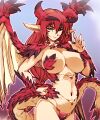 The "scale bikini" look is popular for dragon-girls.
 -
 Well, when a dragon kidnaps a princess, sometimes the kingdom gets an heir out of it.
 -
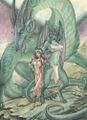 There's something for everyone.
 -
 Some like their dragons with breasts.
 -
 Some like their dragons au naturale.
 -
 Even the dread Athasian Dragon isn't immune to the Monstergirls treatment.
 -
 A rare example of the Faerie Dragon getting the MG treatment.
 -
 Exhibit A in why furries & /tg/ have such a love-hate relationship.


Monster Girl Encyclopedia
Naturally, the Monster Girl Encyclopedia has its share of dragon-themed Monstergirls.
The actual Dragon fits the same kind of style first seen on the setting's Lizardgirl; scaly limbs, paw-like hands and feet, a tail, fin-like ears, horns and wings. They are characterized by their extreme pride; whilst not quite Tsunderes, they're determined to give themselves only to the best possible man, this pride and arrogance however can reach heights that leave them unable to find a husband that either they could tolerate or any man that could tolerate them, thus leading to...
In a terrible irony, if a Dragon fails to find a husband before she dies, the dark energies permeating the world will heed her unspoken desires and regrets over dying alone, and reanimate her as a Dragon Zombie, a corpse-colored (blue-gray skin, dark mold-green wings, white hair) dragon with bony scales. In this state, her mind has degenerated, leaving her a horny bimbo obsessed with finding a man and taking him as her mate. These dragon-girls are quite dangerous, because they possess a "rotten breath" attack that can convert human women into undead Monstergirls.
The Wyvern is a dragon-girl with a more harpy-like body structure, having wings instead of arms. These Monstergirls are far more friendly and easy-going than the standard dragons and readily team up with human adventurers to train with them as "dragoons". Needless to say, this "training" is merely a more adventurous form of courtship, as all dragoons end up married to their "mounts".
The Wurm is a linnorm-style dragon-girl, essentially a massively strong Lamia with paw-like hands, with an extremely lustful, aggressive personality that sees them going out and chasing after a man. They are however rather dim-witted, a little dopey, and easy-going (well after the fact) compared to the other dragon types, which has its own waifu appeal despite their arguable status as dragons.
The Jabberwock is a lewd, lascivious, depraved dragon-girl from the "Wonderland" region. It can be distinguished by its dark red colors and the presence of two tentacles, each of which bears a slavering maw and lecherous tongue used to pleasure victims and guzzle semen. Unlike regular Dragons, Jabberwocks are extremely direct in their affections, and do not pride themselves on being "powerful" or their "draconic superiority", instead they pride themselves on being sexy and being able to overpower a man in a sexual manner. If they like you, and they want you, then things will be happening either the easy way or the hard way.
Finally, there are the two dragons of Zipangu. The Ryu is another lamia-like dragon, but this time based on the Eastern Dragons of myth rather than the Western myths; a gentle-natured and benevolent Mamono with the power to influence the weather, in particular rainy weather.
The Otohime is an aquatic dragon-girl princess of the deeps who resembles a mermaid with the body of a seahorse (long story; seahorses are believed by the Japanese to be connected to dragons) and clawed hands, who seduces men to join her in her life of eternal partying in her palace under the sea. Have no fear from her seahorse appearance, though; pedophilia and rape aside, the MGE is far too vanilla to allow explicitly advertise pegging as part of its setting, never mind male pregnancy, which not even heterodox fanons dare to touch.
-
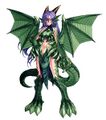 The original Dragon mamono, proud and haughty and determined to take only the best.
 -
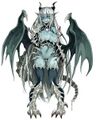 Back from the grave, and now a shameless bimbo.
 -
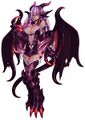 She's the Queen Slut, and she's proud of it.
 -
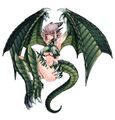 Loyal, steadfast and true, even if she's not the curviest of monstergirls.
 -
 Don't let her looks fool you; she will punch through mountains to chase you down.
 -
 Beloved and mystical dragon-girl of Zipangu.
 -
 Party-girl from below the waves.


Life with Monstergirls
Meanwhile, Life With Monstergirls has the Dragonewts. They have wings and tails like dragons, as well as some scales on their faces and clawed hands. In the series we meet a Dragonewt named Draco, who tries to steal Miia away from her darling. While initially appearing to be male she's later revealed to be a flat-chested woman who develops an obsession with Miia, and it takes a couple of bullets to her wings from Manako and a reprimanding from Suu to cool her off. Other variants of the Dragonewt is the Chinese Ryu-jin who has horns and has no wings, and the aggressive but dim-witted Wyvern.
The manga takes time to explain just how much commonly-depicted dragongirl traits would suck in real life; bulletproof scales that require regular maintenance and clipping to prevent clothing snags, a big, muscular tail that needs specially-designed pants and undies on top of making it impossible to sleep on your back, and wings that only allow you to glide at best, which is further exacerbated by their weak chest muscles, generate air resistance while you're on foot, and are just plain in the way (Wyverns get past the wing issue, but again, they're dummies so they break even).
Gallery

See Also
- Johnniass Dragonraper is known to rape a dragon on occasion.
- Toothless Dragon the Dawww-est dragon.
- The Periodic Table of Dragons.